

News Details
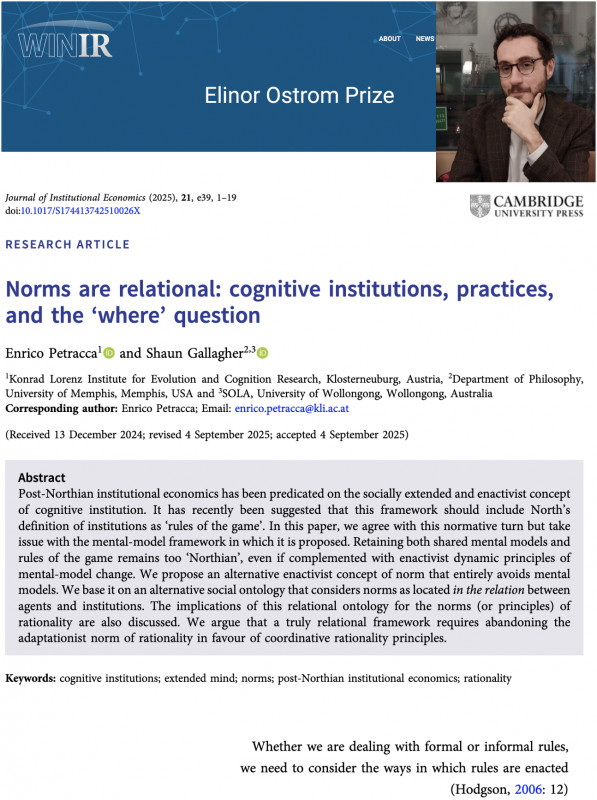
KLI postdoctoral fellow Enrico Petracca, together with Shaun Gallagher, received the esteemed Elinor Ostrom Prize at the WINIR 2026 conference in Rome, Italy, for their publication “Norms are Relational: Cognitive Institutions, Practices, and the ‘Where’ Question” in the Journal of Institutional Economics.
The Elinor Ostrom Prize has been established in honor of the Nobel laureate Elinor Ostrom (1933–2012), who was a pioneering figure in institutional research. Her work addressed managing common-pool resources, political governance and climate change, and theoretical research on rules.
The prize is awarded each year for the best full-length article published in JOIE in the preceding calendar year.
The article aims to contribute to a growing literature in institutional economics that aims to shed light on the nature of institutions, that is, on institutions’ ontology. Douglass North famously argued that institutions are primarily made of rules and norms. North’s view has been recently taken up by a new thread within institutional economics that argues that rules and norms are the outcome of interaction between institutions and individuals who shape the norms.
In this paper, the authors agree that norms are the outcome of an interaction, but disagree that, as currently maintained, a norm’s content (e.g., “stop at the red light”) is physically located in agents’ minds/brain. They argue that norms are genuinely relational concepts emerging from a practical interaction, such that, if a location for norms is to be identified, we propose that norms are located in institutional practices. For instance, when we stop at a traffic light, we don’t activate a rule/norm stored in the mind, but enact a behavior which is mostly the outcome of our past encounters with traffic lights and our enculturation process. The paper also discusses what this means for rational behavior. The idea, in a nutshell, is that behaving rationally in an institutional setting mostly concerns coordinating with other institutional actors (e.g., traffic wardens) and resources (e.g., traffic lights) rather than adapting an institutional resource to an agent's goal.
[This summary has been kindly contributed by Enrico Petracca.]
Publication:
Petracca E, Gallagher S. Norms are relational: cognitive institutions, practices, and the ‘where’ question. Journal of Institutional Economics. 2025;21:e39. https://doi.org/10.1017/S174413742510026X