

KLI Colloquia are invited research talks of about an hour followed by 30 min discussion. The talks are held in English, open to the public, and offered in hybrid format.
Join via Zoom:
https://us02web.zoom.us/j/5881861923?omn=85945744831
Meeting ID: 588 186 1923
Fall-Winter 2026/27 KLI Colloquium Series
1 October 2026 (Thurs) 3-4:30 PM CET 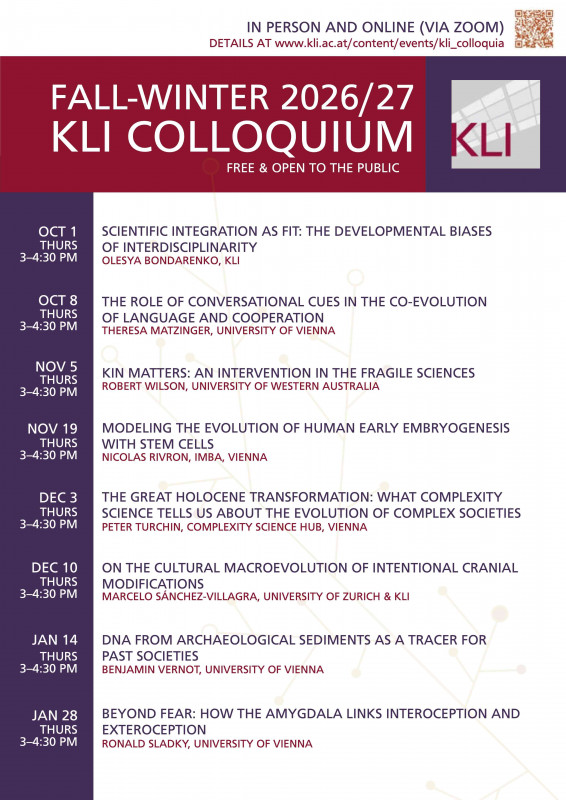
Scientific Integration as Fit: The Developmental Biases of Interdisciplinarity
Olesya BONDARENKO (KLI)
8 October 2026 (Thurs) 3-4:30 PM CET
The Role of Conversational Cues in the Co-Evolution of Language and Cooperation
Theresa MATZINGER (University of Vienna)
5 November 2026 (Thurs) 3-4:30 PM CET
Kin Matters: An Intervention in the Fragile Sciences
Robert A. WILSON (University of Western Australia)
19 November 2026 (Thurs) 3-4:30 PM CET
Modeling the Evolution of Human Early Embryogenesis with Stem Cells
Nicolas RIVRON (Institute of Molecular Biotechnology/IMBA, Vienna)
3 December 2026 (Thurs) 3-4:30 PM CET
Peter TURCHIN (Complexity Science Hub, Vienna)
10 December 2026 (Thurs) 3-4:30 PM CET
On the Cultural Macroevolution of Intentional Cranial Modifications
Marcelo SÁNCHEZ-VILLAGRA (University of Zurich)
14 January 2027 (Thurs) 3-4:30 PM CET
DNA from Archaeological Sediments as a Tracer for Past Societies
Benjamin VERNOT (University of Vienna)
28 January 2027 (Thurs) 3-4:30 PM CET
Beyond Fear: How the Amygdala Links Interoception and Exteroception
Ronald SLADKY (University of Vienna)
KLI Colloquia 2014 – 2026
Event Details

Topic description:
Collaboration, which I treat as occurring when two or more agents team up to take on a shared task, is foundational to human social life. However, rigorous work on the ontogeny and evolution of human collaboration is rather recent, though for some time there has been work in the philosophy of action that attempts to analyze the structure of collaboration in adults. What I will talk about in this discussion are some of the results of the work on collaboration that I have carried out over the past two years. The main focus of my talk will be on an analysis that Rory Smead (Northeastern University) and I recently completed. In our work, we present a game theoretic model of the evolution of learning rules in a population of individuals playing the Stag Hunt. We show that there is selection for the predisposition to cooperate in the Stag Hunt. We then relate this game theoretic model to recent empirical work on collaboration that shows a child’s ability to collaborate emerges around the same time ontogenetically across a range of apparently diverse environments. After reviewing the game theoretic model and the empirical work, I’ll discuss to what extent it is meaningful to call collaboration “innate.”
Biographical note:
Brian McLoone is a graduate student in the Philosophy Department at the University of Wisconsin-Madison. His research is in biology and cognitive science, primarily the conceptual and methodological issues that arise in both of these fields. He is currently a visiting fellow at the KLI Institute, working on a project called “Conceptual Issues Concerning the Ontogeny and Evolution of Human Collaboration.” The research he conducts at the KLI Institute is part of a long-term project to better understand humans’ ability to engage in collaborative activities. A “collaborative activity” occurs when two or more individuals take on some shared task. The task could be something as prosaic as moving a table, or as sophisticated as electing a new representative. A few of the more specific goals of Brian’s project are: to attempt to differentiate collaborative activities from other forms of cooperation; to develop a framework to understand how a human’s ability to collaborate develops in early life; to model the evolution of collaboration in group-structured populations; and to understand how a human’s ability to collaborate is related to other cognitive systems.
