
KLI Colloquia are invited research talks of about an hour followed by 30 min discussion. The talks are held in English, open to the public, and offered in hybrid format.
Join via Zoom:
https://us02web.zoom.us/j/5881861923?omn=85945744831
Meeting ID: 588 186 1923
Fall-Winter 2026/27 KLI Colloquium Series
1 October 2026 (Thurs) 3-4:30 PM CET 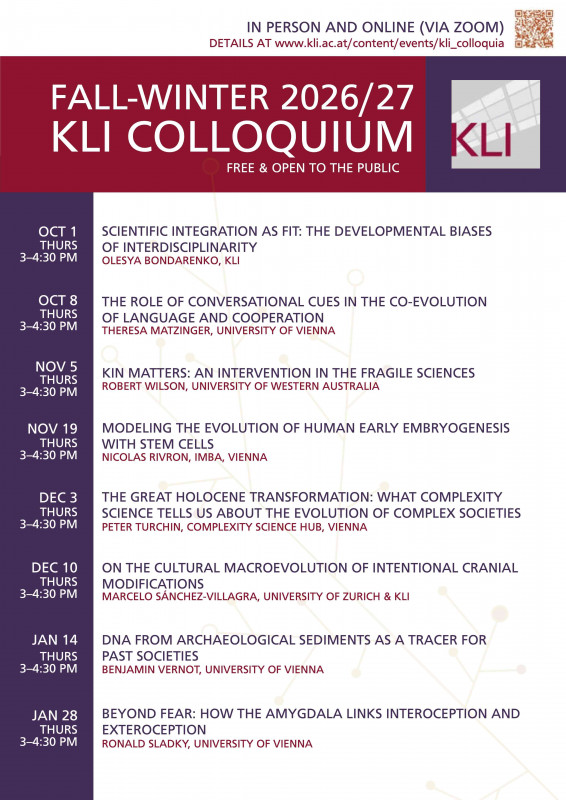
Scientific Integration as Fit: The Developmental Biases of Interdisciplinarity
Olesya BONDARENKO (KLI)
8 October 2026 (Thurs) 3-4:30 PM CET
The Role of Conversational Cues in the Co-Evolution of Language and Cooperation
Theresa MATZINGER (University of Vienna)
5 November 2026 (Thurs) 3-4:30 PM CET
Kin Matters: An Intervention in the Fragile Sciences
Robert A. WILSON (University of Western Australia)
19 November 2026 (Thurs) 3-4:30 PM CET
Modeling the Evolution of Human Early Embryogenesis with Stem Cells
Nicolas RIVRON (Institute of Molecular Biotechnology/IMBA, Vienna)
3 December 2026 (Thurs) 3-4:30 PM CET
Peter TURCHIN (Complexity Science Hub, Vienna)
10 December 2026 (Thurs) 3-4:30 PM CET
On the Cultural Macroevolution of Intentional Cranial Modifications
Marcelo SÁNCHEZ-VILLAGRA (University of Zurich)
14 January 2027 (Thurs) 3-4:30 PM CET
DNA from Archaeological Sediments as a Tracer for Past Societies
Benjamin VERNOT (University of Vienna)
28 January 2027 (Thurs) 3-4:30 PM CET
Beyond Fear: How the Amygdala Links Interoception and Exteroception
Ronald SLADKY (University of Vienna)
KLI Colloquia 2014 – 2026
Event Details
Topic description:
This talk examines the problem of biological individuality through the lens of natural kinds. Biology utilizes a variety of kinds of individuals, including historical, functional, structural, developmental, physiological, and ecological kinds. In many cases these kinds issue in non-overlapping demarcations of biological systems and/or assign them to different hierarchical levels. For example, from physiological and developmental perspectives a worker bee is an individual organism, whereas from an evolutionary perspective it may be a part of a superorganism analogous to an organ. I propose one way of evaluating such rival perspectives, which is to assess the capacity of their associated kinds to support true inductive inferences. On this basis, I argue that the functional kind ‘object of selection,’ which is central to evolutionary accounts of individuality, is inferentially weak compared to other kinds, in addition to being operationally parasitic on non-functional biological kinds. These weaknesses can be traced to more general limitations of functionally defined kinds in the sciences.
Biographical note:
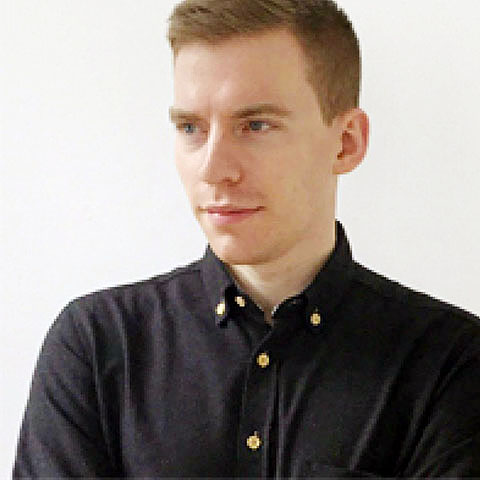
James received his PhD in Philosophy from University of Leuven, Belgium, with a dissertation entitled "Process and Levels of Organization: A Dynamic Ontology for the Life Sciences." His research focuses on problems related to biological organization, functions, individuality, and levels, as well as on a variety of themes in naturalistic metaphysics including physicalism and the relations between scientific domains.
