

KLI Colloquia are invited research talks of about an hour followed by 30 min discussion. The talks are held in English, open to the public, and offered in hybrid format.
Join via Zoom:
https://us02web.zoom.us/j/5881861923?omn=85945744831
Meeting ID: 588 186 1923
Fall-Winter 2026/27 KLI Colloquium Series
1 October 2026 (Thurs) 3-4:30 PM CET 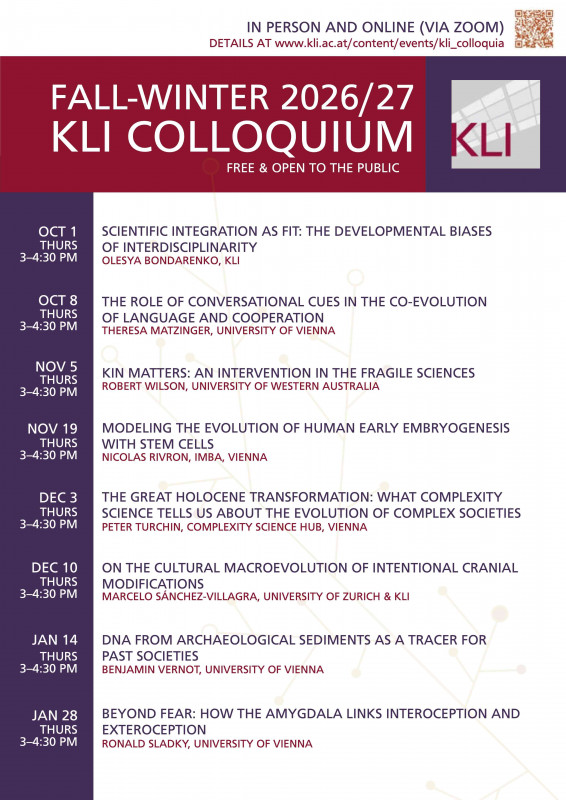
Scientific Integration as Fit: The Developmental Biases of Interdisciplinarity
Olesya BONDARENKO (KLI)
8 October 2026 (Thurs) 3-4:30 PM CET
The Role of Conversational Cues in the Co-Evolution of Language and Cooperation
Theresa MATZINGER (University of Vienna)
5 November 2026 (Thurs) 3-4:30 PM CET
Kin Matters: An Intervention in the Fragile Sciences
Robert A. WILSON (University of Western Australia)
19 November 2026 (Thurs) 3-4:30 PM CET
Modeling the Evolution of Human Early Embryogenesis with Stem Cells
Nicolas RIVRON (Institute of Molecular Biotechnology/IMBA, Vienna)
3 December 2026 (Thurs) 3-4:30 PM CET
Peter TURCHIN (Complexity Science Hub, Vienna)
10 December 2026 (Thurs) 3-4:30 PM CET
On the Cultural Macroevolution of Intentional Cranial Modifications
Marcelo SÁNCHEZ-VILLAGRA (University of Zurich)
14 January 2027 (Thurs) 3-4:30 PM CET
DNA from Archaeological Sediments as a Tracer for Past Societies
Benjamin VERNOT (University of Vienna)
28 January 2027 (Thurs) 3-4:30 PM CET
Beyond Fear: How the Amygdala Links Interoception and Exteroception
Ronald SLADKY (University of Vienna)
KLI Colloquia 2014 – 2026
Event Details
Topic description:
Adaptation depends critically on the effects and dependency on the genetic background of new mutations. However, complete knowledge about any of these factors is virtually impossible from an empirical standpoint. At the same time, the dynamics of adaptation have been technically challenging to analyze beyond the simplest scenarios. Here, I present new analytical methods that allow us to determine the speed of adaptation on complex landscapes. Instead of postulating a particular fitness landscape, we address this problem by considering general classes of landscapes and calculating an upper limit for the time it takes for a population to reach a particular adaptation, circumventing the need to have full knowledge about the fitness landscape. We focus on the distinction between "efficient" and "inefficient" adaptation and find selection thresholds for different classes of landscapes separating these two regimes. I argue that this distinction helps operationalize the concept of complexity in biology.
Biographical note:
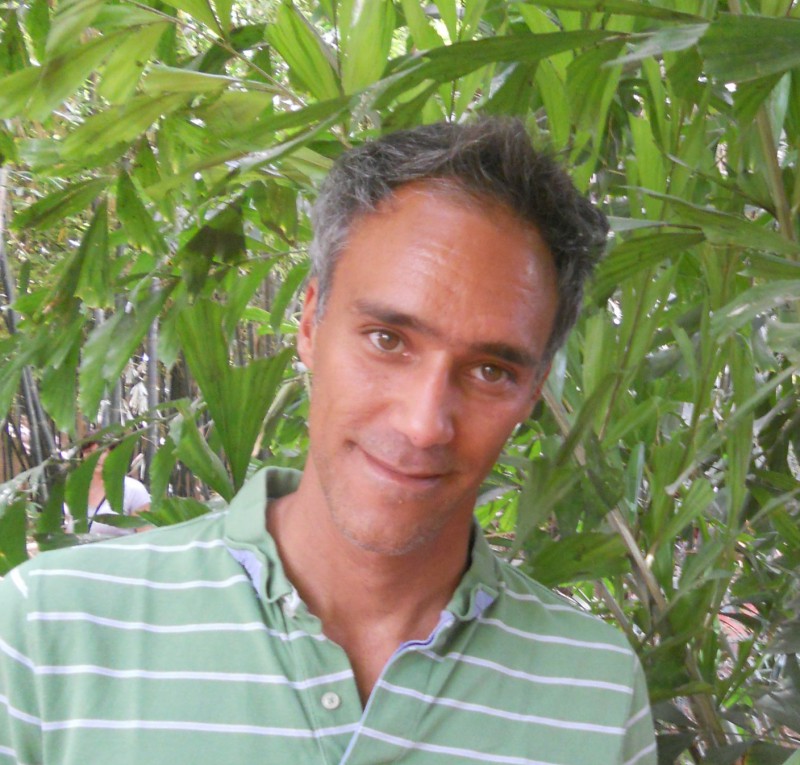
Tiago Paixão has a background in Physics and was awarded his PhD in Biomedical Sciences for his work on theoretical biology. Over his career, his main research interest has been on how biological mechanisms impact on the generation of phenotypic variation, and hence on the adaptation process, and how these mechanisms themselves evolve. His thesis work focused on the mechanistic origin of noise in gene expression and its consequences for the adaptation for cell populations. He has shown that the monoallelic expression pattern of the cytokine IL-10 was due to stochastic effects and not active regulation, and that the timescales of this process are not compatible with simple noisy gene expression. Instead, they suggest the action of a slower process, such as chromatin modifications. Moreover, he proposed a mechanism that produces the distributions of copy number often observed in eukaryotic cells and showed that this type of distribution could have adaptive consequences for populations of cells. In 2008 he moved to the University of Houston, where he has further consolidated his expertise in evolutionary biology. There, he worked on a number of topics, including on how recombination can promote the robustness of promoter sequences, the predictability of evolutionary trajectories, the evolution of selfish elements, and the consequences of stochastic sex determination for the evolution of sex ratios. In 2012, he became a postdoctoral research at IST Austria where, driven by a motivation to include mechanisms in traditional evolutionary theory, he worked on the role of gene interactions on the response to selection from a quantitative genetics perspective. He has also initiated a interdisciplinary research program aimed at developing new tools, inspired by theoretical computer science, to tackle fundamental questions in theoretical population genetics. Using these tools, he has uncovered fundamental limits to the evolution of complexity. Going forward, he aims to combine these tools with biophysical models of gene expression to develop an integrative theory for the evolution of promoter sequences and gene networks.
