

KLI Colloquia are invited research talks of about an hour followed by 30 min discussion. The talks are held in English, open to the public, and offered in hybrid format.
Join via Zoom:
https://us02web.zoom.us/j/5881861923?omn=85945744831
Meeting ID: 588 186 1923
Fall-Winter 2026/27 KLI Colloquium Series
1 October 2026 (Thurs) 3-4:30 PM CET 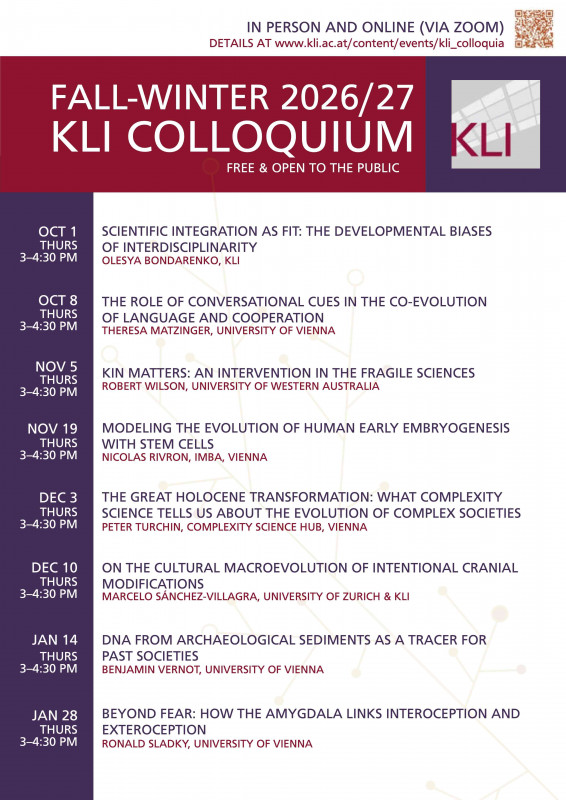
Scientific Integration as Fit: The Developmental Biases of Interdisciplinarity
Olesya BONDARENKO (KLI)
8 October 2026 (Thurs) 3-4:30 PM CET
The Role of Conversational Cues in the Co-Evolution of Language and Cooperation
Theresa MATZINGER (University of Vienna)
5 November 2026 (Thurs) 3-4:30 PM CET
Kin Matters: An Intervention in the Fragile Sciences
Robert A. WILSON (University of Western Australia)
19 November 2026 (Thurs) 3-4:30 PM CET
Modeling the Evolution of Human Early Embryogenesis with Stem Cells
Nicolas RIVRON (Institute of Molecular Biotechnology/IMBA, Vienna)
3 December 2026 (Thurs) 3-4:30 PM CET
Peter TURCHIN (Complexity Science Hub, Vienna)
10 December 2026 (Thurs) 3-4:30 PM CET
On the Cultural Macroevolution of Intentional Cranial Modifications
Marcelo SÁNCHEZ-VILLAGRA (University of Zurich)
14 January 2027 (Thurs) 3-4:30 PM CET
DNA from Archaeological Sediments as a Tracer for Past Societies
Benjamin VERNOT (University of Vienna)
28 January 2027 (Thurs) 3-4:30 PM CET
Beyond Fear: How the Amygdala Links Interoception and Exteroception
Ronald SLADKY (University of Vienna)
KLI Colloquia 2014 – 2026
Event Details

Topic description:
Biologically Inspired Computing (Biocomputing) is an interdisciplinary research area in which ideas and principles from biology are used to design and implement new and improved computing methods. Traditional computer technologies and techniques have their drawbacks and limitations. However, by looking at how biological (“complex”) systems perform computations, process information, and make decisions, we can learn new and interesting ways of overcoming these limitations and make computers smarter, more robust, and more flexible.
This lecture provides an introductory-level overview of Biologically Inspired Computing and some of its methods, such as Evolutionary Computation (using evolution to solve hard optimization problems) and Neural Networks (using ideas from how the brain works to make computers learn). After an introduction to the difference between “easy” problems and “hard” problems in computer science, it is then explained how Nature “computes”, how some of these Biocomputing methods are inspired by biology, and to which kinds of problems these methods can be applied. The lecture is suitable for a general audience (no particular knowledge of science, biology, or computing is necessary), and includes several fun and visual examples (avoiding technical details).
Biographical note:
Wim Hordijk is a computer scientist working in the areas of computational biology and bioinformatics. He was a graduate fellow at the Santa Fe Institute for several years, after which he worked on many short-term research and computing projects all over the world. As an independent researcher/consultant he provides computational support to other scientists, while his own research focuses primarily on autocatalytic sets and the origin and organization of life. For more detailed information, please visit his personal website at http://WorldWideWanderings.net
