

KLI Colloquia are invited research talks of about an hour followed by 30 min discussion. The talks are held in English, open to the public, and offered in hybrid format.
Join via Zoom:
https://us02web.zoom.us/j/5881861923?omn=85945744831
Meeting ID: 588 186 1923
Fall-Winter 2026/27 KLI Colloquium Series
1 October 2026 (Thurs) 3-4:30 PM CET 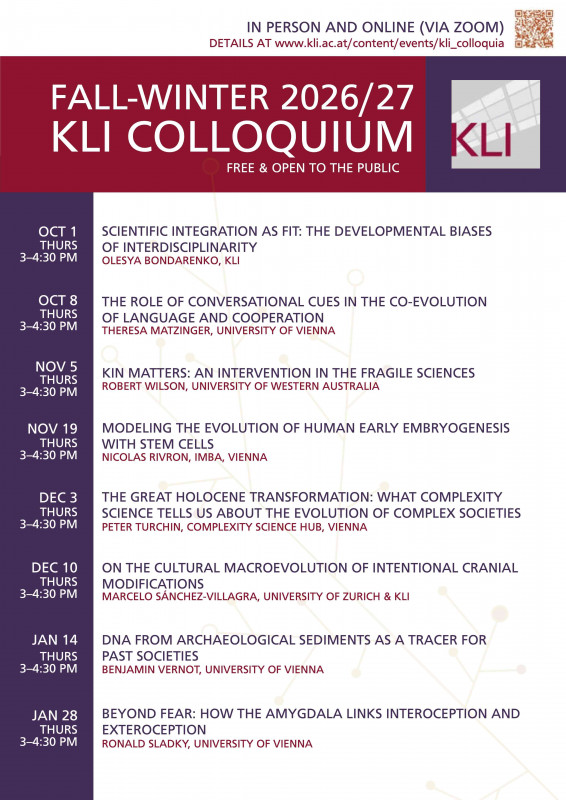
Scientific Integration as Fit: The Developmental Biases of Interdisciplinarity
Olesya BONDARENKO (KLI)
8 October 2026 (Thurs) 3-4:30 PM CET
The Role of Conversational Cues in the Co-Evolution of Language and Cooperation
Theresa MATZINGER (University of Vienna)
5 November 2026 (Thurs) 3-4:30 PM CET
Kin Matters: An Intervention in the Fragile Sciences
Robert A. WILSON (University of Western Australia)
19 November 2026 (Thurs) 3-4:30 PM CET
Modeling the Evolution of Human Early Embryogenesis with Stem Cells
Nicolas RIVRON (Institute of Molecular Biotechnology/IMBA, Vienna)
3 December 2026 (Thurs) 3-4:30 PM CET
Peter TURCHIN (Complexity Science Hub, Vienna)
10 December 2026 (Thurs) 3-4:30 PM CET
On the Cultural Macroevolution of Intentional Cranial Modifications
Marcelo SÁNCHEZ-VILLAGRA (University of Zurich)
14 January 2027 (Thurs) 3-4:30 PM CET
DNA from Archaeological Sediments as a Tracer for Past Societies
Benjamin VERNOT (University of Vienna)
28 January 2027 (Thurs) 3-4:30 PM CET
Beyond Fear: How the Amygdala Links Interoception and Exteroception
Ronald SLADKY (University of Vienna)
KLI Colloquia 2014 – 2026
Event Details
Topic description:
It is a widely held consensus among philosophers of biology that essentialism concerning biological species is wrong and inconsistent with evolutionary theory. This has been claimed on the basis that essentialism leads to the immutability and sharp boundaries of species taxa, taxonomic monism and overlooking the within-species variability that is necessary for the mechanisms of natural selection to work. However, the main anti-essentialist arguments have been mostly targeted against material shared-nature kind essentialism. There are some other notions of essentialism, such as relational and teleological essentialism, allegedly not inconsistent with evolutionary theory, that have been suggested to replace the traditional material essentialism. In the first part of my presentation I will discuss the success of the attempts of this replacement.
In the second part of my presentation I will discuss similar issues in the context of human groups, especially the claim that essentialist thinking underlies the formation of stereotypes about these groups. The supposedly essentialist stereotypes about human groups are usually condemned on the basis that they lead us to make overgeneralizations about the group members and false assumptions about their homogeneity. Essentialist stereotypes are sometimes also supposed to underlie the assumptions about the ‘innateness’, ‘immutability’ and ‘biological basis’ of the traits that are taken to be characteristic of typical category members, which in turn might lead to the assumptions about the fixity of certain social categories and power structures. In the second part of my presentation I will discuss whether we can really talk about ‘essentialist’ thinking in this context (as opposed to prototype theory), and will give an overview of some attempts to apply relational and teleological essentialism to human groups.
Biographical note:
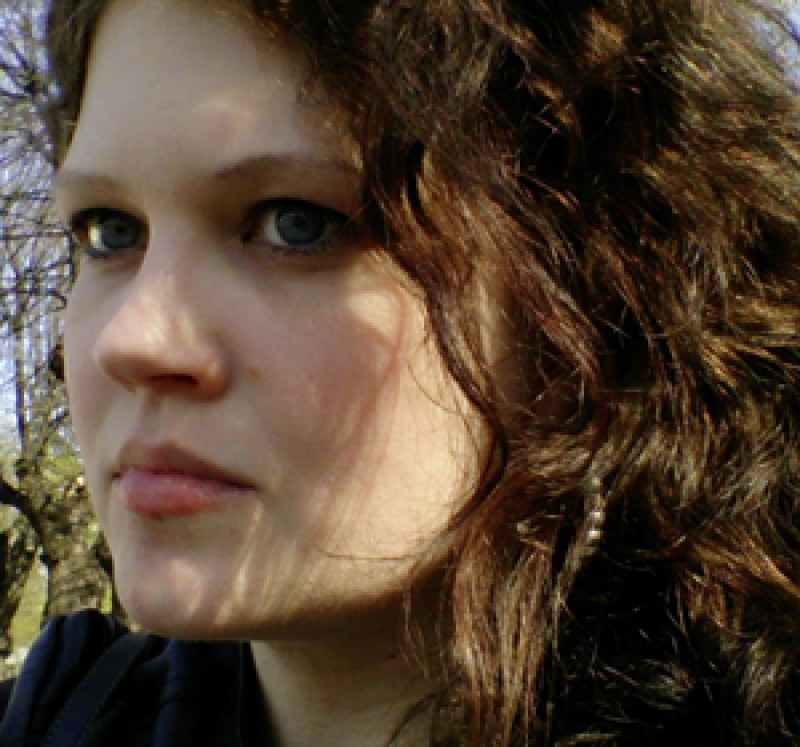
Edit Talpsepp did her undergraduate studies at the University of Tartu, specializing in Philosophy of Science. She wrote her BA dissertation on the comparison between finitist and determinist theories of meaning as the accounts of the meaning of natural kind terms and her thesis supervisor was Associate Professor Endla Lõhkivi. After that Edit Talpsepp took the MA course ‘Philosophy and History of Science’ at the University of Bristol where she also did her PhD on Philosophy of Biology with Professor Samir Okasha. During her doctoral program Edit studied the tension between evolutionary theory and the anti-essentialist consensus from conceptual, historical, methodological, cognitive and empirical perspectives. The title of her dissertation is ‘Species, essentialism and evolutionary theory.’ From 2013 Edit Talpsepp has been working as a Research Fellow at the University of Tartu where she has taught several courses on Philosophy of Science. Since finishing her PhD studies, her research focus has ranged from essentialism concerning biological species to essentialist thinking about human groups and its implications in various contexts.
