
KLI Colloquia are invited research talks of about an hour followed by 30 min discussion. The talks are held in English, open to the public, and offered in hybrid format.
Join via Zoom:
https://us02web.zoom.us/j/5881861923?omn=85945744831
Meeting ID: 588 186 1923
Fall-Winter 2026/27 KLI Colloquium Series
1 October 2026 (Thurs) 3-4:30 PM CET 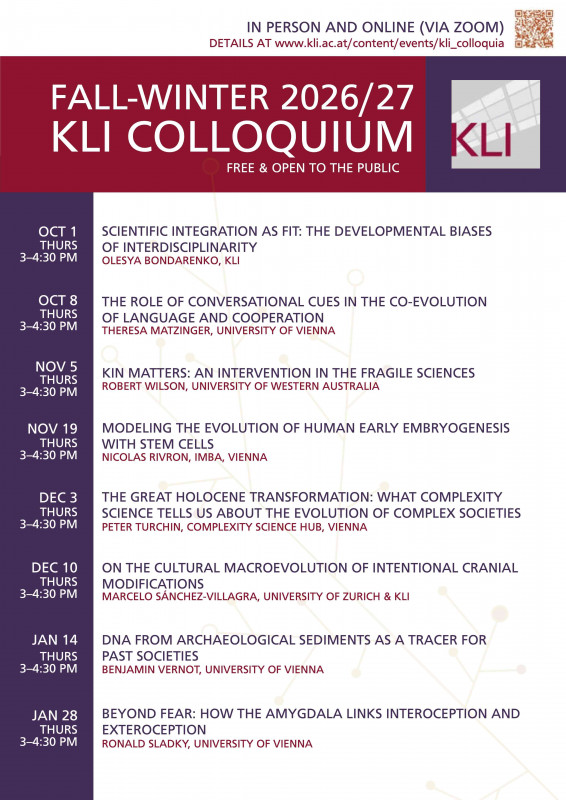
Scientific Integration as Fit: The Developmental Biases of Interdisciplinarity
Olesya BONDARENKO (KLI)
8 October 2026 (Thurs) 3-4:30 PM CET
The Role of Conversational Cues in the Co-Evolution of Language and Cooperation
Theresa MATZINGER (University of Vienna)
5 November 2026 (Thurs) 3-4:30 PM CET
Kin Matters: An Intervention in the Fragile Sciences
Robert A. WILSON (University of Western Australia)
19 November 2026 (Thurs) 3-4:30 PM CET
Modeling the Evolution of Human Early Embryogenesis with Stem Cells
Nicolas RIVRON (Institute of Molecular Biotechnology/IMBA, Vienna)
3 December 2026 (Thurs) 3-4:30 PM CET
Peter TURCHIN (Complexity Science Hub, Vienna)
10 December 2026 (Thurs) 3-4:30 PM CET
On the Cultural Macroevolution of Intentional Cranial Modifications
Marcelo SÁNCHEZ-VILLAGRA (University of Zurich)
14 January 2027 (Thurs) 3-4:30 PM CET
DNA from Archaeological Sediments as a Tracer for Past Societies
Benjamin VERNOT (University of Vienna)
28 January 2027 (Thurs) 3-4:30 PM CET
Beyond Fear: How the Amygdala Links Interoception and Exteroception
Ronald SLADKY (University of Vienna)
KLI Colloquia 2014 – 2026
Event Details

Topic description / abstract:
In many animal species learning may be influenced by the presence and the behaviour of other individuals, or the products of their behaviour. The term ‘social learning’ is currently used to refer to such cases, which include imitation, emulation, stimulus enhancement, and local enhancement. Processes of social learning underlie the ‘passing on’ of knowledge and behaviour among individuals within and across generations. This can lead to what is now commonly called behavioural ‘traditions’ or ‘cultures’ in humans and nonhuman animals. My PhD project follows from a dissatisfaction with how the currently dominant approaches to social learning are supported by, and in turn reinforce, information-centric views of development, inheritance, evolution, cognition, and ‘culture’. In my project I combine conceptual-theoretical studies with empirical studies. With regards to the conceptual part, I intend to clarify the meanings of the term ‘information’ as they appear in this context. I also explore the possibility of studying social learning and ‘culture’ from an alternative framework. This framework is an attempt to integrate developmental systems theory (in biology), radical embodiment approach (in the cognitive sciences), and relational thinking (in social anthropology). I argue that, within this framework, social learning can be conceived as relational-historical processes of development rather than computational processes of transmission of information. With regards to the empirical part of my project, I use methods from recurrence analysis to investigate the coordination of visual attention between human participants during a joint making task in a naturalistic environment. I examine the dynamical constitution of joint visual attention between participants, the extent to which joint visual attention is synchronised during the making activity, and the association between synchronisation and learning outcomes. In this talk I will present an overview of my findings.
Biographical note:
I hold a BSc in Biology and a MSc in Experimental Psychology. After finishing my undergraduate studies, I worked as a science teacher and as a writer and editor of educational materials in Brazil. I have also authored a book about biological evolution for children aged 11-14. I am currently a PhD candidate at the University of St Andrews (UK) supervised by Prof. Kevin Laland.
