

KLI Colloquia are invited research talks of about an hour followed by 30 min discussion. The talks are held in English, open to the public, and offered in hybrid format.
Join via Zoom:
https://us02web.zoom.us/j/5881861923?omn=85945744831
Meeting ID: 588 186 1923
Fall-Winter 2026/27 KLI Colloquium Series
1 October 2026 (Thurs) 3-4:30 PM CET 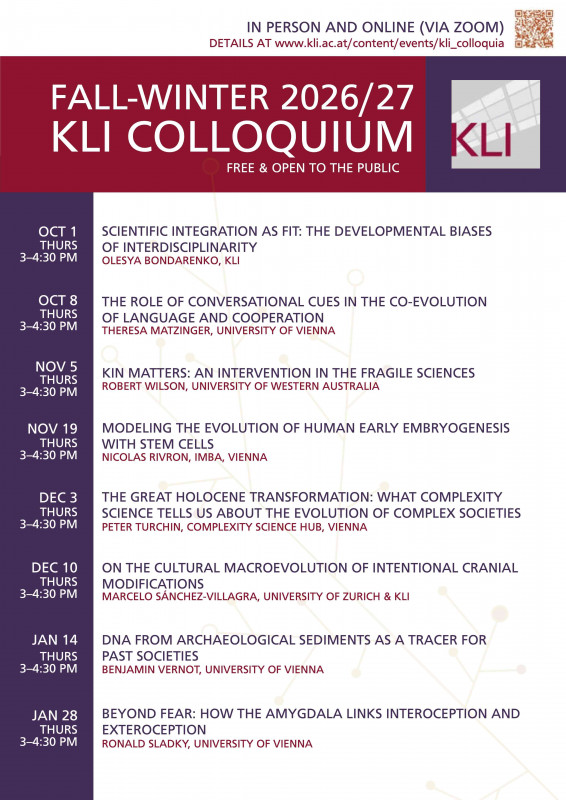
Scientific Integration as Fit: The Developmental Biases of Interdisciplinarity
Olesya BONDARENKO (KLI)
8 October 2026 (Thurs) 3-4:30 PM CET
The Role of Conversational Cues in the Co-Evolution of Language and Cooperation
Theresa MATZINGER (University of Vienna)
5 November 2026 (Thurs) 3-4:30 PM CET
Kin Matters: An Intervention in the Fragile Sciences
Robert A. WILSON (University of Western Australia)
19 November 2026 (Thurs) 3-4:30 PM CET
Modeling the Evolution of Human Early Embryogenesis with Stem Cells
Nicolas RIVRON (Institute of Molecular Biotechnology/IMBA, Vienna)
3 December 2026 (Thurs) 3-4:30 PM CET
Peter TURCHIN (Complexity Science Hub, Vienna)
10 December 2026 (Thurs) 3-4:30 PM CET
On the Cultural Macroevolution of Intentional Cranial Modifications
Marcelo SÁNCHEZ-VILLAGRA (University of Zurich)
14 January 2027 (Thurs) 3-4:30 PM CET
DNA from Archaeological Sediments as a Tracer for Past Societies
Benjamin VERNOT (University of Vienna)
28 January 2027 (Thurs) 3-4:30 PM CET
Beyond Fear: How the Amygdala Links Interoception and Exteroception
Ronald SLADKY (University of Vienna)
KLI Colloquia 2014 – 2026
Event Details

Topic description / abstract:
Humans are considered a remarkable evolutionary accomplishment on account of our large primate brains, which house roughly 80 billion neurons in a roughly 1400 cm3 space. Yet the question remains as to how such a complex organ with strict nutritional requirements was able to evolve in a terrestrial vegetarian ape. There are many obstacles to overcome in the development of a large brain, and the conditions for existence include ready access to omega-3 long chain polyunsaturated fatty acids (PUFAs), which are rare outside of marine and lacustrine resources. Integration of docosahexanoic acid (DHA: C22:6, n-3), into lipid membranes was a highly successful structural enhancement, to the degree that mammalian brain tissue maintains a strict ratio of DHA relative to other lipids. Therefore, larger brains require larger absolute amounts of DHA. Yet, animals can only inefficiently convert very small amounts of essential alpha-linolenic acid (ALA) into DHA, leaving open the question as to whether a more high-throughput system is available to large-brained mammals. In 2001, the bacterial anaerobic pathway for PUFA synthesis was discovered to use a highly conserved pfa gene complex that is disperse across wide ranging bacterial taxa. Bacteria inhabiting mammalian guts could therefore be a potential reservoir of PUFAs. This project entails an exploratory investigation of the distribution of prokaryote genes involved in lipid metabolism (synthesis and degradation) that can be found from shotgun metagenomic data and used to create association networks for diverse gut and environmental microbiomes. The hope is that the relation of host organisms to various distributions of co-correlating genes can yield a contextual map of lipid gene pathways coincident with host ecology and phenotype.
Biographical note:
Stephanie is a biological anthropologist interested in understanding the dietary landscape accessed by human ancestors that enabled the evolution of large brains and complex cognition. During her PhD, she worked with the Hadza of Tanzania to investigate food acquisition and processing behaviors in how these alter the digestibility of plant food resources, mainly underground storage organs, or tubers. Through her research on digestion, Stephanie became interested in understanding the role of the gut microbiota in human nutritional acquisition, particularly in consideration of human foragers who often rely on refractory plant resources that are high in fiber. Her research ranges from work on reconstructing ancient microbiomes from human tissue to ethnographic modeling of food processing in understanding the dietary flexibility of present day humans. In all of her work she maintains a thematic focus on the evolution of human intelligence and cognition and hopes that in some far-fetched way these pursuits could shed light on how intelligence originates in the universe.
