

KLI Colloquia are invited research talks of about an hour followed by 30 min discussion. The talks are held in English, open to the public, and offered in hybrid format.
Join via Zoom:
https://us02web.zoom.us/j/5881861923?omn=85945744831
Meeting ID: 588 186 1923
Fall-Winter 2026/27 KLI Colloquium Series
1 October 2026 (Thurs) 3-4:30 PM CET 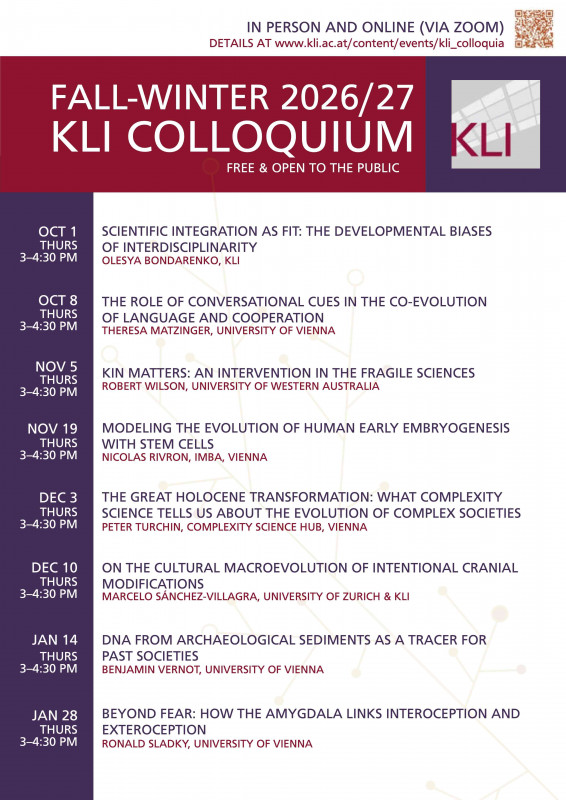
Scientific Integration as Fit: The Developmental Biases of Interdisciplinarity
Olesya BONDARENKO (KLI)
8 October 2026 (Thurs) 3-4:30 PM CET
The Role of Conversational Cues in the Co-Evolution of Language and Cooperation
Theresa MATZINGER (University of Vienna)
5 November 2026 (Thurs) 3-4:30 PM CET
Kin Matters: An Intervention in the Fragile Sciences
Robert A. WILSON (University of Western Australia)
19 November 2026 (Thurs) 3-4:30 PM CET
Modeling the Evolution of Human Early Embryogenesis with Stem Cells
Nicolas RIVRON (Institute of Molecular Biotechnology/IMBA, Vienna)
3 December 2026 (Thurs) 3-4:30 PM CET
Peter TURCHIN (Complexity Science Hub, Vienna)
10 December 2026 (Thurs) 3-4:30 PM CET
On the Cultural Macroevolution of Intentional Cranial Modifications
Marcelo SÁNCHEZ-VILLAGRA (University of Zurich)
14 January 2027 (Thurs) 3-4:30 PM CET
DNA from Archaeological Sediments as a Tracer for Past Societies
Benjamin VERNOT (University of Vienna)
28 January 2027 (Thurs) 3-4:30 PM CET
Beyond Fear: How the Amygdala Links Interoception and Exteroception
Ronald SLADKY (University of Vienna)
KLI Colloquia 2014 – 2026
Event Details
Topic description / abstract:
Two questions about infant consciousness are especially central. First: are infants conscious? Second: what is infants’ conscious experience like? These are fundamental questions to be answered if we aim to understand the infant mind. They raise important epistemological problems that are closely related to the traditional problem of other minds.
I argue that newborn babies are conscious at birth and that it is possible to know something about what infants’ experiences are like. I propose a methodology for investigating infant consciousness, and I present two approaches to determining whether infants are conscious. First, I consider behavioral signs of consciousness. I present two behavior-based arguments for consciousness: an argument from pain behavior, and an argument from flexible behavior. Second, I discuss what the major theories of consciousness, including both philosophical and scientific theories, predict about infant consciousness.
Biographical note:
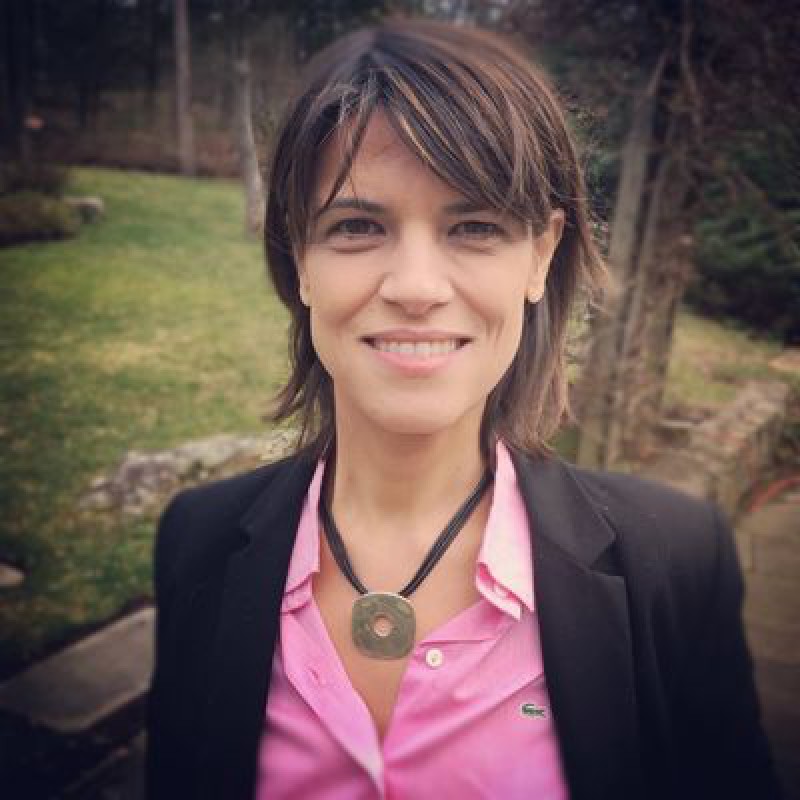
Claudia Passos-Ferreira is a philosopher and a psychologist in the Center for Bioethics at New York University. She works on the development of consciousness and self-consciousness, moral psychology, and other topics in the philosophy of psychology and philosophy of mind. She was trained as a psychologist and has a Ph.D. in public health and a second Ph.D. in philosophy.
