
KLI Colloquia are invited research talks of about an hour followed by 30 min discussion. The talks are held in English, open to the public, and offered in hybrid format.
Join via Zoom:
https://us02web.zoom.us/j/5881861923?omn=85945744831
Meeting ID: 588 186 1923
Fall-Winter 2026/27 KLI Colloquium Series
1 October 2026 (Thurs) 3-4:30 PM CET 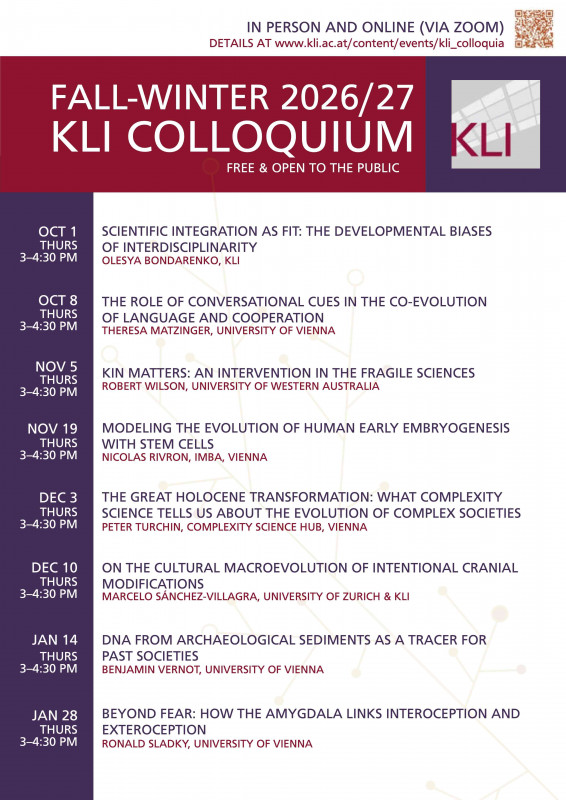
Scientific Integration as Fit: The Developmental Biases of Interdisciplinarity
Olesya BONDARENKO (KLI)
8 October 2026 (Thurs) 3-4:30 PM CET
The Role of Conversational Cues in the Co-Evolution of Language and Cooperation
Theresa MATZINGER (University of Vienna)
5 November 2026 (Thurs) 3-4:30 PM CET
Kin Matters: An Intervention in the Fragile Sciences
Robert A. WILSON (University of Western Australia)
19 November 2026 (Thurs) 3-4:30 PM CET
Modeling the Evolution of Human Early Embryogenesis with Stem Cells
Nicolas RIVRON (Institute of Molecular Biotechnology/IMBA, Vienna)
3 December 2026 (Thurs) 3-4:30 PM CET
Peter TURCHIN (Complexity Science Hub, Vienna)
10 December 2026 (Thurs) 3-4:30 PM CET
On the Cultural Macroevolution of Intentional Cranial Modifications
Marcelo SÁNCHEZ-VILLAGRA (University of Zurich)
14 January 2027 (Thurs) 3-4:30 PM CET
DNA from Archaeological Sediments as a Tracer for Past Societies
Benjamin VERNOT (University of Vienna)
28 January 2027 (Thurs) 3-4:30 PM CET
Beyond Fear: How the Amygdala Links Interoception and Exteroception
Ronald SLADKY (University of Vienna)
KLI Colloquia 2014 – 2026
Event Details

Topic description / abstract:
Recent work in Metaphysics and in Philosophy of Science, and in particular in Philosophy of Biology, shows a revival of interest in issues that might be considered to be either metaphysical issues that can be further elucidated by recourse to biological cases or metaphysical consequences that some advancements in Biology have. In our talk, we will explore how the teleological discourse appears in Biology, and we will explore some ideas to test whether it is possible to argue for a particular kind of primitive and sui generis irreducibility of such teleological dimension.
We will discuss recent work by Daniel McShea, in which he has proposed to understand biological teleology in the framework of the theory of compositional hierarchies, so that containing structures or systems are the source of direction (teleology) of contained substructures or subsystems (McShea 2012). He offers examples of developmental processes, in particular of primary mesenchyme cell migration in skeleton formation of sea urchin embryos. Recent work in biology and philosophy of cancer also seems to point in the same direction, since the fate of the cells seems to depend on the context in which they are (Bertolaso 2016; Tata et al. 2018). But on the other hand, developmental and neoplastic processes are different as cancer can be described precisely as the pathology of development. We intend to address such apparent tension and explore the consequences that the comparison between development and cancer has for contemporary philosophical debates on biological teleology. We hope that this will allow us to defend also, as a secondary aim, the plausibility of a fertile interaction between metaphysics and biology, in particular, an interaction that can be described as “philosophy FROM biology”, that is, the consequences that biological discoveries have for philosophy.
Biographical notes:
Marta Bertolaso is Associate Professor for Philosophy of Science, Faculty of Engineering, University Campus Bio-Medico of Rome, Italy. Since 2008, after having experienced in first hand some bio-medical research, she has been developing her philosophical training, skills and academic CV. Her main interests have been for the biological complexity, inter-level regulatory processes' models and the philosophy of cancer. She developed her research program in in contact with the national and international scientific and academic environments, both Anglo-Saxon and Latin, Spanish speaking communities. She also investigated contemporary issues related to the notion of progress in biotechnology and in silico medicine. She has been a speaker of philosophy of science and bioethics in several Italian universities, in Munich (Germany), Puebla and Mexico DC, and in St. Louis (USA). Among her latest publications, Philosophy of Cancer - A Dynamic and Relational View. Springer Series in "History, Philosophy & Theory of the Life Sciences", 2016, and The Future of Scientific Practice: 'Bio-Techno-Logos', Pickering & Chatto Publishers, London, 2015. She is the Editor in Chief of the Springer series "Human Perspectives in Bio-Medical Sciences & Technology".
María Cerezo is Professor of Logic and Philosophy of Science at the Department of Philosophy of the University of Murcia, Spain. Her initial interests centred on the Philosophy of Language, in particular, the Tractatus Logico-philosophicus of Ludwig Wittgenstein. From 2008 on, she has started working on issues of Philosophy of Biology, and in particular on metaphysical issues that arise in biological concepts and problems. She is the coordinator of the research project Metaphysics of biology: framing the interactions between molecular, developmental and evolutionary biology. Her interests in Philosophy of Biology center in issues such as: metaphysical theories of persistence applied to species evolution; causation, individuation and teleology in developmental biology; and dispositional theories of genes.
