

KLI Colloquia are invited research talks of about an hour followed by 30 min discussion. The talks are held in English, open to the public, and offered in hybrid format.
Join via Zoom:
https://us02web.zoom.us/j/5881861923?omn=85945744831
Meeting ID: 588 186 1923
Fall-Winter 2026/27 KLI Colloquium Series
1 October 2026 (Thurs) 3-4:30 PM CET 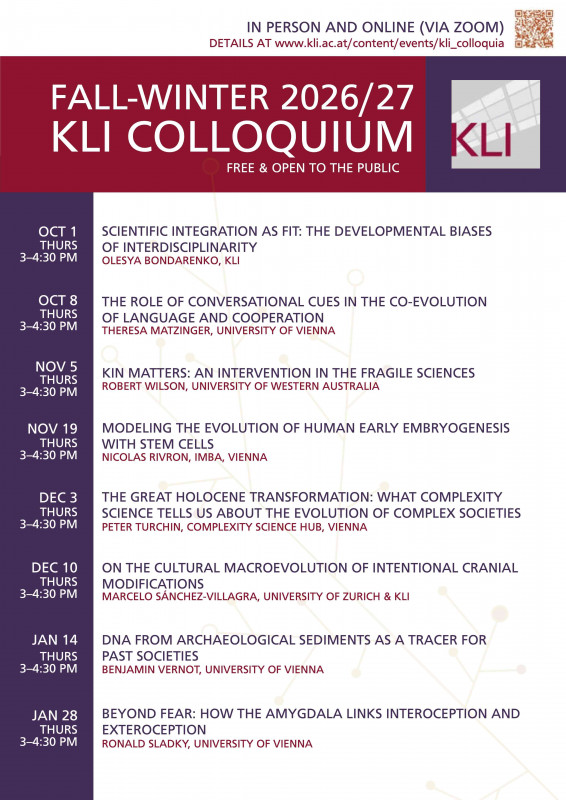
Scientific Integration as Fit: The Developmental Biases of Interdisciplinarity
Olesya BONDARENKO (KLI)
8 October 2026 (Thurs) 3-4:30 PM CET
The Role of Conversational Cues in the Co-Evolution of Language and Cooperation
Theresa MATZINGER (University of Vienna)
5 November 2026 (Thurs) 3-4:30 PM CET
Kin Matters: An Intervention in the Fragile Sciences
Robert A. WILSON (University of Western Australia)
19 November 2026 (Thurs) 3-4:30 PM CET
Modeling the Evolution of Human Early Embryogenesis with Stem Cells
Nicolas RIVRON (Institute of Molecular Biotechnology/IMBA, Vienna)
3 December 2026 (Thurs) 3-4:30 PM CET
Peter TURCHIN (Complexity Science Hub, Vienna)
10 December 2026 (Thurs) 3-4:30 PM CET
On the Cultural Macroevolution of Intentional Cranial Modifications
Marcelo SÁNCHEZ-VILLAGRA (University of Zurich)
14 January 2027 (Thurs) 3-4:30 PM CET
DNA from Archaeological Sediments as a Tracer for Past Societies
Benjamin VERNOT (University of Vienna)
28 January 2027 (Thurs) 3-4:30 PM CET
Beyond Fear: How the Amygdala Links Interoception and Exteroception
Ronald SLADKY (University of Vienna)
KLI Colloquia 2014 – 2026
Event Details
Topic description / abstract:
Through the expansion of human activities, humanity has evolved to become a driving force of global environmental change and influences a substantial and growing part of natural ecosystem trophic interactions and energy flows. However, by constructing and building its own niche, human distance from nature increased remarkably during the last decades due to processes of globalization and urbanization. This increasing disconnect has both material and immaterial consequences for how humans interact and connect with nature. Indeed, many regions across the world have disconnected themselves from the productivity of their regional environment by (1) accessing biological products from distant places through international trade, and (2) using non-renewable resources from outside the biosphere to boost the productivity of their natural environment. Both mechanisms allow for greater resource use then would be possible otherwise, but also involve complex sustainability challenges and lead to fundamentally different feedbacks between humans and the environment.
Biographical note:
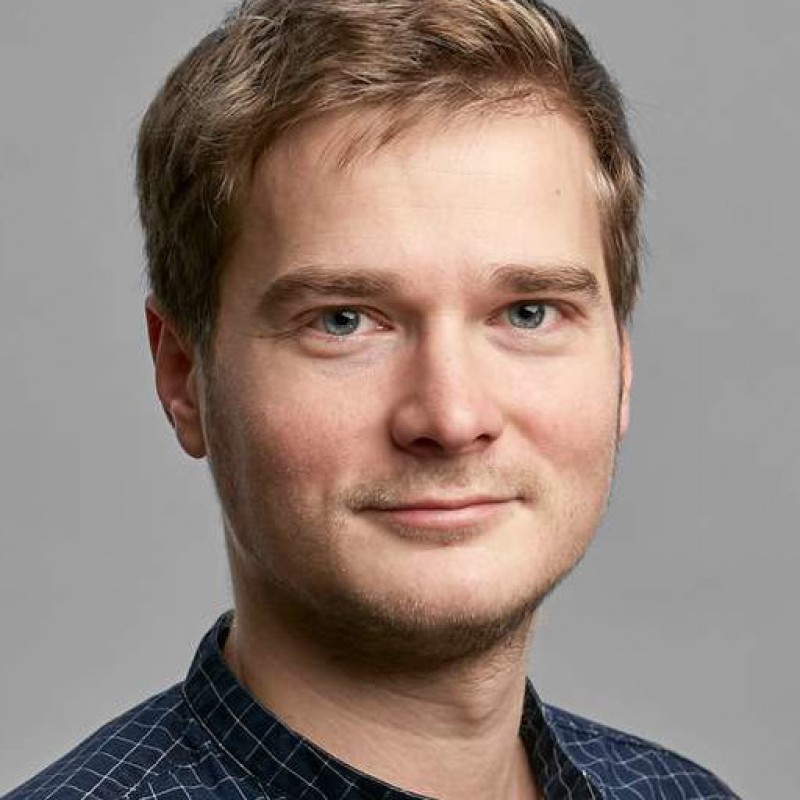
Christian Dorninger is a PhD-candidate at the Leuphana University of Lüneburg, Germany, and a writing-up fellow at the KLI Klosterneuburg. He has a background in sociology, development studies, and social ecology. Since 2015 he has been involved as a project member in the inter- and transdisciplinary 'Leverage Points for Sustainability Transformation' project at Leuphana University. His research interests include the development and application of methods of human-nature interaction, the sustainability transformation, resource use and decoupling, a biophysical perspective on trade relations, teleconnections, and ecologically unequal exchange. Since April 2019 he is a fellow at the KLI Klosterneuburg and has started approaching these complex phenomena through a niche construction perspective.
