
KLI Colloquia are invited research talks of about an hour followed by 30 min discussion. The talks are held in English, open to the public, and offered in hybrid format.
Join via Zoom:
https://us02web.zoom.us/j/5881861923?omn=85945744831
Meeting ID: 588 186 1923
Fall-Winter 2026/27 KLI Colloquium Series
1 October 2026 (Thurs) 3-4:30 PM CET 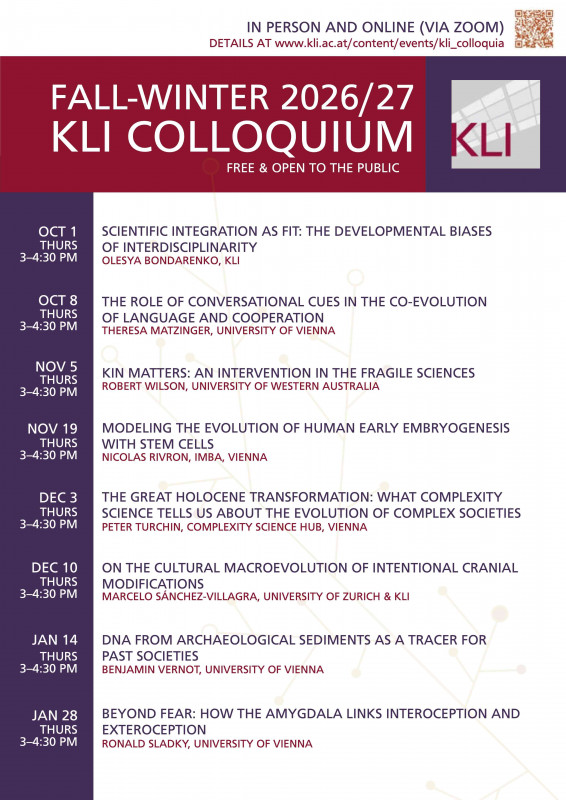
Scientific Integration as Fit: The Developmental Biases of Interdisciplinarity
Olesya BONDARENKO (KLI)
8 October 2026 (Thurs) 3-4:30 PM CET
The Role of Conversational Cues in the Co-Evolution of Language and Cooperation
Theresa MATZINGER (University of Vienna)
5 November 2026 (Thurs) 3-4:30 PM CET
Kin Matters: An Intervention in the Fragile Sciences
Robert A. WILSON (University of Western Australia)
19 November 2026 (Thurs) 3-4:30 PM CET
Modeling the Evolution of Human Early Embryogenesis with Stem Cells
Nicolas RIVRON (Institute of Molecular Biotechnology/IMBA, Vienna)
3 December 2026 (Thurs) 3-4:30 PM CET
Peter TURCHIN (Complexity Science Hub, Vienna)
10 December 2026 (Thurs) 3-4:30 PM CET
On the Cultural Macroevolution of Intentional Cranial Modifications
Marcelo SÁNCHEZ-VILLAGRA (University of Zurich)
14 January 2027 (Thurs) 3-4:30 PM CET
DNA from Archaeological Sediments as a Tracer for Past Societies
Benjamin VERNOT (University of Vienna)
28 January 2027 (Thurs) 3-4:30 PM CET
Beyond Fear: How the Amygdala Links Interoception and Exteroception
Ronald SLADKY (University of Vienna)
KLI Colloquia 2014 – 2026
Event Details
Topic description / abstract:
Until recently, signs of an increase in technical and social complexity over deep time have taken to be signs of, and caused by, increases in individual cognitive capacity. Likewise, long period of no-change have been seen as the result of constraints on individual cognitive capacity. This picture has recently been challenged both empirically and theoretically. The empirical challenge derives from an apparent mis-match between morphological evolution in our lineage, including the expansion of our brain and neocortex, and changes in material culture. The theoretical challenge derives from a set of ideas that link cultural complexity to social scale. These models suggest that material culture is sensitive to the social and demographic environment, not just the native cognitive capacities of individual agents. Innovation and its uptake is more reliable in larger social worlds. This paper takes up these ideas, and distinguishes three different versions of the view that increases in social scale support increases in the complexity of material culture. Those are: (i) cultural selection is more efficient in larger social worlds; (ii) larger social worlds support more specialisation, which in turn supports a more complex material culture; (iii) cultural learning is more efficient in larger social worlds. The paper argues that the first two of these pathways are probably more important than the third in explaining otherwise puzzling features of the archaeological and ethnographic record.
Biographical note:
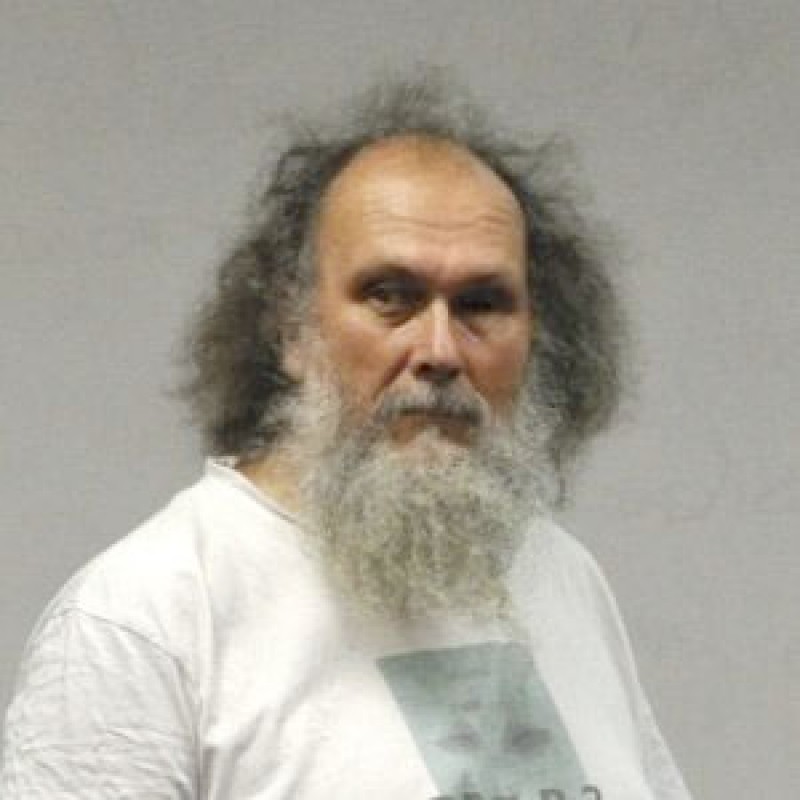
After studying philosophy at Sydney University, Kim Sterelny taught philosophy in Australia at Sydney, La Trobe University, and ANU (where he was Research Fellow, and then Senior Research Fellow, in Philosophy at RSSS from 1983 until 1987), before taking up a position at Victoria University in Wellington. Between 1999 and 2008 he spent half a year at Victoria and the other half here at the ANU. After 2009 he transitioned to full time at the ANU. His research interests have always been in the border areas between philosophy and the sciences; most of his research and graduate supervision has been in philosophy of biology and the philosophy of the cognitive sciences. In the last decade and a half, he has been particularly interested in human evolution, and in understanding the the evolution of the distinctive features of human social life, and of the cognitive capacities that make that life possible.
Sterelny has been a Visiting Professor at Simon Fraser University in Canada, and at Cal Tech and the University of Maryland, College Park, in the USA. He is the author of The Representational Theory of Mind; the co-author of Language and Reality (with Michael Devitt); Sex and Death: An Introduction to Philosophy of Biology (with Paul Griffiths); Thought in a Hostile World (which won the 2003 Lakatos Prize); What is Biodiversity (with James MacLaurin); Dawkins vs Gould; and The Evolved Apprentice (the book of the 2009 Nicod Prize Lectures). He is Fellow of the Australian Academy of the Humanities, and the Royal Society of New Zealand. In addition to philosophy, Kim spends his time eating curries, drinking red wine, bushwalking, snorkelling and bird watching.
