
KLI Colloquia are invited research talks of about an hour followed by 30 min discussion. The talks are held in English, open to the public, and offered in hybrid format.
Join via Zoom:
https://us02web.zoom.us/j/5881861923?omn=85945744831
Meeting ID: 588 186 1923
Fall-Winter 2026/27 KLI Colloquium Series
1 October 2026 (Thurs) 3-4:30 PM CET 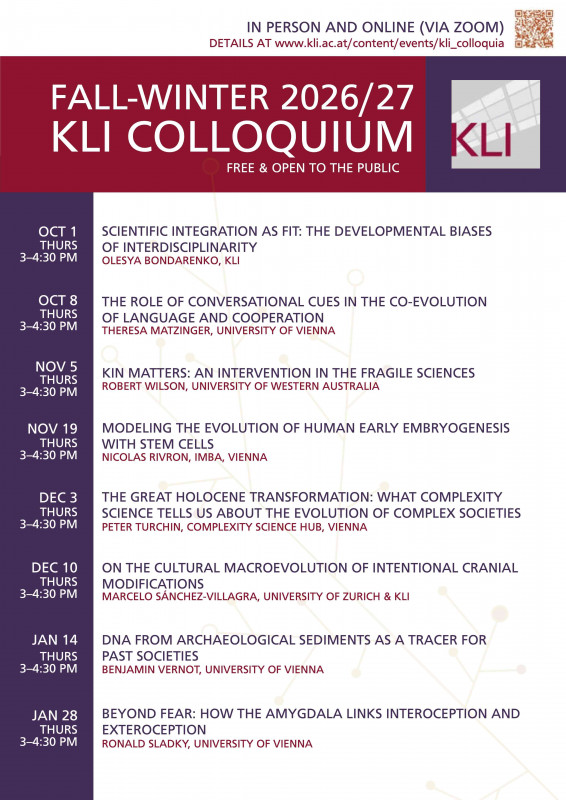
Scientific Integration as Fit: The Developmental Biases of Interdisciplinarity
Olesya BONDARENKO (KLI)
8 October 2026 (Thurs) 3-4:30 PM CET
The Role of Conversational Cues in the Co-Evolution of Language and Cooperation
Theresa MATZINGER (University of Vienna)
5 November 2026 (Thurs) 3-4:30 PM CET
Kin Matters: An Intervention in the Fragile Sciences
Robert A. WILSON (University of Western Australia)
19 November 2026 (Thurs) 3-4:30 PM CET
Modeling the Evolution of Human Early Embryogenesis with Stem Cells
Nicolas RIVRON (Institute of Molecular Biotechnology/IMBA, Vienna)
3 December 2026 (Thurs) 3-4:30 PM CET
Peter TURCHIN (Complexity Science Hub, Vienna)
10 December 2026 (Thurs) 3-4:30 PM CET
On the Cultural Macroevolution of Intentional Cranial Modifications
Marcelo SÁNCHEZ-VILLAGRA (University of Zurich)
14 January 2027 (Thurs) 3-4:30 PM CET
DNA from Archaeological Sediments as a Tracer for Past Societies
Benjamin VERNOT (University of Vienna)
28 January 2027 (Thurs) 3-4:30 PM CET
Beyond Fear: How the Amygdala Links Interoception and Exteroception
Ronald SLADKY (University of Vienna)
KLI Colloquia 2014 – 2026
Event Details
Topic description / abstract:
Humanity and the planet are entering a period of major, transformative change in economies, political power, human-environment relationships and technology. Whether for the good or for the bad, transformation of society is, in some way, inevitable. Humanity has therefore no option other than to try and find ways to help steward such transformations towards more equitable and sustainable futures. While science and knowledge have an important role to play in this process, these are arguably failing humanity when its impact is measured against the level of progress being made towards addressing burgeoning global environmental and social crises. For all its brilliant success, science, research and technology have also led to many of the problems to which transformative responses are now needed, including climate change, obesity, smoking, mental health, plastics in the oceans and premature deaths from air pollution. This raises important questions about the kinds of knowledge and learning needed for, and in, a transforming world.
This seminar explores some of these issues, highlighting that, in the world of 21st century challenges in which we find ourselves, nothing can be taken for granted. In effect, we are all apprentices and need to rapidly develop new ways of approaching problems. In relation to knowledge we need to accept we are all apprentices; draw on much more diverse forms of knowledge; develop wisdom about how to act in the world, not just knowledge; and unleash creativity and possibilities. This raises challenges not just for the way knowledge is produced, but also for the systems and structures supporting it. It also requires asking difficult existential questions about who we should be at the end of the world as we know it.
Biographical note:
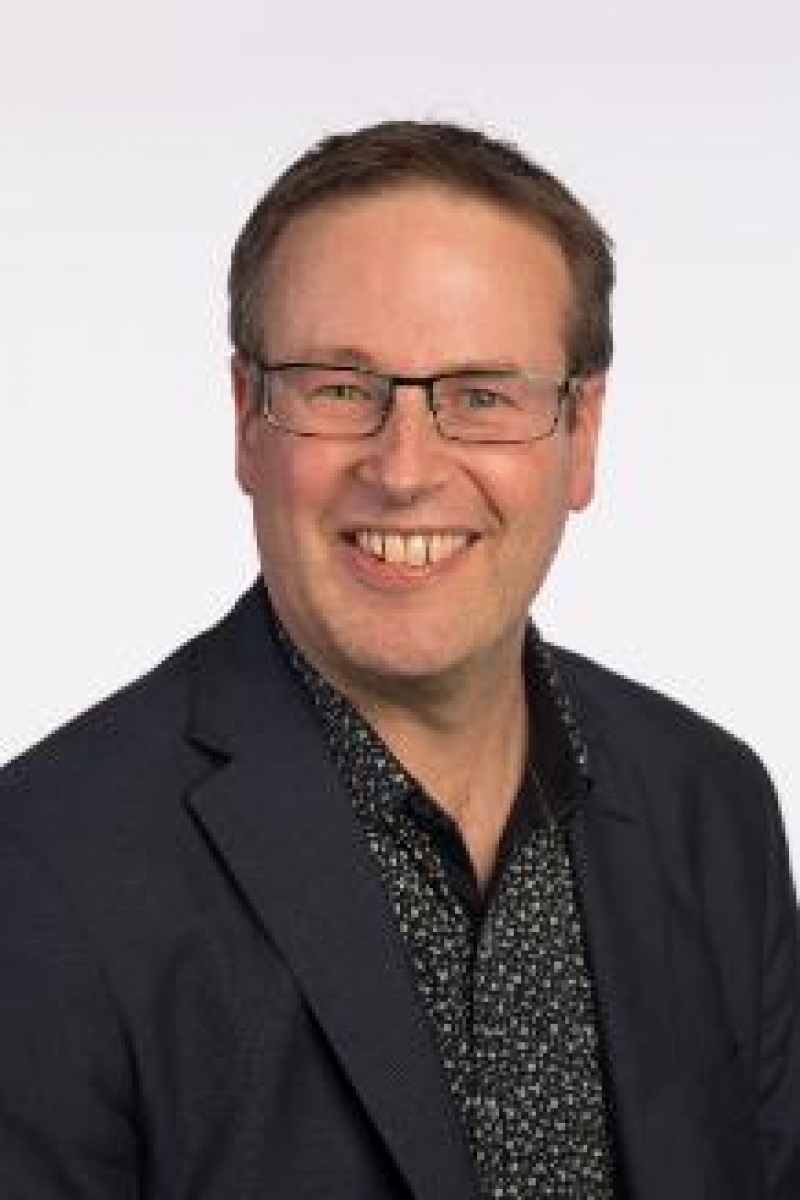
Ioan Fazey is Professor of the Social Dimensions of Environment and Change at the University of York. He has over 65 research publications in knowledge, learning, resilience, vulnerability, sustainability and how to support societal transformations. His work has included innovative projects on community resilience in the South Pacific and Scotland, co-creative projects to build flood resilient floating homes in Bangladesh, and helping facilitate conversations about how to transform responses to rapidly rising sea levels in Louisiana, USA. He is actively involved in helping support and facilitate emergence of a growing field of research and practice related to Transformations to Sustainability. This includes convening the Transformations Conference Series and being a co-founder of the SDG Transformation Forum. He is also atrustee of H3Uni, an action oriented organisation seeking to promote transformative thinking and capacity for working within a changing world. To find solace from a turbulent world and help him foster inspiration and support he spends time connecting with the non-human world, including with his dog.
