
KLI Colloquia are invited research talks of about an hour followed by 30 min discussion. The talks are held in English, open to the public, and offered in hybrid format.
Join via Zoom:
https://us02web.zoom.us/j/5881861923?omn=85945744831
Meeting ID: 588 186 1923
Fall-Winter 2026/27 KLI Colloquium Series
1 October 2026 (Thurs) 3-4:30 PM CET 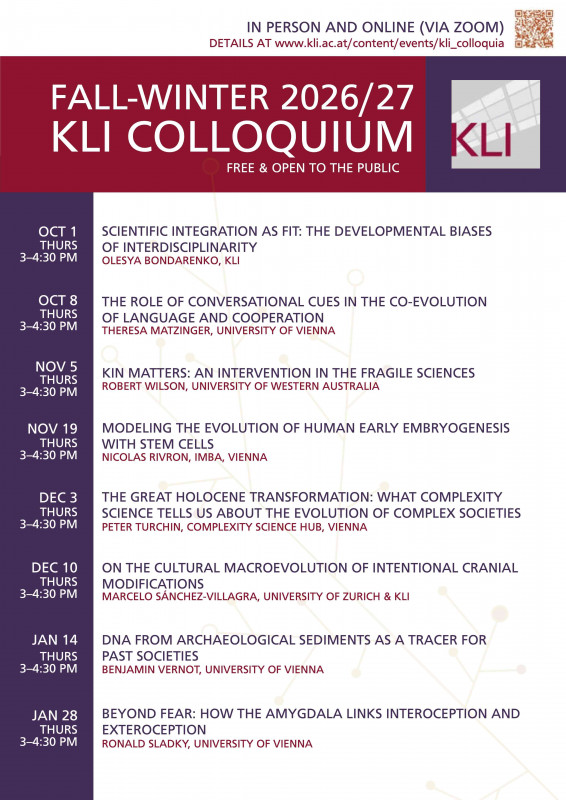
Scientific Integration as Fit: The Developmental Biases of Interdisciplinarity
Olesya BONDARENKO (KLI)
8 October 2026 (Thurs) 3-4:30 PM CET
The Role of Conversational Cues in the Co-Evolution of Language and Cooperation
Theresa MATZINGER (University of Vienna)
5 November 2026 (Thurs) 3-4:30 PM CET
Kin Matters: An Intervention in the Fragile Sciences
Robert A. WILSON (University of Western Australia)
19 November 2026 (Thurs) 3-4:30 PM CET
Modeling the Evolution of Human Early Embryogenesis with Stem Cells
Nicolas RIVRON (Institute of Molecular Biotechnology/IMBA, Vienna)
3 December 2026 (Thurs) 3-4:30 PM CET
Peter TURCHIN (Complexity Science Hub, Vienna)
10 December 2026 (Thurs) 3-4:30 PM CET
On the Cultural Macroevolution of Intentional Cranial Modifications
Marcelo SÁNCHEZ-VILLAGRA (University of Zurich)
14 January 2027 (Thurs) 3-4:30 PM CET
DNA from Archaeological Sediments as a Tracer for Past Societies
Benjamin VERNOT (University of Vienna)
28 January 2027 (Thurs) 3-4:30 PM CET
Beyond Fear: How the Amygdala Links Interoception and Exteroception
Ronald SLADKY (University of Vienna)
KLI Colloquia 2014 – 2026
Event Details

Join Zoom Meeting
https://us02web.zoom.us/j/85816588027?pwd=aW9YY1E0akI3NHZZT0xuK09ta3BEdz09
Meeting ID: 858 1658 8027
Topic description / abstract:
Emerging Infectious Diseases in humans, livestock and crops currently cost the world 1 trillion dollars a year in production losses and treatment costs, more than the GDP of all but 15 countries. Evolutionary analysis of this crisis, based on the newly-formulated Stockholm Paradigm, links the potential for emerging infectious disease outbreaks directly to climate change. Highly specialized pathogens evolve in localized settings in association with one or a few hosts. Climate change and ecological disruption alters geographic distributions, bringing those pathogens into contact with susceptible but previously unexposed hosts. This has been true throughout the history of life on this planet. Human activities during the past 15,000 years, including domestication and agriculture, population growth, conflict and migration, urbanization and globalization have all increased the risk. Technological humanity now faces an existential crisis in global climate change and emerging infectious disease. We have run out of time and we are largely unprepared. But we can change that. The very evolutionary specializations that make pathogens a threat for widespread emergence also provide insights into how we can find them before they find us. The DAMA (document – assess – monitor – act) protocol links activities from neighborhood gardens to global surveillance systems that can allow us to anticipate to mitigate emerging diseases. We can lower costs to society, limiting the global impact of pathogens and slowing the expanding and accelerating crisis, while buying time for traditional efforts to medicate, vaccinate and eradicate.
Biographical note:
Daniel R. Brooks is Professor Emeritus, University of Toronto, and Senior Research Fellow, H.W. Manter Laboratory of Parasitology, University of Nebraska State Museum. He is a Fellow of the Royal Society of Canada (Academy of Science) and Fellow of the Linnaean Society of London. He has been awarded honorary doctorates from Stockholm University and the University of Nebraska and has been a Visiting Fellow of the Collegium Budapest, Stellenbosch Institute of Advanced Study, Institute of Advanced Studies, Köszeg, and the Hungarian National Institute of Ecology. Dan is an evolutionary biologist whose work ranges from field studies in tropical wildlands to foundational studies of evolutionary theory. His current focus is understanding the evolutionary relationship between global climate change and emerging disease to develop proactive policy for coping with the crisis. Author of more than 375 scientific publications, Dan is one of the top 200 biologists according to Google Scholar, and among the top 1% of scholars on Research Gate. His newest book is The Stockholm Paradigm: Climate Change and Emerging Disease (University of Chicago Press).
