

KLI Colloquia are invited research talks of about an hour followed by 30 min discussion. The talks are held in English, open to the public, and offered in hybrid format.
Join via Zoom:
https://us02web.zoom.us/j/5881861923?omn=85945744831
Meeting ID: 588 186 1923
Fall-Winter 2026/27 KLI Colloquium Series
1 October 2026 (Thurs) 3-4:30 PM CET 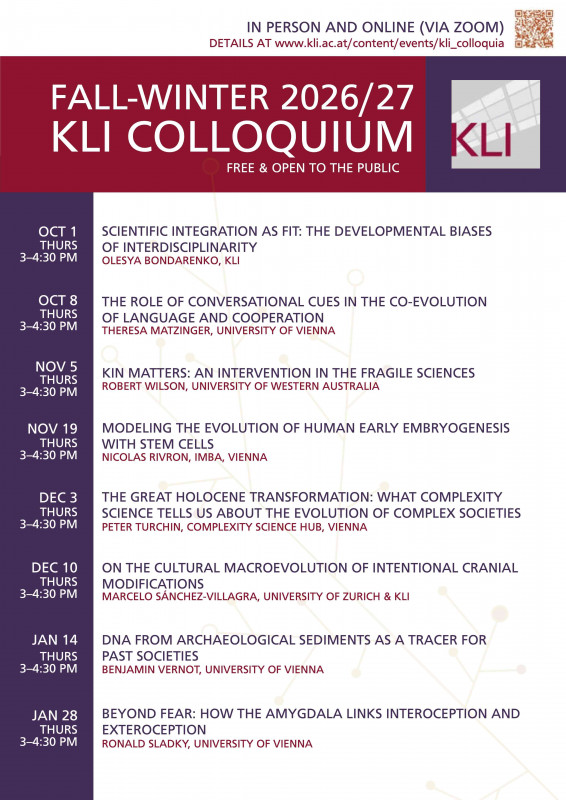
Scientific Integration as Fit: The Developmental Biases of Interdisciplinarity
Olesya BONDARENKO (KLI)
8 October 2026 (Thurs) 3-4:30 PM CET
The Role of Conversational Cues in the Co-Evolution of Language and Cooperation
Theresa MATZINGER (University of Vienna)
5 November 2026 (Thurs) 3-4:30 PM CET
Kin Matters: An Intervention in the Fragile Sciences
Robert A. WILSON (University of Western Australia)
19 November 2026 (Thurs) 3-4:30 PM CET
Modeling the Evolution of Human Early Embryogenesis with Stem Cells
Nicolas RIVRON (Institute of Molecular Biotechnology/IMBA, Vienna)
3 December 2026 (Thurs) 3-4:30 PM CET
Peter TURCHIN (Complexity Science Hub, Vienna)
10 December 2026 (Thurs) 3-4:30 PM CET
On the Cultural Macroevolution of Intentional Cranial Modifications
Marcelo SÁNCHEZ-VILLAGRA (University of Zurich)
14 January 2027 (Thurs) 3-4:30 PM CET
DNA from Archaeological Sediments as a Tracer for Past Societies
Benjamin VERNOT (University of Vienna)
28 January 2027 (Thurs) 3-4:30 PM CET
Beyond Fear: How the Amygdala Links Interoception and Exteroception
Ronald SLADKY (University of Vienna)
KLI Colloquia 2014 – 2026
Event Details

Zoom link for registration:
Deadline for the registration with Zoom is 12.30 pm on the day of the talk.
Please take note that nobody will be admitted in the room after 3:05 pm.
Topic description / abstract:
Besides intense efforts to understand the relation between diet and morphology in primates, we still cannot extend the findings across different groups. That may occur due to the insufficiency in communication between scientific areas. From an evolutionary perspective, behavior may also play a role in the pattern between morphology and diet. After all, the diet's composition is not only determined by the species and varies on the season, year, and social status. On top of that, several species present complex socially transmitted behaviors to access food, including anvil and stone tools. So how can the confluence of etology and morphological studies expand our understanding of the morphology evolution?
Biographical note:
Mariana Dutra Fogaça is a primatologist and a post-doctoral fellow at the University of Veterinary Medicine Vienna. She focuses on the feeding behavior of wild animals, with experience with Neotropical Monkeys and Strepsirrhinesi. She aims to understand how behavior plays a role in the morphological evolution of the masticatory anatomy, allowing a broader view of feeding evolution.
She works towards the conservation by incorporating her founds into agroforestry systems with the community surrounding the forests. And as a science communicator in Brazilian science media.
