Events

KLI Colloquia are invited research talks of about an hour followed by 30 min discussion. The talks are held in English, open to the public, and offered in hybrid format. 

Join via Zoom:
https://us02web.zoom.us/j/5881861923?omn=85945744831
Meeting ID: 588 186 1923

Fall–Winter 2026/27 KLI Colloquium Series

1 October 2026 (Thurs) 3-4:30 PM CET
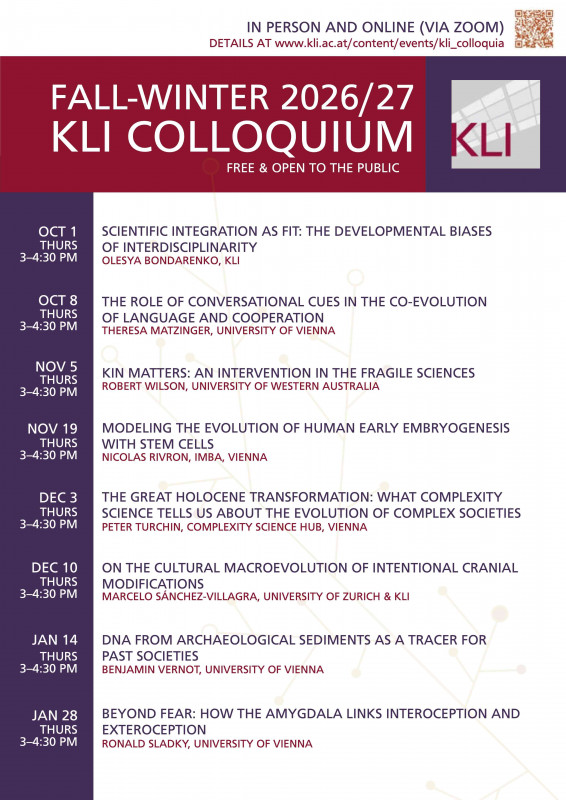
Scientific Integration as Fit: The Developmental Biases of Interdisciplinarity

Olesya BONDARENKO (KLI)


8 October 2026 (Thurs) 3-4:30 PM CET

The Role of Conversational Cues in the Co-Evolution of Language and Cooperation

Theresa MATZINGER (University of Vienna)


5 November 2026 (Thurs) 3-4:30 PM CET

Kin Matters: An Intervention in the Fragile Sciences

Robert A. WILSON (University of Western Australia)


19 November 2026 (Thurs) 3-4:30 PM CET

TBA

Nicolas RIVRON (Institute of Molecular Biotechnology/IMBA, Vienna)


3 December 2026 (Thurs) 3-4:30 PM CET

The Great Holocene Transformation: What Complexity Science Tells Us About The Evolution of Complex Societies

Peter TURCHIN (Complexity Science Hub, Vienna)


10 December 2026 (Thurs) 3-4:30 PM CET

On the Cultural Macroevolution of Intentional Cranial Modifications

Marcelo SÁNCHEZ-VILLAGRA (University of Zurich)


14 January 2027 (Thurs) 3-4:30 PM CET

DNA from Archaeological Sediments as a Tracer for Past Societies

Benjamin VERNOT (University of Vienna)


28 January 2027 (Thurs) 3-4:30 PM CET

Beyond Fear: How the Amygdala Links Interoception and Exteroception

Ronald SLADKY (University of Vienna)


KLI Colloquia 2014 – 2026

Event Details
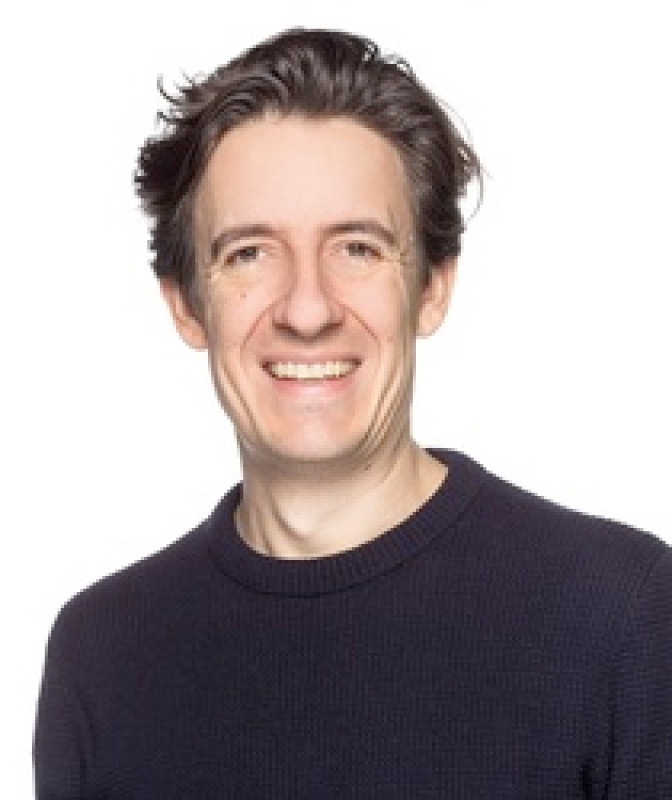
Daniel Hausknost
KLI Colloquia
The Modern State and the Glass Ceiling for a Sustainability Transformation – a Systems Perspective
Daniel HAUSKNOST (Vienna University of Economics and Business)
2021-01-21 15:00 - 2021-01-21 17:00
KLI
Organized by KLI
Register in advance for this meeting:
 
After registering, you will receive a confirmation email containing information about joining the meeting.
 
 
Topic description / abstract:
What are the capacities of the modern state to facilitate a comprehensive sustainability transition? It is argued in this paper that structural barriers akin to an invisible ‘glass ceiling’ are inhibiting any such transformation. Building on insights from historical institutionalism, it is argued that the structure of state imperatives does not allow for the addition of an independent sustainability imperative without major contradictions. Secondly, the imperative of legitimation is identified as a crucial component of the glass ceiling. Adding a systems-theoretical perspective, a distinction is introduced between ‘lifeworld’ and ‘system’ sustainability, showing that the environmental state has created an environmentally sustainable lifeworld, which continues to be predicated on a fundamentally unsustainable reproductive system. While this ‘decoupling’ of lifeworld from system sustainability has alleviated legitimation pressure from the state (thereby stabilizing the system), a transition to systemic sustainability would require deep and disruptive changes in the lifeworld. This constitutes a renewed challenge for state legitimation and explains the state’s reluctance to engage in effective transformation politics. Some speculations regarding possible futures of the environmental state conclude the article.
 
The talk is based on a recent article published in Environmental Politicshttps://www.tandfonline.com/doi/full/10.1080/09644016.2019.1680062
 
 
Biographical note:
Daniel Hausknost is a political scientist and social theorist, whose research focuses on the transformative capacities of the modern state and of modern democracy. He is interested to know to what extent the modern state and its democratic versions are dependent on economic growth and an industrial social metabolism and to what extent this dependency could be ‘decoupled’ to enable the emergence of a stable democratic order beyond the modern industrial energy and growth regime. He is currently an Assistant Professor at the Institute for Social Change and Sustainability (IGN) at the Vienna University of Economics and Business (WU Wien) and was previously a senior researcher at the Institute of Social Ecology (Vienna). He holds a PhD in Politics and International Relations from Keele University (UK) and a Master in Politics and Philosophy from the University of Vienna.