

KLI Colloquia are invited research talks of about an hour followed by 30 min discussion. The talks are held in English, open to the public, and offered in hybrid format.
Join via Zoom:
https://us02web.zoom.us/j/5881861923?omn=85945744831
Meeting ID: 588 186 1923
Fall-Winter 2026/27 KLI Colloquium Series
1 October 2026 (Thurs) 3-4:30 PM CET 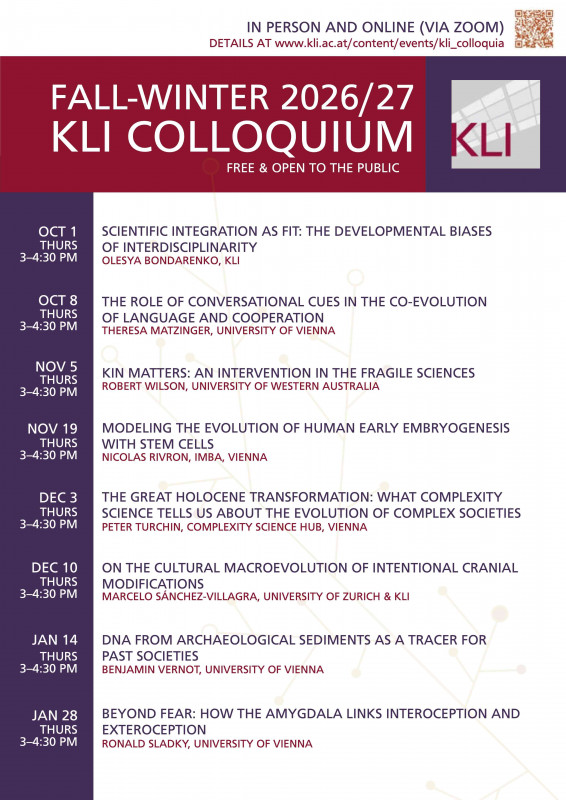
Scientific Integration as Fit: The Developmental Biases of Interdisciplinarity
Olesya BONDARENKO (KLI)
8 October 2026 (Thurs) 3-4:30 PM CET
The Role of Conversational Cues in the Co-Evolution of Language and Cooperation
Theresa MATZINGER (University of Vienna)
5 November 2026 (Thurs) 3-4:30 PM CET
Kin Matters: An Intervention in the Fragile Sciences
Robert A. WILSON (University of Western Australia)
19 November 2026 (Thurs) 3-4:30 PM CET
Modeling the Evolution of Human Early Embryogenesis with Stem Cells
Nicolas RIVRON (Institute of Molecular Biotechnology/IMBA, Vienna)
3 December 2026 (Thurs) 3-4:30 PM CET
Peter TURCHIN (Complexity Science Hub, Vienna)
10 December 2026 (Thurs) 3-4:30 PM CET
On the Cultural Macroevolution of Intentional Cranial Modifications
Marcelo SÁNCHEZ-VILLAGRA (University of Zurich)
14 January 2027 (Thurs) 3-4:30 PM CET
DNA from Archaeological Sediments as a Tracer for Past Societies
Benjamin VERNOT (University of Vienna)
28 January 2027 (Thurs) 3-4:30 PM CET
Beyond Fear: How the Amygdala Links Interoception and Exteroception
Ronald SLADKY (University of Vienna)
KLI Colloquia 2014 – 2026
Event Details
Topic description / abstract
Since its publication in February 2021, the Dasgupta review, titled “The Economics of Biodiversity,” has had a strong impact. The report invites us to consider nature as an “asset,” or a form of “capital,” whose value should be measured using controversial indicators and methodologies. The contributions of this capitalized nature to human societies would have then to be referred to as “ecosystem services”—the Dasgupta review devotes a full chapter to them. The literature on “natural capital” and “ecosystem services” has developed since the 1990s, but the concept of “nature’s services” is actually much older: we can find traces of it at least in the work of Alexander von Humboldt at the turn of the 19th century. One episode deserves special attention: the intertwining of economic and ecological expertise between the 1880s and the 1920s in the United States. At that time, some economists, ecologists, biologists and professionals of all kinds worked on the “services of nature,” particularly in forestry and agriculture. The concept of “natural capital” was also coined at that moment. The purpose of this presentation will be, therefore, to review that episode and to draw some lessons on the role of economic words in our understanding of environmental challenges. Economic imperialism, disciplinary hybridization, the role of biology and ecology in economics… these topics will be discussed to show how conceptual history can help answer the question: do economic words harm sustainability?
Biographical note
Antoine Missemer is a CNRS researcher currently working at CIRED - Centre international de recherche sur l'environnement et le développement (Paris, France). He holds a PhD in economics from the University of Lausanne. His interdisciplinary work focuses primarily on the history of environmental, energy, and natural resource economics, i.e. on how the economic discipline and economists have approached energy and ecological transition in the past. He is the author of several books (in French) and articles (in French and English) crossing the history of ideas and sustainability issues. His is currently working, with Marco P. Vianna Franco (KLI), on a history of the relationship between economics and the science of ecology, to be published by Routledge.
