
KLI Colloquia are invited research talks of about an hour followed by 30 min discussion. The talks are held in English, open to the public, and offered in hybrid format.
Join via Zoom:
https://us02web.zoom.us/j/5881861923?omn=85945744831
Meeting ID: 588 186 1923
Fall-Winter 2026/27 KLI Colloquium Series
1 October 2026 (Thurs) 3-4:30 PM CET 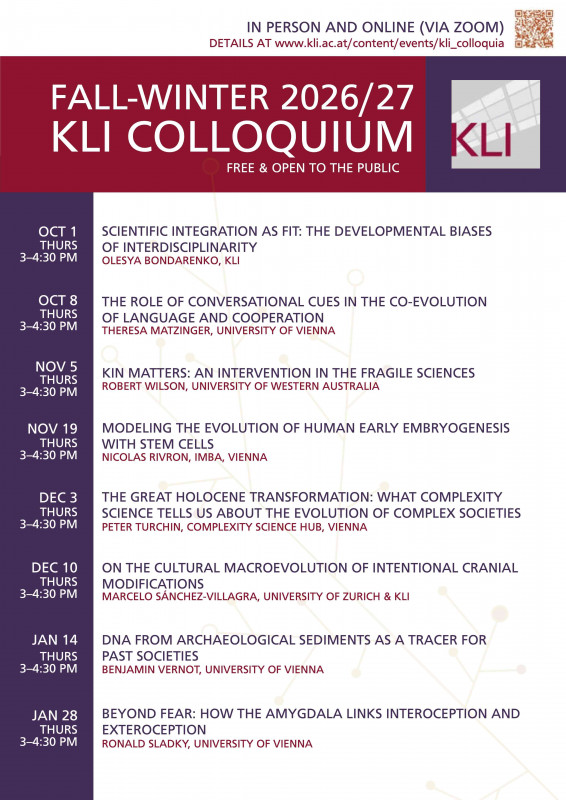
Scientific Integration as Fit: The Developmental Biases of Interdisciplinarity
Olesya BONDARENKO (KLI)
8 October 2026 (Thurs) 3-4:30 PM CET
The Role of Conversational Cues in the Co-Evolution of Language and Cooperation
Theresa MATZINGER (University of Vienna)
5 November 2026 (Thurs) 3-4:30 PM CET
Kin Matters: An Intervention in the Fragile Sciences
Robert A. WILSON (University of Western Australia)
19 November 2026 (Thurs) 3-4:30 PM CET
Modeling the Evolution of Human Early Embryogenesis with Stem Cells
Nicolas RIVRON (Institute of Molecular Biotechnology/IMBA, Vienna)
3 December 2026 (Thurs) 3-4:30 PM CET
Peter TURCHIN (Complexity Science Hub, Vienna)
10 December 2026 (Thurs) 3-4:30 PM CET
On the Cultural Macroevolution of Intentional Cranial Modifications
Marcelo SÁNCHEZ-VILLAGRA (University of Zurich)
14 January 2027 (Thurs) 3-4:30 PM CET
DNA from Archaeological Sediments as a Tracer for Past Societies
Benjamin VERNOT (University of Vienna)
28 January 2027 (Thurs) 3-4:30 PM CET
Beyond Fear: How the Amygdala Links Interoception and Exteroception
Ronald SLADKY (University of Vienna)
KLI Colloquia 2014 – 2026
Event Details

Topic description / abstract:
Both evolution and learning are known to produce (sometimes spectacular) adaptive solutions. One can rightfully ask whether these processes might share some common features, and whether they can help each other, possibly in the form of one being a "subroutine" in the other and vice versa.
Learning in evolution: Recent models inform us that ecosystem evolution and evolution of genetic regulatory networks (so important in development) can partly be best understood as learning processes. Features like Hebbian change in coupling terms, memory capacity, forgetting and graceful degradation all come into play. These investigations are complemented by the proposals that the Bayesian update rule is analogous to the discrete-time replicator equation and that evolving replicator populations can learn about grammatical classes. I shall give examples of these processes.
Evolution in learning: This is the flip side of the coin. The idea that something like evolution by natural selection might go on in the brain is not new. Neurobiology saw some eminent attempts to validate this claim, but previous proposals are merely selectionist rather than truly evolutionary. In order to advance in the latter direction one must demonstrate some form of replication, even though neurons do not reproduce. I shall discuss how this might work.
Biographical note:
Eörs Szathmáry (1959) is a Hungarian theoretical and evolutionary biologist, best known for his continued work on the comparative and theoretical aspects of the major evolutionary transitions. The theme was set by a book that he published together with the late John Maynard Smith in 1995. This monograph and the subsequent popular book have were published in a dozen countries. Google finds about 150 thousand hits for the “major transition” AND “evolution”. In addition, Szathmáry studies replicator theory, the relationship between learning and evolution, the question of minimal life and the conditions for open-ended evolution. He is a member of the Hungarian Academy of Sciences, EMBO, the Norwegian Academy of Sciences and Letters as well as Academia Europaea.
