

KLI Colloquia are invited research talks of about an hour followed by 30 min discussion. The talks are held in English, open to the public, and offered in hybrid format.
Join via Zoom:
https://us02web.zoom.us/j/5881861923?omn=85945744831
Meeting ID: 588 186 1923
Fall-Winter 2026/27 KLI Colloquium Series
1 October 2026 (Thurs) 3-4:30 PM CET 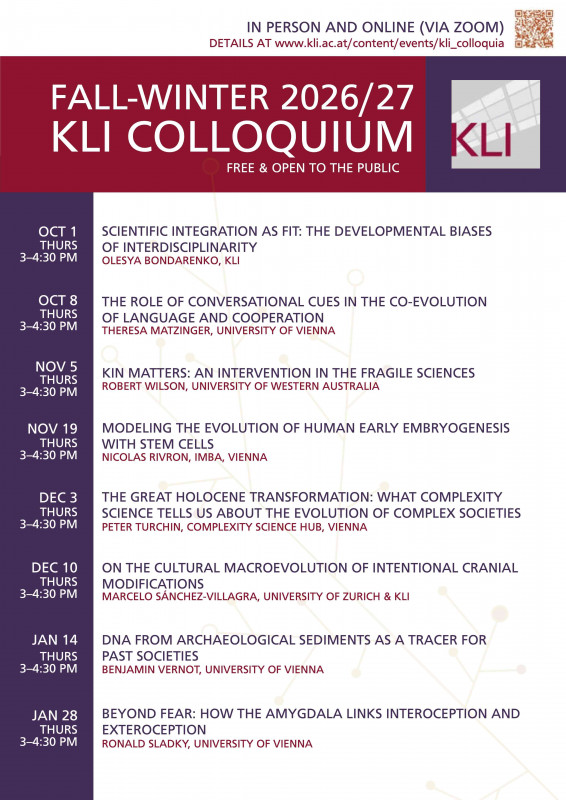
Scientific Integration as Fit: The Developmental Biases of Interdisciplinarity
Olesya BONDARENKO (KLI)
8 October 2026 (Thurs) 3-4:30 PM CET
The Role of Conversational Cues in the Co-Evolution of Language and Cooperation
Theresa MATZINGER (University of Vienna)
5 November 2026 (Thurs) 3-4:30 PM CET
Kin Matters: An Intervention in the Fragile Sciences
Robert A. WILSON (University of Western Australia)
19 November 2026 (Thurs) 3-4:30 PM CET
Modeling the Evolution of Human Early Embryogenesis with Stem Cells
Nicolas RIVRON (Institute of Molecular Biotechnology/IMBA, Vienna)
3 December 2026 (Thurs) 3-4:30 PM CET
Peter TURCHIN (Complexity Science Hub, Vienna)
10 December 2026 (Thurs) 3-4:30 PM CET
On the Cultural Macroevolution of Intentional Cranial Modifications
Marcelo SÁNCHEZ-VILLAGRA (University of Zurich)
14 January 2027 (Thurs) 3-4:30 PM CET
DNA from Archaeological Sediments as a Tracer for Past Societies
Benjamin VERNOT (University of Vienna)
28 January 2027 (Thurs) 3-4:30 PM CET
Beyond Fear: How the Amygdala Links Interoception and Exteroception
Ronald SLADKY (University of Vienna)
KLI Colloquia 2014 – 2026
Event Details
Topic description / abstract:
The debate on biological individuality has usually been focused on the definition and characterization of evolutionary individuals. Addressing this topic has helped clarify the discussion about units of selection and the requirements for evolution by natural selection. Less attention has been paid to other kinds of individuality, among which the main alternative to evolution to ground biological individuality has been constituted by organismal physiology. As a consequence, non-evolutionary accounts of biological individuality are still underdeveloped in comparison to evolutionary ones. Where generalization has been attempted, criteria involved in physiology, metabolism, organisms, anatomy, and ecology all tend to get bundled up together with very few distinctions to be made about why they go together. This is especially evident in relation to interactive cases (i.e. host-microbe symbioses, microbe-microbe symbioses, colonies, etc.) that transcend the “traditional organism”. In this scenario, the need for precise accounts based on conceptual or theoretical criteria is therefore especially apparent.
This talk aims to fill this gap by proposing an account of physiological individuality based on the organizational framework, which focuses on how parts and processes are related and on the functional role they play in maintaining biological systems. The core idea is that looking at what types of functional interactions are realised within and between living systems can allow us to make theoretically grounded distinctions between different types of biological individuals and specify their distinctive boundaries.
Biographical note:
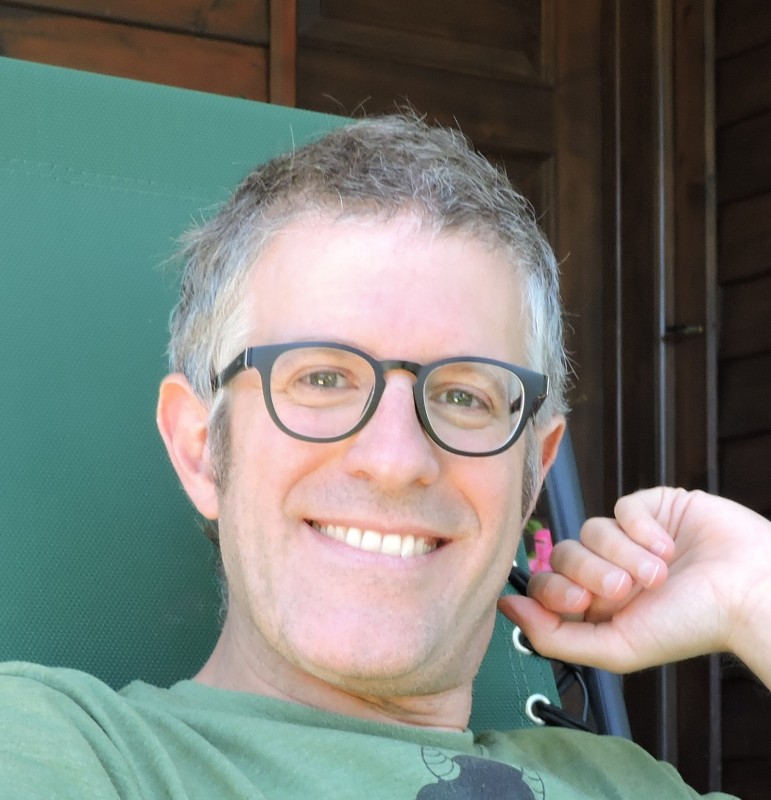
Leonardo Bich is a ‘Ramon y Cajal’ Researcher at the IAS-Research Centre of the University of the Basque Country (Spain). He obtained a PhD in Epistemology of Complex Systems from the University of Bergamo (Italy). He worked at the CNRS (France), at the Biology of Cognition Lab of the Universidad de Chile, and at the Center for Philosophy of Science of the University of Pittsburgh. His research is focused on theoretical and epistemological issues related to biological organisation, autonomy, and control and on their implications for investigations in Origins of Life, Synthetic and Systems Biology, and Theoretical Biology.
