

KLI Colloquia are invited research talks of about an hour followed by 30 min discussion. The talks are held in English, open to the public, and offered in hybrid format.
Join via Zoom:
https://us02web.zoom.us/j/5881861923?omn=85945744831
Meeting ID: 588 186 1923
Fall-Winter 2026/27 KLI Colloquium Series
1 October 2026 (Thurs) 3-4:30 PM CET 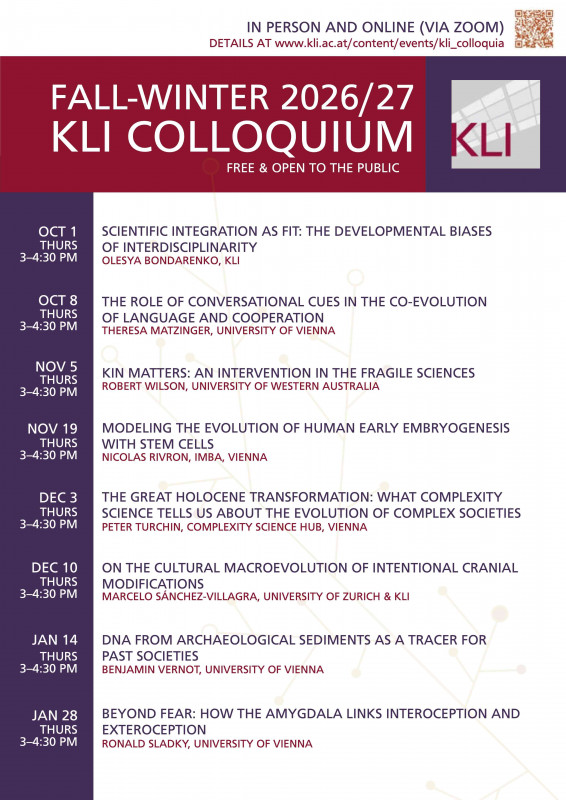
Scientific Integration as Fit: The Developmental Biases of Interdisciplinarity
Olesya BONDARENKO (KLI)
8 October 2026 (Thurs) 3-4:30 PM CET
The Role of Conversational Cues in the Co-Evolution of Language and Cooperation
Theresa MATZINGER (University of Vienna)
5 November 2026 (Thurs) 3-4:30 PM CET
Kin Matters: An Intervention in the Fragile Sciences
Robert A. WILSON (University of Western Australia)
19 November 2026 (Thurs) 3-4:30 PM CET
Modeling the Evolution of Human Early Embryogenesis with Stem Cells
Nicolas RIVRON (Institute of Molecular Biotechnology/IMBA, Vienna)
3 December 2026 (Thurs) 3-4:30 PM CET
Peter TURCHIN (Complexity Science Hub, Vienna)
10 December 2026 (Thurs) 3-4:30 PM CET
On the Cultural Macroevolution of Intentional Cranial Modifications
Marcelo SÁNCHEZ-VILLAGRA (University of Zurich)
14 January 2027 (Thurs) 3-4:30 PM CET
DNA from Archaeological Sediments as a Tracer for Past Societies
Benjamin VERNOT (University of Vienna)
28 January 2027 (Thurs) 3-4:30 PM CET
Beyond Fear: How the Amygdala Links Interoception and Exteroception
Ronald SLADKY (University of Vienna)
KLI Colloquia 2014 – 2026
Event Details

Topic description / abstract:
Many believe that what Adam Smith said about the improving power of market competition is similar to what Darwin said about the improving power of natural selection. But how similar are Smith's and Darwin's ideas really? To answer this question, I'll compare two "fundamental" theorems—the fundamental theorem of natural selection and the first fundamental theorem of welfare economics. The theorems have more in common than their names; I have chosen to compare them because they are often taken to precisify (respectively) the way in which selection and market competition can lead to improvement. After characterizing the sense in which the theorems are indeed similar, I go on to show that the theorems' idealizations obscure some important points of contact between Smith's ideas and Darwin's, particularly concerning the benefits of division of labor.
Biographical note:
Brian McLoone works primarily in philosophy of biology. At the moment, he is working on a project about the relationship between natural selection and ideas in political economy and also on a project concerning how to logically represent counterfactual reasoning in science. He graduated from the University of Wisconsin–Madison in 2016, and he is currently an instructor at Auburn University (USA).
