

KLI Colloquia are invited research talks of about an hour followed by 30 min discussion. The talks are held in English, open to the public, and offered in hybrid format.
Join via Zoom:
https://us02web.zoom.us/j/5881861923?omn=85945744831
Meeting ID: 588 186 1923
Fall-Winter 2026/27 KLI Colloquium Series
1 October 2026 (Thurs) 3-4:30 PM CET 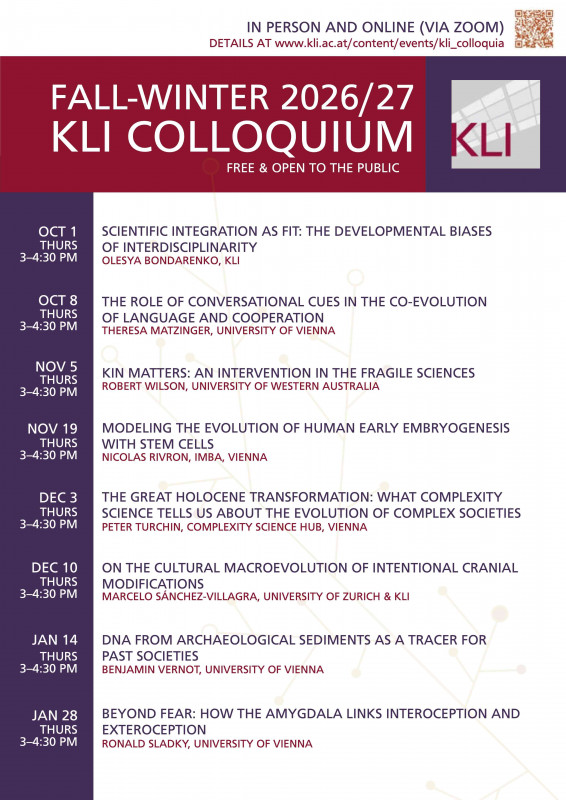
Scientific Integration as Fit: The Developmental Biases of Interdisciplinarity
Olesya BONDARENKO (KLI)
8 October 2026 (Thurs) 3-4:30 PM CET
The Role of Conversational Cues in the Co-Evolution of Language and Cooperation
Theresa MATZINGER (University of Vienna)
5 November 2026 (Thurs) 3-4:30 PM CET
Kin Matters: An Intervention in the Fragile Sciences
Robert A. WILSON (University of Western Australia)
19 November 2026 (Thurs) 3-4:30 PM CET
Modeling the Evolution of Human Early Embryogenesis with Stem Cells
Nicolas RIVRON (Institute of Molecular Biotechnology/IMBA, Vienna)
3 December 2026 (Thurs) 3-4:30 PM CET
Peter TURCHIN (Complexity Science Hub, Vienna)
10 December 2026 (Thurs) 3-4:30 PM CET
On the Cultural Macroevolution of Intentional Cranial Modifications
Marcelo SÁNCHEZ-VILLAGRA (University of Zurich)
14 January 2027 (Thurs) 3-4:30 PM CET
DNA from Archaeological Sediments as a Tracer for Past Societies
Benjamin VERNOT (University of Vienna)
28 January 2027 (Thurs) 3-4:30 PM CET
Beyond Fear: How the Amygdala Links Interoception and Exteroception
Ronald SLADKY (University of Vienna)
KLI Colloquia 2014 – 2026
Event Details

IN-PERSON EVENT!
PARTICIPATION VIA ZOOM IS NOT POSSIBLE!
Topic description / abstract:
Both health promotion research (HPR) and transdisciplinary sustainability research (TSR) are research fields that address grand societal challenges that affect not only the health of humans but also the natural life-support systems on earth on which we all depend. Further, both fields highlight the intertwining of health and environment at the center of these societal challenges. This leads to a mandate for science to not only better understand the interconnectedness of health and environment in various contexts at local, national and global levels, but also to develop and implement viable fair solution options at an increased pace to support fundamental transformations at the individual and societal level. In response to these demands, HPR and TSR have developed largely in parallel over the past more recently decades, without a more intensive exchange with regard to research objects, ethical and epistemological foundations. In my talk I aim to contribute to bridging HPR and TSR. In the first part, I will briefly introduce the historical roots of HPR. I will also present more recently developed key characteristics of HPR and compare them with some key characteristics of TSR. And then I will show some preliminary thoughts developed in the tdAcademy Fellow group "Transdisciplinary Research and its Scientific Impact" on the interconnection of health and environment. In the second part, I will engage with the participants more actively and conduct a moderated interactive group exchange based on selected key questions related to the topics presented.
Biographical note:
Jana Semrau is research Associate at the Friedrich-Alexander-Universität (FAU) Erlangen-Nürnberg, Department of Sport Science and Sport (DSS), Germany. Jana‘s research focuses on the sustainable implementation and scaling up of population-based health promotion interventions in local communities with a specific focus on health equity. Her current work is located at the intersection of health promotion science and practice related to the nationwide implementation of the German Prevention Act in local communities.Jana coproduces her work in collaboration with transdisciplinary groups consisting of actors from research, politics, and practice as well as with citizens.
