

KLI Colloquia are invited research talks of about an hour followed by 30 min discussion. The talks are held in English, open to the public, and offered in hybrid format.
Join via Zoom:
https://us02web.zoom.us/j/5881861923?omn=85945744831
Meeting ID: 588 186 1923
Fall-Winter 2026/27 KLI Colloquium Series
1 October 2026 (Thurs) 3-4:30 PM CET 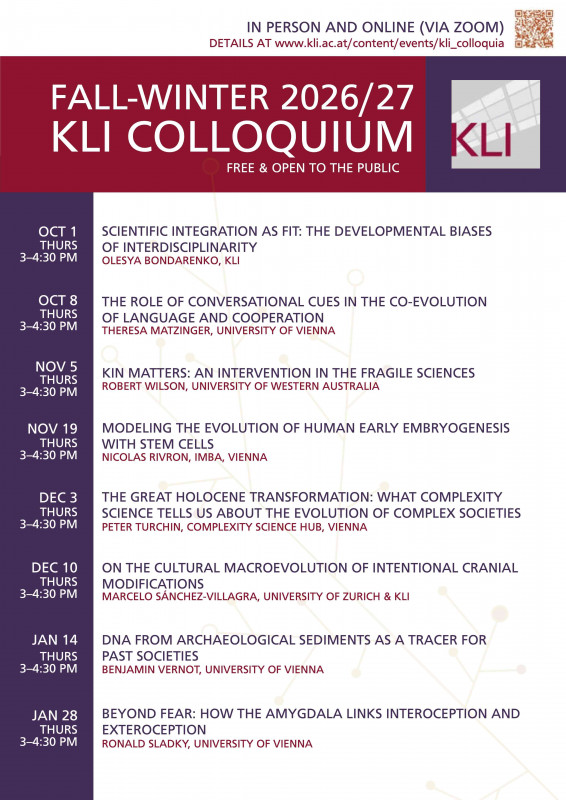
Scientific Integration as Fit: The Developmental Biases of Interdisciplinarity
Olesya BONDARENKO (KLI)
8 October 2026 (Thurs) 3-4:30 PM CET
The Role of Conversational Cues in the Co-Evolution of Language and Cooperation
Theresa MATZINGER (University of Vienna)
5 November 2026 (Thurs) 3-4:30 PM CET
Kin Matters: An Intervention in the Fragile Sciences
Robert A. WILSON (University of Western Australia)
19 November 2026 (Thurs) 3-4:30 PM CET
Modeling the Evolution of Human Early Embryogenesis with Stem Cells
Nicolas RIVRON (Institute of Molecular Biotechnology/IMBA, Vienna)
3 December 2026 (Thurs) 3-4:30 PM CET
Peter TURCHIN (Complexity Science Hub, Vienna)
10 December 2026 (Thurs) 3-4:30 PM CET
On the Cultural Macroevolution of Intentional Cranial Modifications
Marcelo SÁNCHEZ-VILLAGRA (University of Zurich)
14 January 2027 (Thurs) 3-4:30 PM CET
DNA from Archaeological Sediments as a Tracer for Past Societies
Benjamin VERNOT (University of Vienna)
28 January 2027 (Thurs) 3-4:30 PM CET
Beyond Fear: How the Amygdala Links Interoception and Exteroception
Ronald SLADKY (University of Vienna)
KLI Colloquia 2014 – 2026
Event Details

Join Zoom Meeting
https://us06web.zoom.us/j/89150023508?pwd=ETrhb8WIAwSVemo0cbfLkSp3OP8X3I.1
Topic description / abstract
Growing body of literature in the fields of sustainability science, critical social sciences and philosophy of science evidences that researchers are facing multiple challenges in knowledge co-production processes in inter- and transdisciplinary research. These challenges are normative and have ethical, political and epistemological implications (Caniglia et al. 2023, Nagatsu et al., 2020). Recent work particularly suggests that knowledge co-production risks reproducing injustices if no concepts and methodologies are in place to reflect upon its ethical-political dimensions (West et al. 2022).
Although conceptual resources and novel methodologies along with empirical work have been increasingly developed in the last decade to address these concerns (Chambers et al. 2022, Lang et al. 2012), the question of how to navigate ethical, political and epistemological problems often simultaneously faced is still largely underexplored.
In this talk, I will focus on how we as, as researchers, can recognise and explicitly address not only epistemological but also ethical-political dimensions of knowledge co-production in inter- and transdisciplinary sustainability research. I will introduce approaches that can help to enhance researchers’ capacity to incorporate ethics and justice-related concepts and principles into research practices to ensure more equitable collaborative processes and outcomes.
To illustrate how some of these approaches function in practice, I will present a ‘justice lens’ developed and applied in a Horizon Europe project PLUS Change. This transdisciplinary project engages research and practice partners in 12 European regions. Having a strong equity and justice orientation, the project aims to shape more equitable collaborative processes and outcomes in the context of land use planning. I will demonstrate how the justice lens as a conceptual and practical framework can help to build partners’ capacity to navigate critical justice situations and to meaningfully engage with the ethical-political dimensions of knowledge co-production.
Biographical note:
Dr Marina Knickel is a social scientist working on and with inter- and transdisciplinary approaches in agri-food and land use change research. Her research activities lie at the intersection of transdisciplinary sustainability research, social sciences & humanities, and innovation studies. In her work, she is particularly interested in strengthening interdisciplinary research and science-society collaborations by focusing on learning and reflexivity for actors’ capacity-building, knowledge integration processes and epistemic justice. Marina’s main area of expertise is fostering knowledge co-production processes in transdisciplinary collaborations aiming at transformative outcomes in the areas of agri-food and land use planning.
Marina’s research experience includes work in multiple EU-funded research projects on a range of sustainability topics such as food systems, agri-food innovation, climate change adaptation and land use planning – both in the rural and urban context. In these projects she has conducted theoretical and empirical research, using qualitative research methodologies in the latter. During her research career, Marina has studied and worked in different academic and research institutions in Italy, Austria, Germany, Portugal, the Netherlands, Latvia and China. She has completed her PhD at the University of Pisa (Italy) on collaboration and co-learning in transdisciplinary innovation-oriented research.
