Events

KLI Colloquia are invited research talks of about an hour followed by 30 min discussion. The talks are held in English, open to the public, and offered in hybrid format. 

Join via Zoom:
https://us02web.zoom.us/j/5881861923?omn=85945744831
Meeting ID: 588 186 1923

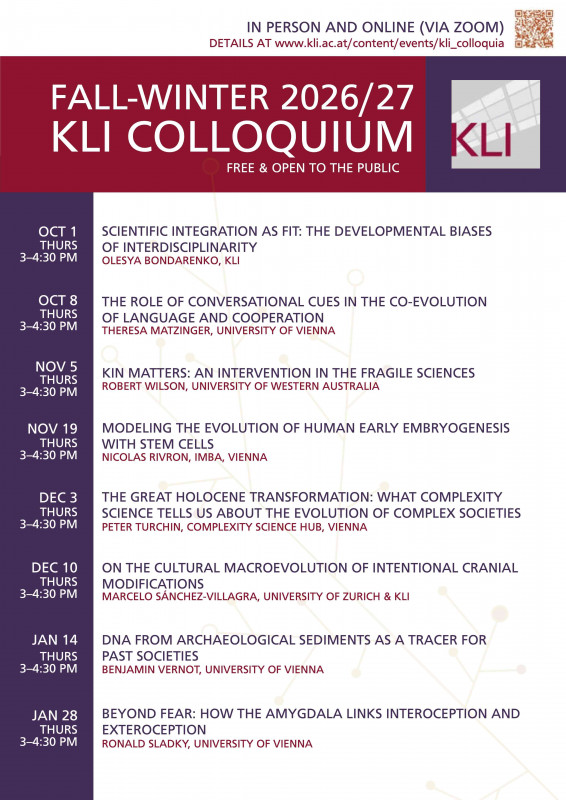
Spring-Summer 2026 KLI Colloquium Series

12 March 2026 (Thurs) 3-4:30 PM CET

What Is Biological Modality, and What Has It Got to Do With Psychology?

Carrie Figdor (University of Iowa)


26 March 2026 (Thurs) 3-4:30 PM CET

The Science of an Evolutionary Transition in Humans

Tim Waring (University of Maine)


9 April 2026 (Thurs) 3-4:30 PM CET

Hierarchies and Power in Primatology and Their Populist Appropriation

Rebekka Hufendiek (Ulm University)


16 April 2026 (Thurs) 3-4:30 PM CET

A Metaphysics for Dialectical Biology

Denis Walsh (University of Toronto)


30 April 2026 (Thurs) 3-4:30 PM CET

What's in a Trait? Reconceptualizing Neurodevelopmental Timing by Seizing Insights From Philosophy

Isabella Sarto-Jackson (KLI)


7 May 2026 (Thurs) 3-4:30 PM CET

The Evolutionary Trajectory of Human Hippocampal-Cortical Interactions

Daniel Reznik (Max Planck Society)


21 May 2026 (Thurs) 3-4:30 PM CET

Why Directionality Emerged in Multicellular Differentiation

Somya Mani (KLI)


28 May 2026 (Thurs) 3-4:30 PM CET

The Interplay of Tissue Mechanics and Gene Regulatory Networks in the Evolution of Morphogenesis

James DiFrisco (Francis Crick Institute)


11 June 2026 (Thurs) 3-4:30 PM CET

Brave Genomes: Genome Plasticity in the Face of Environmental Challenge

Silvia Bulgheresi (University of Vienna)


25 June 2026 (Thurs) 3-4:30 PM CET

The Evolvability of the Mammalian Ear: From Microevolutionary Variation to Macroevolutionary Patterns

Anne LeMaitre (KLI)


KLI Colloquia 2014 – 2026

Event Details

Corey Bunce
KLI Colloquia
Narrative Discourse and the Process of Science
Corey BUNCE (KLI, Klosterneuburg)
2024-05-23 15:00 - 2024-05-23 17:00
KLI
Organized by KLI
You are invited to a Zoom meeting. 
When: May 23, 2024 03:00 PM Vienna 
Register in advance for this meeting:
After registering, you will receive a confirmation email containing information about joining the meeting.
 
 
Topic description / abstract:
 
Modern biology is a primarily discursive endeavor. Researchers acquire and contribute the majority of their knowledge of biological systems through communication with other researchers in the form of scientific discussions, research articles, and presentations. Within these forms, different fields are prone to favor different modes of discourse. In developmental biology, for instance, both the norms of research reporting and the primary goal of characterizing and explicating developmental processes necessitates that communication between researchers often invokes the basic structure of narrative. Narrative, as a mode of discourse, presents certain constraints and affordances which can influence practice and progress in the field. Ongoing calls which argue that scientists should embrace storytelling as an effective tool for communicating complex ideas in understandable and memorable ways appeal to the affordances of narrative. However, simultaneously there are calls for biologists to reexamine the problematic ways that narratives can oversimplify reality, distort perspectives, and bias understanding. This results in significant tension around the use and value of narrative in science. In order to illuminate the complexities of using narrative and best inform scientific practice, I turn to the disciplines of Literary Studies and Narratology. When reformulating the discursive challenges researchers face in terms of these fields, I find that literary theory and semiotics can offer practical solutions. As a first example, I look at the scientific report and construe the scientific method as a narrative in order to show how current practices balance factuality across discourse levels. In a second example, I look to the field of sex development, where researchers are interested in disrupting narrative norms which have problematically shaped the understanding of developmental processes. These examples show how literary ideas can contribute practical insights to the study of scientific practices and scientific training.
 
Biographical note:

Corey Bunce is a biologist with a broad range of interests across development, evolution, systems biology, and philosophy of biology. He obtained a Master's degree in Cell and Developmental Biology from the University of Connecticut where he specialized in symbiosis and studied developmental regulation in hydrothermal vent tubeworms. He completed his Ph.D. in Cell Biology at Duke University where his research investigated the spatiotemporal dynamics of mouse gonad development and sex determination. At the KLI, Corey will explore the discursive side of science, hoping to bridge biological research practices and literary theory.