
KLI Colloquia are invited research talks of about an hour followed by 30 min discussion. The talks are held in English, open to the public, and offered in hybrid format.
Join via Zoom:
https://us02web.zoom.us/j/5881861923?omn=85945744831
Meeting ID: 588 186 1923
Fall-Winter 2026/27 KLI Colloquium Series
1 October 2026 (Thurs) 3-4:30 PM CET 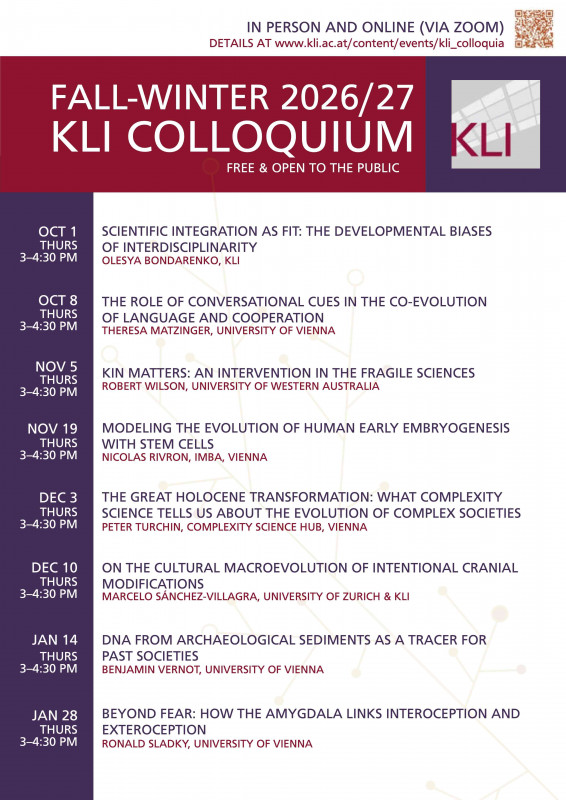
Scientific Integration as Fit: The Developmental Biases of Interdisciplinarity
Olesya BONDARENKO (KLI)
8 October 2026 (Thurs) 3-4:30 PM CET
The Role of Conversational Cues in the Co-Evolution of Language and Cooperation
Theresa MATZINGER (University of Vienna)
5 November 2026 (Thurs) 3-4:30 PM CET
Kin Matters: An Intervention in the Fragile Sciences
Robert A. WILSON (University of Western Australia)
19 November 2026 (Thurs) 3-4:30 PM CET
Modeling the Evolution of Human Early Embryogenesis with Stem Cells
Nicolas RIVRON (Institute of Molecular Biotechnology/IMBA, Vienna)
3 December 2026 (Thurs) 3-4:30 PM CET
Peter TURCHIN (Complexity Science Hub, Vienna)
10 December 2026 (Thurs) 3-4:30 PM CET
On the Cultural Macroevolution of Intentional Cranial Modifications
Marcelo SÁNCHEZ-VILLAGRA (University of Zurich)
14 January 2027 (Thurs) 3-4:30 PM CET
DNA from Archaeological Sediments as a Tracer for Past Societies
Benjamin VERNOT (University of Vienna)
28 January 2027 (Thurs) 3-4:30 PM CET
Beyond Fear: How the Amygdala Links Interoception and Exteroception
Ronald SLADKY (University of Vienna)
KLI Colloquia 2014 – 2026
Event Details

To join the KLI Colloquia via Zoom:
https://us02web.zoom.us/j/86548837670?pwd=AWm1v389npLyoJD5e01a9rjMXD7FP6.1
Meeting ID: 865 4883 7670
Passcode: 342640
Topic description / abstract:
This talk will present an interpretation of the evolution of multicellular organisms based on physical inherencies of cell aggregates and the conserved, intrinsic functionalities of cells. Focusing on the metazoans, it will describe how morphological motifs across all animal phyla – tissue layers and cavities, segments, appendages – are attractor states in morphospaces of cell clusters that arose with the appearance of clade-specific toolkit molecules such as classical cadherins, Wnt, and Notch. Further, the emergence of evolutionarily optional functionally differentiated cells and organs in the animals – e.g., muscle, liver, kidney – is based on partitioning and amplification of life-sustaining processes that at the cellular level are obligatory. This is accomplished by chromatin-based, enhancer-dependent gene co-expression machinery unique to metazoans. In contrast to the gradual generation of novel forms and functions postulated by adaptationist population biological models, this newer perspective suggests that novelties arising from these material and cellular inherencies come to characterize evolutionary lineages by serving as enablements for new kinds of organismal agency. This faculty, which pertains to all living systems, is the basis of niche selection and other creative capabilities that led Richard Lewontin to speak of the organism as subject, not just object, of evolution.
Biosketch:
Stuart A. Newman is a professor of cell biology and anatomy at New York Medical College, Valhalla, New York and a member of the External Faculty of the Konrad Lorenz Institute (KLI). His early scientific training was in chemistry, but he then moved into biology, both theoretical and experimental. He has contributed to several fields, including biophysical chemistry, embryonic morphogenesis, and evolutionary theory. His theoretical work includes a mechanism for patterning of the vertebrate limb skeleton based on the physics of self-organizing systems, and a physico-genetic framework for understanding the origination of animal body plans. His experimental work includes the characterization of the biophysical process of matrix-driven cell translocation and evidence for thermogenesis-related gene loss in the origin of birds. Newman has also written on ethical and societal issues related to research in developmental biology and was a founding member the Council for Responsible Genetics (Cambridge, Mass.). He has been a visiting scientist at the Institut Pasteur, Paris, Monash University, Melbourne, Australia, the University of Tokyo, Komaba, Japan. He is editor of the KLI’s journal Biological Theory.
