

KLI Colloquia are invited research talks of about an hour followed by 30 min discussion. The talks are held in English, open to the public, and offered in hybrid format.
Join via Zoom:
https://us02web.zoom.us/j/5881861923?omn=85945744831
Meeting ID: 588 186 1923
Fall-Winter 2026/27 KLI Colloquium Series
1 October 2026 (Thurs) 3-4:30 PM CET 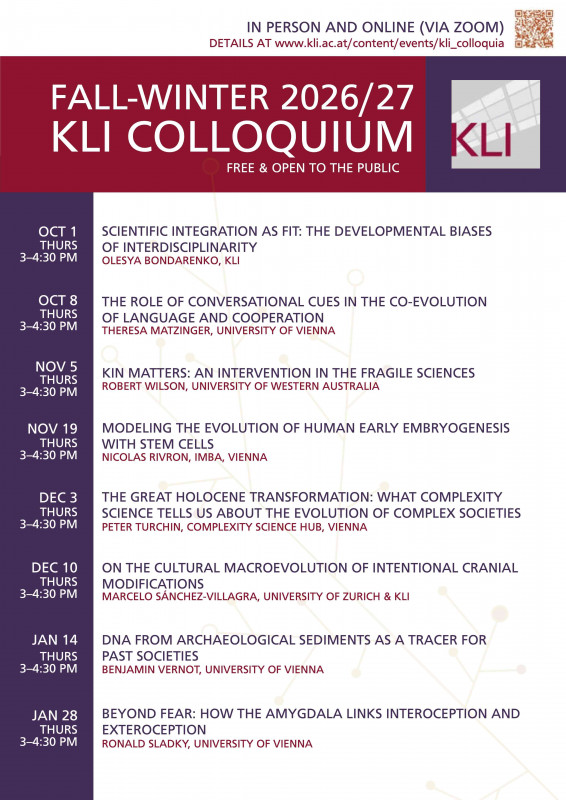
Scientific Integration as Fit: The Developmental Biases of Interdisciplinarity
Olesya BONDARENKO (KLI)
8 October 2026 (Thurs) 3-4:30 PM CET
The Role of Conversational Cues in the Co-Evolution of Language and Cooperation
Theresa MATZINGER (University of Vienna)
5 November 2026 (Thurs) 3-4:30 PM CET
Kin Matters: An Intervention in the Fragile Sciences
Robert A. WILSON (University of Western Australia)
19 November 2026 (Thurs) 3-4:30 PM CET
Modeling the Evolution of Human Early Embryogenesis with Stem Cells
Nicolas RIVRON (Institute of Molecular Biotechnology/IMBA, Vienna)
3 December 2026 (Thurs) 3-4:30 PM CET
Peter TURCHIN (Complexity Science Hub, Vienna)
10 December 2026 (Thurs) 3-4:30 PM CET
On the Cultural Macroevolution of Intentional Cranial Modifications
Marcelo SÁNCHEZ-VILLAGRA (University of Zurich)
14 January 2027 (Thurs) 3-4:30 PM CET
DNA from Archaeological Sediments as a Tracer for Past Societies
Benjamin VERNOT (University of Vienna)
28 January 2027 (Thurs) 3-4:30 PM CET
Beyond Fear: How the Amygdala Links Interoception and Exteroception
Ronald SLADKY (University of Vienna)
KLI Colloquia 2014 – 2026
Event Details

To join the KLI Colloquia via Zoom:
https://us02web.zoom.us/j/86548837670?pwd=AWm1v389npLyoJD5e01a9rjMXD7FP6.1
Meeting ID: 865 4883 7670
Passcode: 342640
Topic description / abstract:
Rudolf Carnap spent much of the last 25 years of his career developing an inductive logic: a logic of reasoning from the known to the unknown that is derived from first principles and, at the same time, faithful to how scientists evaluate hypotheses and make predictions based on observations. In my talk, I will review what I take to be the main contribution of Carnap's inductive logic. I will then connect it to developments in Bayesian statistics, in particular probabilistic symmetries and invariance principles and developments in predictive inference, and suggest ways in which it can be enriched to supply a more comprehensive account of scientific inference. I will end with some philosophical reflections on the kind of model of scientific reasoning that inductive logic gives rise to.
Biographical note:
Simon Huttegger is a Chancellor's Professor of Logic and Philosophy of Science at the University of California Irvine (UCI). After having studied at the University of Salzburg, he spent two years as a postdoctoral fellow at the Konrad Lorenz Institute of Evolution and Cognition Research before moving to UCI. He has worked on game theory, decision theory, measurement in biology, the foundations of probability theory and inductive reasoning.
