

KLI Colloquia are invited research talks of about an hour followed by 30 min discussion. The talks are held in English, open to the public, and offered in hybrid format.
Join via Zoom:
https://us02web.zoom.us/j/5881861923?omn=85945744831
Meeting ID: 588 186 1923
Fall-Winter 2026/27 KLI Colloquium Series
1 October 2026 (Thurs) 3-4:30 PM CET 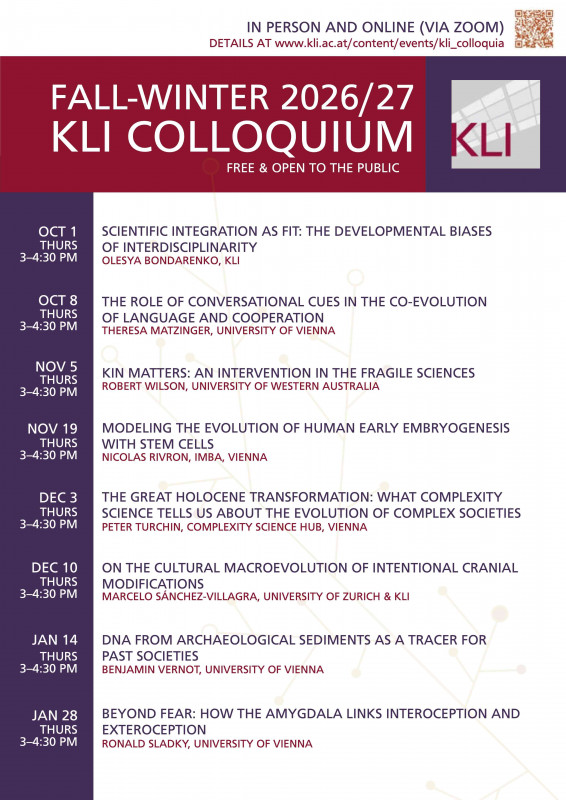
Scientific Integration as Fit: The Developmental Biases of Interdisciplinarity
Olesya BONDARENKO (KLI)
8 October 2026 (Thurs) 3-4:30 PM CET
The Role of Conversational Cues in the Co-Evolution of Language and Cooperation
Theresa MATZINGER (University of Vienna)
5 November 2026 (Thurs) 3-4:30 PM CET
Kin Matters: An Intervention in the Fragile Sciences
Robert A. WILSON (University of Western Australia)
19 November 2026 (Thurs) 3-4:30 PM CET
Modeling the Evolution of Human Early Embryogenesis with Stem Cells
Nicolas RIVRON (Institute of Molecular Biotechnology/IMBA, Vienna)
3 December 2026 (Thurs) 3-4:30 PM CET
Peter TURCHIN (Complexity Science Hub, Vienna)
10 December 2026 (Thurs) 3-4:30 PM CET
On the Cultural Macroevolution of Intentional Cranial Modifications
Marcelo SÁNCHEZ-VILLAGRA (University of Zurich)
14 January 2027 (Thurs) 3-4:30 PM CET
DNA from Archaeological Sediments as a Tracer for Past Societies
Benjamin VERNOT (University of Vienna)
28 January 2027 (Thurs) 3-4:30 PM CET
Beyond Fear: How the Amygdala Links Interoception and Exteroception
Ronald SLADKY (University of Vienna)
KLI Colloquia 2014 – 2026
Event Details

Join Zoom Meeting
https://us02web.zoom.us/j/5881861923?omn=85945744831
Meeting ID: 588 186 1923
Topic description / abstract:
The color patterns of butterflies and moths are a uniquely tractable experimental system because they are composed of an underlying series of homologous characters. Although significant progress has been made in identifying candidate genes associated with specific pattern homologs, the mechanisms responsible for determining the positioning of elements, and the overall structure of patterns remain more-or-less unknown. In this talk, I will discuss an ongoing project that aims to make preliminary progress on these fronts. More specifically, I will show how robust positioning rules and continuous variation in wing morphology can jointly contribute to changes in the overall structure of color patterns. An important implication of the proposed model is that physiological processes such as the growth, scaling, and allometry of the wing itself play an important role in the development and evolution of color patterns.
Biographical note:
Richard Gawne is an evolutionary developmental biologist working as Curator of Natural History at the Nevada State Museum - Las Vegas. His current projects are primarily focused on understanding the evolution and development of lepidopteran color patterns. This work involves the use of preserved museum specimens, as well as experimental and computational methods. In addition to this line of research, he has other longstanding interests in entomology, theoretical biology, the construction of automated experimental devices.
