
KLI Colloquia are invited research talks of about an hour followed by 30 min discussion. The talks are held in English, open to the public, and offered in hybrid format.
Join via Zoom:
https://us02web.zoom.us/j/5881861923?omn=85945744831
Meeting ID: 588 186 1923
Fall-Winter 2026/27 KLI Colloquium Series
1 October 2026 (Thurs) 3-4:30 PM CET 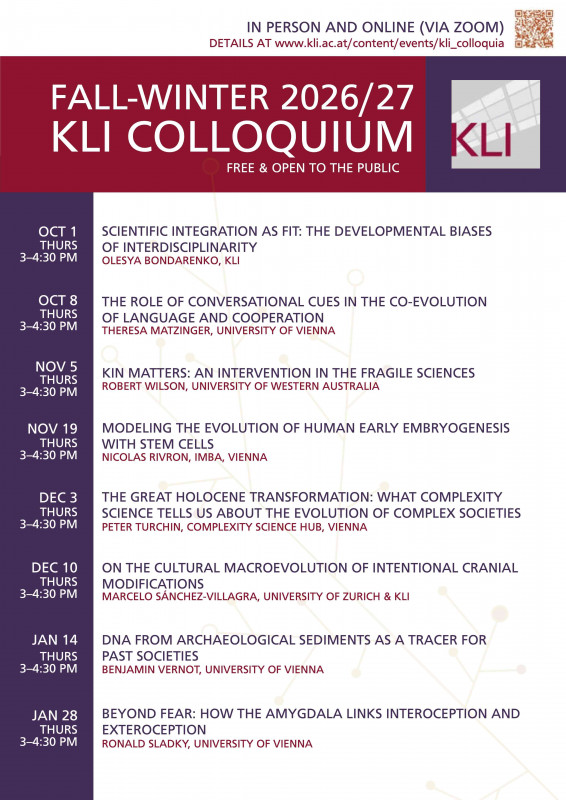
Scientific Integration as Fit: The Developmental Biases of Interdisciplinarity
Olesya BONDARENKO (KLI)
8 October 2026 (Thurs) 3-4:30 PM CET
The Role of Conversational Cues in the Co-Evolution of Language and Cooperation
Theresa MATZINGER (University of Vienna)
5 November 2026 (Thurs) 3-4:30 PM CET
Kin Matters: An Intervention in the Fragile Sciences
Robert A. WILSON (University of Western Australia)
19 November 2026 (Thurs) 3-4:30 PM CET
Modeling the Evolution of Human Early Embryogenesis with Stem Cells
Nicolas RIVRON (Institute of Molecular Biotechnology/IMBA, Vienna)
3 December 2026 (Thurs) 3-4:30 PM CET
Peter TURCHIN (Complexity Science Hub, Vienna)
10 December 2026 (Thurs) 3-4:30 PM CET
On the Cultural Macroevolution of Intentional Cranial Modifications
Marcelo SÁNCHEZ-VILLAGRA (University of Zurich)
14 January 2027 (Thurs) 3-4:30 PM CET
DNA from Archaeological Sediments as a Tracer for Past Societies
Benjamin VERNOT (University of Vienna)
28 January 2027 (Thurs) 3-4:30 PM CET
Beyond Fear: How the Amygdala Links Interoception and Exteroception
Ronald SLADKY (University of Vienna)
KLI Colloquia 2014 – 2026
Event Details
|
Topic description / abstract:
In this talk, I use the term "behavioral modernity" to refer to the establishment of a lifeway among our ancestors that was intuitively on par with that of ethnographically known hunter-gatherers. This notion is thus inherently inclusive of a wide range of human social, cognitive, and technological traits. I argue that the production and maintenance of larger and more diverse packages of common knowledge among various human social groups was a crucial driver of this transition. Here, "common knowledge" refers to information that is not just shared by a group of agents, but which is mutually known to be shared by those agents. I shall pay special attention to the role of material symbols in this process, focusing in particular on the essentially public and normative dimension of such symbols. With this increase in common knowledge came new and more complex opportunities for collaborative action, generating, in turn, additional forms of common knowledge, etc. The result was a common knowledge-collaborative action feedback loop that propelled our ancestors towards full-fledged behavioral modernity, I suggest.
Biographical note:
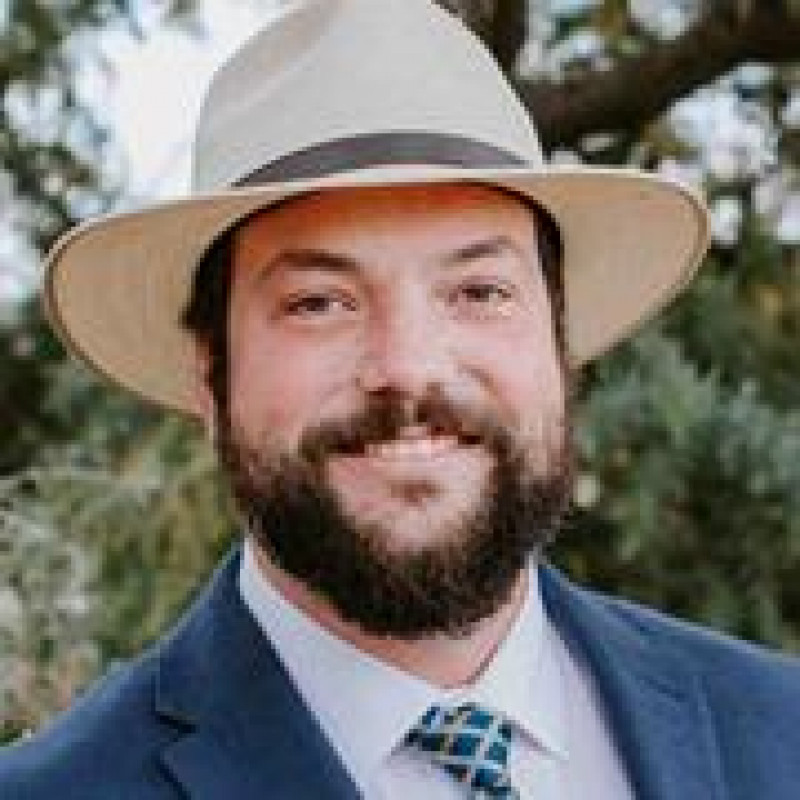
Ronald Planer obtained his PhD in Philosophy and Cognitive Science from Rutgers University, New Brunswick, in 2015. After that, he carried out post-doctoral research on the evolution of language at the Australian National University and the University of Melbourne. Currently, he is a Lecturer in the School of Liberal Arts at the University of Wollongong, where he also serves as Head of Post-Graduate Studies.
He researches a wide variety of topics relating to behavioral, social, and cognitive evolution, especially as regards humans, hominins, and other great apes. Though he is trained as a philosopher and cognitive scientist, he has developed broad competences across a range of fields and methodologies. These include evolutionary and developmental biology, archeology, anthropology, and linguistics.
He has published 30+ journal articles and an MIT Press book on the evolution of language (with Kim Sterelny). He was recently a Research Fellow at the Words, Bones, Genes, and Tools Center at the University of Tübingen and is currently a Visiting Fellow at the KLI. He maintains a rich global network of research connections with world-leading experts in human evolution, culture, and language.
