

KLI Colloquia are invited research talks of about an hour followed by 30 min discussion. The talks are held in English, open to the public, and offered in hybrid format.
Join via Zoom:
https://us02web.zoom.us/j/5881861923?omn=85945744831
Meeting ID: 588 186 1923
Fall-Winter 2026/27 KLI Colloquium Series
1 October 2026 (Thurs) 3-4:30 PM CET 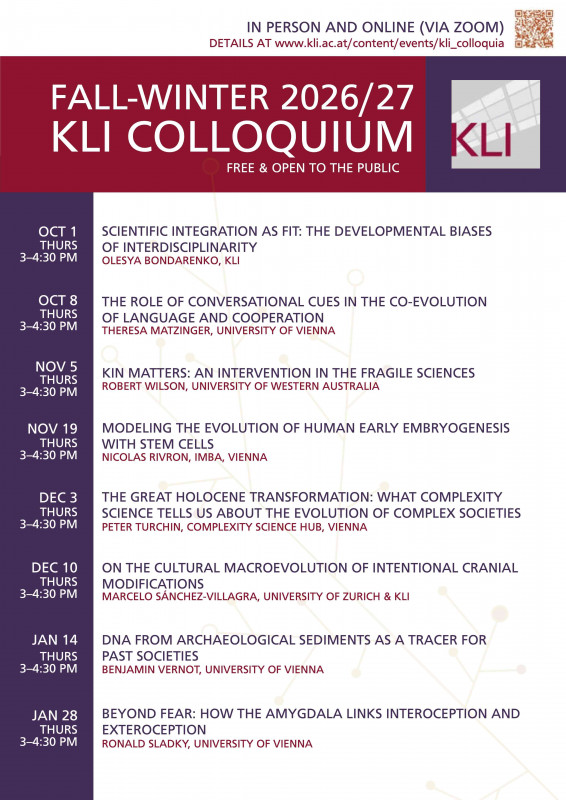
Scientific Integration as Fit: The Developmental Biases of Interdisciplinarity
Olesya BONDARENKO (KLI)
8 October 2026 (Thurs) 3-4:30 PM CET
The Role of Conversational Cues in the Co-Evolution of Language and Cooperation
Theresa MATZINGER (University of Vienna)
5 November 2026 (Thurs) 3-4:30 PM CET
Kin Matters: An Intervention in the Fragile Sciences
Robert A. WILSON (University of Western Australia)
19 November 2026 (Thurs) 3-4:30 PM CET
Modeling the Evolution of Human Early Embryogenesis with Stem Cells
Nicolas RIVRON (Institute of Molecular Biotechnology/IMBA, Vienna)
3 December 2026 (Thurs) 3-4:30 PM CET
Peter TURCHIN (Complexity Science Hub, Vienna)
10 December 2026 (Thurs) 3-4:30 PM CET
On the Cultural Macroevolution of Intentional Cranial Modifications
Marcelo SÁNCHEZ-VILLAGRA (University of Zurich)
14 January 2027 (Thurs) 3-4:30 PM CET
DNA from Archaeological Sediments as a Tracer for Past Societies
Benjamin VERNOT (University of Vienna)
28 January 2027 (Thurs) 3-4:30 PM CET
Beyond Fear: How the Amygdala Links Interoception and Exteroception
Ronald SLADKY (University of Vienna)
KLI Colloquia 2014 – 2026
Event Details

Join Zoom Meeting
https://us02web.zoom.us/j/5881861923?omn=85945744831
Meeting ID: 588 186 1923
Topic description / abstract:
Rates of evolution get smaller when they are measured over longer time intervals. As first shown by Gingerich, rates of morphological change measured from fossil time series show a robust minus-one scaling with time span, implying that evolutionary changes are just as large when measured over a hundred years as when measured over a hundred-thousand years. On even longer time scales, however, the scaling shifts toward a minus-half exponent consistent with evolution behaving as Brownian motion, as commonly observed in phylogenetic comparative studies. Here, I discuss how such scaling patterns arise, and I derive the patterns expected from standard stochastic models of evolution. I argue that observed shifts cannot be easily explained by simple univariate models, but require shifts in mode of evolution as time scale is changing. To illustrate this idea, I present a hypothesis about three distinct, but connected, modes of evolution. I analyze the scaling patterns predicted from this, and use the results to discuss how rates of evolution should be measured and interpreted. I argue that distinct modes of evolution at different time scales act to decouple micro- and macroevolution, and criticize various attempts at extrapolating from one to the other.
