
KLI Colloquia are invited research talks of about an hour followed by 30 min discussion. The talks are held in English, open to the public, and offered in hybrid format.
Join via Zoom:
https://us02web.zoom.us/j/5881861923?omn=85945744831
Meeting ID: 588 186 1923
Fall-Winter 2026/27 KLI Colloquium Series
1 October 2026 (Thurs) 3-4:30 PM CET 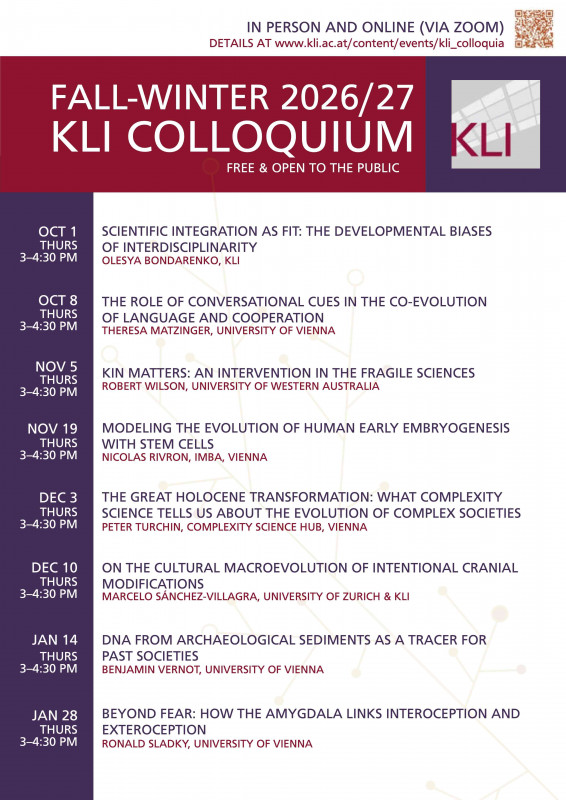
Scientific Integration as Fit: The Developmental Biases of Interdisciplinarity
Olesya BONDARENKO (KLI)
8 October 2026 (Thurs) 3-4:30 PM CET
The Role of Conversational Cues in the Co-Evolution of Language and Cooperation
Theresa MATZINGER (University of Vienna)
5 November 2026 (Thurs) 3-4:30 PM CET
Kin Matters: An Intervention in the Fragile Sciences
Robert A. WILSON (University of Western Australia)
19 November 2026 (Thurs) 3-4:30 PM CET
Modeling the Evolution of Human Early Embryogenesis with Stem Cells
Nicolas RIVRON (Institute of Molecular Biotechnology/IMBA, Vienna)
3 December 2026 (Thurs) 3-4:30 PM CET
Peter TURCHIN (Complexity Science Hub, Vienna)
10 December 2026 (Thurs) 3-4:30 PM CET
On the Cultural Macroevolution of Intentional Cranial Modifications
Marcelo SÁNCHEZ-VILLAGRA (University of Zurich)
14 January 2027 (Thurs) 3-4:30 PM CET
DNA from Archaeological Sediments as a Tracer for Past Societies
Benjamin VERNOT (University of Vienna)
28 January 2027 (Thurs) 3-4:30 PM CET
Beyond Fear: How the Amygdala Links Interoception and Exteroception
Ronald SLADKY (University of Vienna)
KLI Colloquia 2014 – 2026
Event Details

Join Zoom Meeting
https://us02web.zoom.us/j/5881861923?omn=85945744831
Meeting ID: 588 186 1923
Topic description / abstract:
Today, theoretical biology is often understood as a field that employs mathematical and computational methods to model biological processes with quantitative precision. However, this was not always the case. When theoretical biology first emerged as a distinct research program a century ago, it had a far more ambitious agenda: to critically examine the conceptual foundations of biology, resolve longstanding theoretical disputes, and achieve an epistemic unification of the life sciences. This early “philosophical” form of theoretical biology has since been largely forgotten, its significance overshadowed by the later dominance of mathematical approaches.
This paper traces the rise and fall of this original philosophical version of theoretical biology and the emergence of today’s mathematical version from the 1940s onwards. Therefore, it adopts a digital humanities methodology that analyzes a multilingual corpus of 55,000 journal articles, monographs, and book series on theoretical biology published between 1880 and 2020. This approach allows for an analysis of the thematic development of theoretical biology during the 20th century, paying particular attention to the field’s declining interest in philosophical disputes. Through this bibliometric approach, and by drawing on additional archival material, several questions are addressed: Which scholars, research communities, and thematic debates dominated theoretical biology in the early 20th century? What explains the break in the reception of philosophical frameworks and debates that coincided with a transition of the field toward more formal approaches in the mid-20th century? The paper closes with some general reflections on the changing understanding of “theory” in the field, as well as on the disciplinary identity and possible future developments of theoretical biology.
Biographical note:
Jan Baedke is Professor at the Department of Philosophy I, Ruhr University Bochum. His research interests include the history and philosophy of the life sciences (especially biology), and philosophical anthropology. Currently he is PI of the German Research Foundation (DFG) funded research group The Return of the Organism in the Biosciences: Theoretical, Historical, and Social Dimensions. It investigates the conceptual, methodological and anthropological challenges going along with the current comeback of the concept of organism in the bio- and biomedical sciences. The group combines philosophical, historical and sociological approaches to study biological individuality, agency, organism-environment boundaries, and the concept of environment. In mid-2026 he will start a new ERC project titled “Botanical Legacies: Towards a New History and Philosophy of Virtual Herbaria”. It links the history of local plant knowers with current digitation trends and global biodiversity issues.
