
KLI Colloquia are invited research talks of about an hour followed by 30 min discussion. The talks are held in English, open to the public, and offered in hybrid format.
Join via Zoom:
https://us02web.zoom.us/j/5881861923?omn=85945744831
Meeting ID: 588 186 1923
Fall-Winter 2026/27 KLI Colloquium Series
1 October 2026 (Thurs) 3-4:30 PM CET 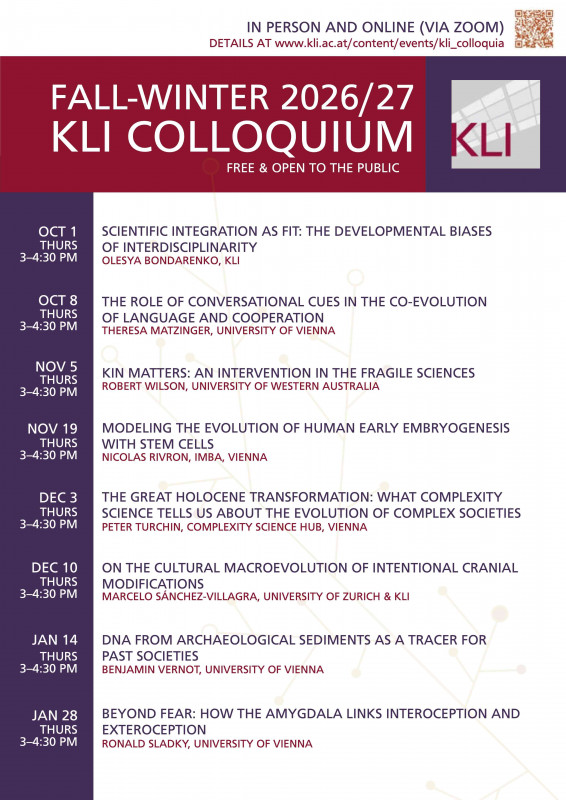
Scientific Integration as Fit: The Developmental Biases of Interdisciplinarity
Olesya BONDARENKO (KLI)
8 October 2026 (Thurs) 3-4:30 PM CET
The Role of Conversational Cues in the Co-Evolution of Language and Cooperation
Theresa MATZINGER (University of Vienna)
5 November 2026 (Thurs) 3-4:30 PM CET
Kin Matters: An Intervention in the Fragile Sciences
Robert A. WILSON (University of Western Australia)
19 November 2026 (Thurs) 3-4:30 PM CET
Modeling the Evolution of Human Early Embryogenesis with Stem Cells
Nicolas RIVRON (Institute of Molecular Biotechnology/IMBA, Vienna)
3 December 2026 (Thurs) 3-4:30 PM CET
Peter TURCHIN (Complexity Science Hub, Vienna)
10 December 2026 (Thurs) 3-4:30 PM CET
On the Cultural Macroevolution of Intentional Cranial Modifications
Marcelo SÁNCHEZ-VILLAGRA (University of Zurich)
14 January 2027 (Thurs) 3-4:30 PM CET
DNA from Archaeological Sediments as a Tracer for Past Societies
Benjamin VERNOT (University of Vienna)
28 January 2027 (Thurs) 3-4:30 PM CET
Beyond Fear: How the Amygdala Links Interoception and Exteroception
Ronald SLADKY (University of Vienna)
KLI Colloquia 2014 – 2026
Event Details
Join via Zoom:
https://us02web.zoom.us/j/5881861923?omn=85945744831
Meeting ID: 588 186 1923
Topic description / abstract
Over the course of forty years or more Richard Levins and Richard Lewontin repeatedly and steadfastly advocated for a ‘dialectical biology’. The defining characteristic of dialectical biology is its emphasis on ‘interpenetration’—of part and whole, organism and environment, cause and effect, subject and object—in contradistinction to the ‘alienation’ between these dyads that Levins and Lewontin perceive to be a consequence of conventional mechanism. While Levins and Lewontin explicitly lay out the precepts of dialectical biology, they say little about what the biological world must be like in order for this methodology to be the appropriate way to study it. As a way of filling this gap, I argue that organisms are ecological agents. As such they encounter the world from a perspective. This perspective inaugurates a new realm of facts, neither subjective nor objective, but ‘constitutively perspectival’. I argue that the ‘constitutively perspectival’ is what Levins and Lewontin mean by ‘interpenetration’. It is this crucial feature of biological systems that is opaque to conventional mechanism and uniquely accommodated by the methods of dialectical biology. Ecological agency thus provides a metaphysics for dialectical biology.
Biographical note
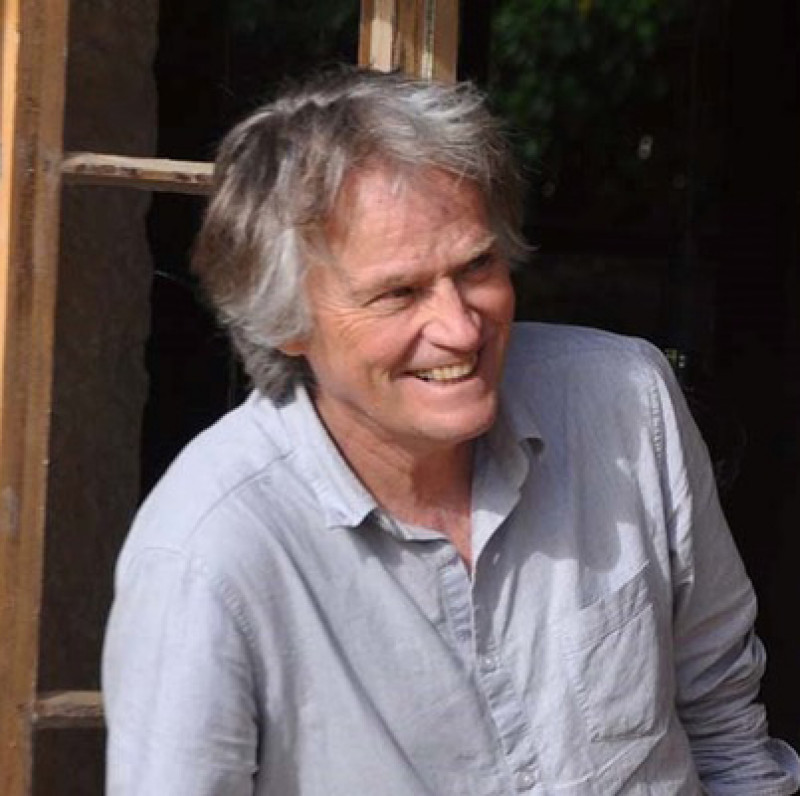
I am a philosopher of science, primarily of biology, working at the University of Toronto. I received a PhD in evolutionary biology from McGill University in Montreal, and a PhD in Philosophy from Kings College London. Over the years I have worked extensively on the nature of explanation in biology. I formulated and defended what became known as the „statistical interpretation“ of population dynamics models. I have worked extensively on the understanding of naturalised teleology and its role in evolutionary biology. Since 2012, I have been researching the concept of agency as it applies to evolutionary biology. In particular, I have articulated and defended the „ecological account“ of agency. In 2015 I published Organisms, Agency, and Evolution (Cambridge University Press), (a significant part of which was written while on various visits to KLI). In 2018-2019 I was fellow at the Institute for Advance Study, Paris (and FMSH). I have taught at LSE, University of Edinburgh, Dartmouth College, MIT, and University of Toronto..
