

KLI Colloquia are invited research talks of about an hour followed by 30 min discussion. The talks are held in English, open to the public, and offered in hybrid format.
Join via Zoom:
https://us02web.zoom.us/j/5881861923?omn=85945744831
Meeting ID: 588 186 1923
Fall-Winter 2026/27 KLI Colloquium Series
1 October 2026 (Thurs) 3-4:30 PM CET 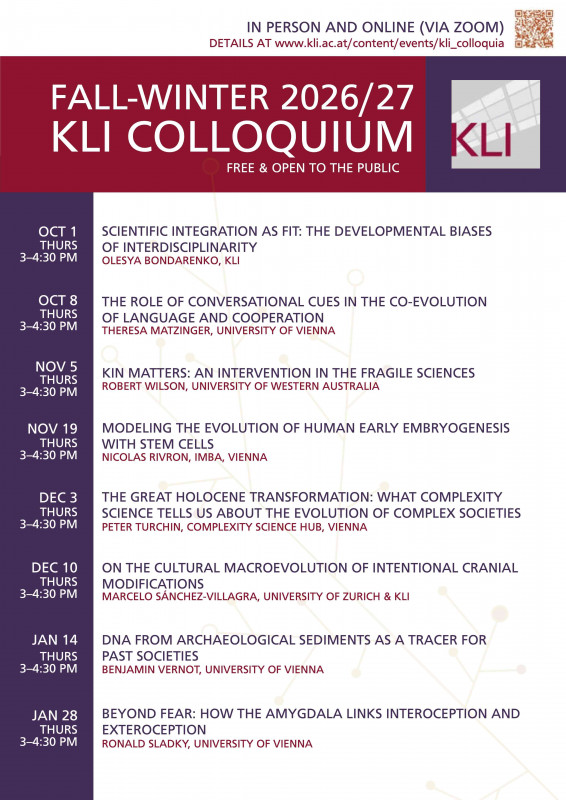
Scientific Integration as Fit: The Developmental Biases of Interdisciplinarity
Olesya BONDARENKO (KLI)
8 October 2026 (Thurs) 3-4:30 PM CET
The Role of Conversational Cues in the Co-Evolution of Language and Cooperation
Theresa MATZINGER (University of Vienna)
5 November 2026 (Thurs) 3-4:30 PM CET
Kin Matters: An Intervention in the Fragile Sciences
Robert A. WILSON (University of Western Australia)
19 November 2026 (Thurs) 3-4:30 PM CET
Modeling the Evolution of Human Early Embryogenesis with Stem Cells
Nicolas RIVRON (Institute of Molecular Biotechnology/IMBA, Vienna)
3 December 2026 (Thurs) 3-4:30 PM CET
Peter TURCHIN (Complexity Science Hub, Vienna)
10 December 2026 (Thurs) 3-4:30 PM CET
On the Cultural Macroevolution of Intentional Cranial Modifications
Marcelo SÁNCHEZ-VILLAGRA (University of Zurich)
14 January 2027 (Thurs) 3-4:30 PM CET
DNA from Archaeological Sediments as a Tracer for Past Societies
Benjamin VERNOT (University of Vienna)
28 January 2027 (Thurs) 3-4:30 PM CET
Beyond Fear: How the Amygdala Links Interoception and Exteroception
Ronald SLADKY (University of Vienna)
KLI Colloquia 2014 – 2026
Event Details

Join via Zoom:
https://us02web.zoom.us/j/5881861923?omn=85945744831
Meeting ID: 588 186 1923
Topic description / abstract
Multicellular development is the process that brings about the expression of different cell-types at the right time, right place and the right numbers in the developing organism. A crucial aspect of developmental evolution is the evolution of cell-type repertoires along different multicellular lineages. Especially, animal evolution is marked by inventions of novel, lineage specific cell-types and the subsequent diversification of these cell-types. In the proposed project, I will explore the mechanism of cell-type evolution. In particular, I ask whether new genes are necessary for cell-type diversification.Expressed differently, I ask about the organizational level at which cell-type identity is encoded: Is the evolution of novel cell-types always caused by novel genes, or do new cell-types also arise through rewiring of existing gene regulatory complexity?
Both sides of this debate are supported by empirical evidence: On the one hand, well known cases of novel cell-type evolution are associated with new genes, for example, the evolution of Cnidarian stinging cells involved the duplication of a transcription factor gene. At the same time, animal origins are also marked by significant elaboration of gene regulatory mechanisms, which supports the view that animal cell-type diversification does not necessarily require evolution of new genes. However, we lack specific examples of cell-types whose evolution did not involve new genes. A major roadblock impeding the resolution of this question is that most ideas on the subject rely on broad, macroevolutionary trends, and there are very few studies focussed on evolutionary trajectories of specific cell-types.
In this project, I will address this problem directly through comparing genome evolutionary patterns against cell-type diversification among Cnidarian species. Cnidarians are early branching animals and are important model organisms for developmental evolution. I will use single cell RNA sequencing data, which is freely available for multiple Cnidarian species, to compare their cell-type repertoires and study the importance of species-specific gene duplicates in cell-type diversification. Overall, this project bridges evolution at two levels of biological organization: genome evolution and cell-type evolution. The results of this work will shed light on the important ongoing debate around the necessity of the evolution of new genes for innovations at the cell-type level.
Biographical note
I am a theoretical biologist, and I study evolutionary transitions and novelties in biology. I apply theories and techniques from physics and mathematics (especially graph theory and statistics) to formulate models of biological systems and understand principles of their evolution. I moved from experimental molecular biology towards more theoretical approaches to biological problems during my Masters. In my PhD, I studied the evolution of intracel-lular transport, which is a crucial aspect of the origin of eukaryotes. During my postdoc in South Korea, I built Boolean models to study the evolution of development and mul-ticellularity, and delved into studying the de novo origin of genes. In my current position at the KLI, in collaboration with scientists at the University of Vienna and at IST-A, I continue to explore questions around multicellular evolution: I use both theoretical as well as empirical approaches to understanding why multicellular development evolved to be directional. I also focus on tying together hypotheses and predictions from my theoretical work with empirical and experimental observations on the topic of cell-type evolution.
