

KLI Colloquia are invited research talks of about an hour followed by 30 min discussion. The talks are held in English, open to the public, and offered in hybrid format.
Join via Zoom:
https://us02web.zoom.us/j/5881861923?omn=85945744831
Meeting ID: 588 186 1923
Fall-Winter 2026/27 KLI Colloquium Series
1 October 2026 (Thurs) 3-4:30 PM CET 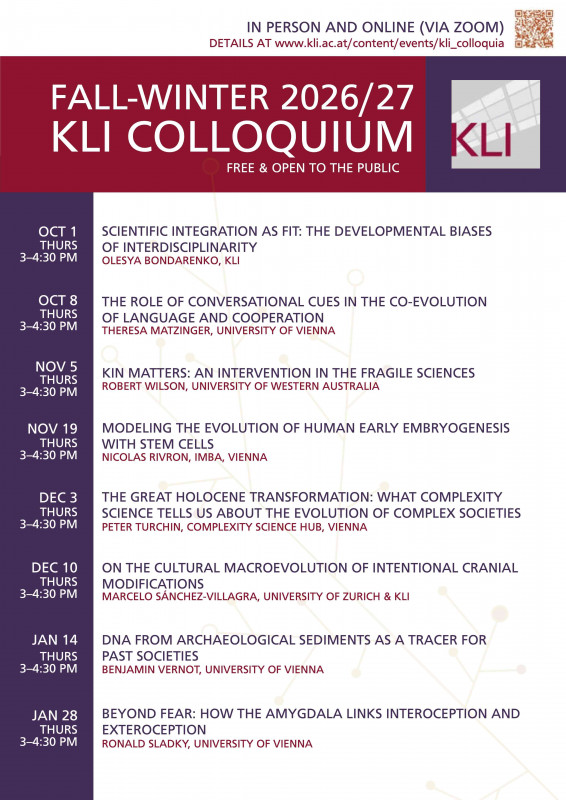
Scientific Integration as Fit: The Developmental Biases of Interdisciplinarity
Olesya BONDARENKO (KLI)
8 October 2026 (Thurs) 3-4:30 PM CET
The Role of Conversational Cues in the Co-Evolution of Language and Cooperation
Theresa MATZINGER (University of Vienna)
5 November 2026 (Thurs) 3-4:30 PM CET
Kin Matters: An Intervention in the Fragile Sciences
Robert A. WILSON (University of Western Australia)
19 November 2026 (Thurs) 3-4:30 PM CET
Modeling the Evolution of Human Early Embryogenesis with Stem Cells
Nicolas RIVRON (Institute of Molecular Biotechnology/IMBA, Vienna)
3 December 2026 (Thurs) 3-4:30 PM CET
Peter TURCHIN (Complexity Science Hub, Vienna)
10 December 2026 (Thurs) 3-4:30 PM CET
On the Cultural Macroevolution of Intentional Cranial Modifications
Marcelo SÁNCHEZ-VILLAGRA (University of Zurich)
14 January 2027 (Thurs) 3-4:30 PM CET
DNA from Archaeological Sediments as a Tracer for Past Societies
Benjamin VERNOT (University of Vienna)
28 January 2027 (Thurs) 3-4:30 PM CET
Beyond Fear: How the Amygdala Links Interoception and Exteroception
Ronald SLADKY (University of Vienna)
KLI Colloquia 2014 – 2026
Event Details
Join via Zoom:
https://us02web.zoom.us/j/5881861923?omn=85945744831
Meeting ID: 588 186 1923
Topic description / abstract:
The role of environmentally triggered genetic and epigenetic changes in microbial adaptation and evolution is still not broadly appreciated. The recently published book Brave Genomes narrates how organisms cope with environmental changes including unanticipated ones. Although it does comprise eukaryotes, it focuses on bacteria and – whenever possible – on archaea. Among the environmentally sensitive sources of genome plasticity, the book treats tandem repeats, mutagenic break repair, transcription-associated mutagenesis and transposable elements. As key regulators of genome plasticity, the book also deals with epigenetic mechanisms such as DNA methylation and regulatory RNA-based systems. In closing, symbiosis and genetic noise are also discussed as possible sources of phenotypic plasticity. Brave Genomes underscores the role of the environment in generating genotypic and phenotypic diversity. This emerges, in turn, as the most efficient response to challenging conditions.
Biographical note:
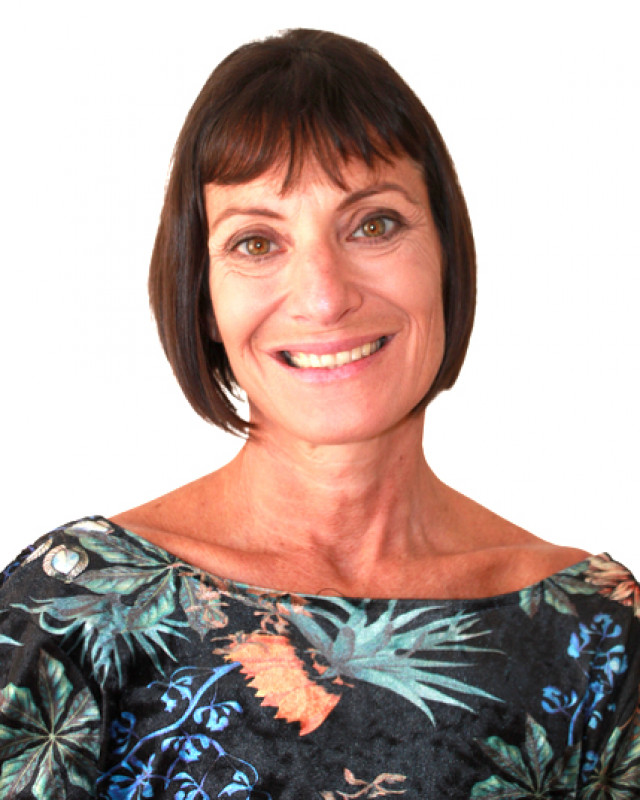
Silvia Bulgheresi is Associate Professor in Environmental Cell Biology and independent researcher at the University of Vienna. Her research on the molecular mechanisms underlying symbiont growth, division and chromosome segregation challenged long-established cell biology tenets. Since 2008, she has been teaching environmental cell biology, microbial symbioses, as well as microbial genome plasticity to Bachelor, Master ad PhD students. It is in the effort of collecting the notes, thoughts and students’ questions that arose during numerous microbial genome plasticity lectures that this book was born.
