
KLI Colloquia are invited research talks of about an hour followed by 30 min discussion. The talks are held in English, open to the public, and offered in hybrid format.
Join via Zoom:
https://us02web.zoom.us/j/5881861923?omn=85945744831
Meeting ID: 588 186 1923
Spring-Summer 2026 KLI Colloquium Series
12 March 2026 (Thurs) 3-4:30 PM CET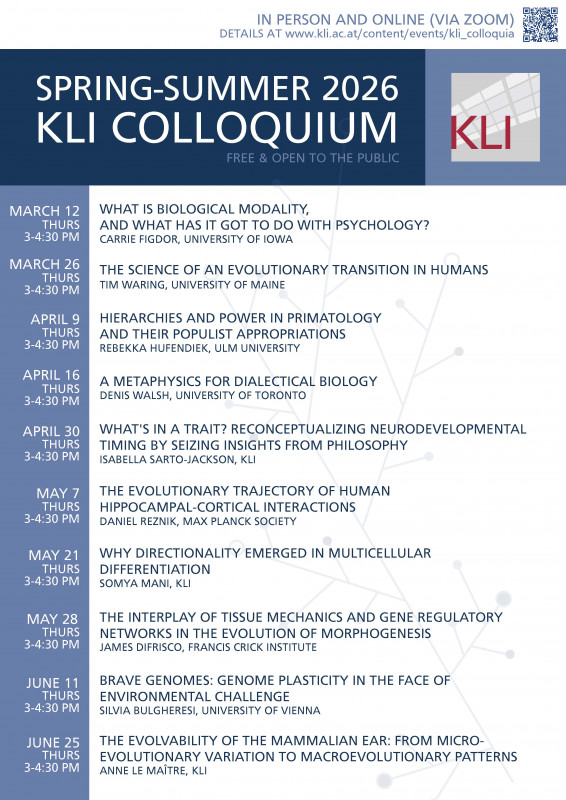
What Is Biological Modality, and What Has It Got to Do With Psychology?
Carrie Figdor (University of Iowa)
26 March 2026 (Thurs) 3-4:30 PM CET
The Science of an Evolutionary Transition in Humans
Tim Waring (University of Maine)
9 April 2026 (Thurs) 3-4:30 PM CET
Hierarchies and Power in Primatology and Their Populist Appropriation
Rebekka Hufendiek (Ulm University)
16 April 2026 (Thurs) 3-4:30 PM CET
A Metaphysics for Dialectical Biology
Denis Walsh (University of Toronto)
30 April 2026 (Thurs) 3-4:30 PM CET
What's in a Trait? Reconceptualizing Neurodevelopmental Timing by Seizing Insights From Philosophy
Isabella Sarto-Jackson (KLI)
7 May 2026 (Thurs) 3-4:30 PM CET
The Evolutionary Trajectory of Human Hippocampal-Cortical Interactions
Daniel Reznik (Max Planck Society)
21 May 2026 (Thurs) 3-4:30 PM CET
Why Directionality Emerged in Multicellular Differentiation
Somya Mani (KLI)
28 May 2026 (Thurs) 3-4:30 PM CET
The Interplay of Tissue Mechanics and Gene Regulatory Networks in the Evolution of Morphogenesis
James DiFrisco (Francis Crick Institute)
11 June 2026 (Thurs) 3-4:30 PM CET
Brave Genomes: Genome Plasticity in the Face of Environmental Challenge
Silvia Bulgheresi (University of Vienna)
25 June 2026 (Thurs) 3-4:30 PM CET
Anne LeMaitre (KLI)
KLI Colloquia 2014 – 2026
Event Details
Invited guests only
The relationship between development and adaptive diversification has always been at the centre of debates on evolution. Even before the Origin of Species, there was disagreement over what came first, form or function? Darwin seemingly resolved the issue by the theory of evolution by natural selection, which to many biologists implies that adaptive evolutionary change can be explained solely in terms of fitness differences. The counterargument is that developmental processes must contribute adaptive directionality in evolution because development is the source of all phenotypic variation: development is what enables the appearance of phenotypes that are both novel and functional. However, this argument, and its many variants, has never managed to gain traction. Indeed, biologists and philosophers have frequently claimed that, while developmental processes may shape the patterns of evolution, the logic of evolution by natural selection prevents development from contributing to the explanation for adaptive evolution. An asymmetry exists in contemporary understanding of evolutionary causality among evolutionary biologists, whereby developmental causes are explained by earlier natural selection, but not vice-versa. Claims that development is the ‘first order cause’ of adaptive evolution (West-Eberhard 2003) have either been ignored or dismissed.
Nonetheless, recent work from a wide range of fields points towards some form of conceptual change. Zooming in on molecular, cell and developmental biology, researchers are beginning to ask what it is about living systems that explains their capacity to accommodate genetic and environmental perturbations in a functional manner, and whether the ability of developmental systems to produce adaptive solutions explains why organisms are so good at adapting to new challenges. Zooming out, other researchers are asking to what extent macro-evolution follows ‘lines of least developmental resistance’, as well as whether bursts of diversification are associated with developmental reorganization, and whether developmental bias explains why organisms adapt in some ways rather than others. Combining these perspectives, recently researchers have made progress on understanding how and why the capacity to generate adaptive phenotypic variation itself evolves, manifesting in differences between organisms in their capacity to evolve, or ‘evolvability’.
These empirical and theoretical advances are paralleled by efforts within philosophy of biology to understand the structure of evolutionary theory, and the nature of evolutionary explanation. As a result, traditional explanatory agendas are called into question, opening up the possibility that generative and selective processes do not, after all, represent explanations to different questions (i.e., ‘how?’ and ‘why?’). To the contrary, it now seems possible that an integration of selective and developmental explanations may result in explanations of adaptive evolutionary change that might in some respects be considered ‘better’ than explanations solely reliant on natural selection.
This workshop brings together leading researchers who approach evolvability from a developmentalist perspective. In a nutshell, the workshop aims for making progress at different scales and participants together embark on an intellectual journey. We begin with a welcome address, followed by a reflection on the history of our field and past efforts to acknowledge developmental influences on evolvability. Next, we delve into evolutionary developmental biology (evo-devo) to explore the fundamental principles of how organisms are built. From there, we take a broader view, examining how developmental processes shape evolutionary outcomes (devo-evo). Finally, we conclude with a philosophical discussion on whether and to what extent the developmentalist perspective on evolvability provides a robust and productive research framework.
