
KLI Colloquia are invited research talks of about an hour followed by 30 min discussion. The talks are held in English, open to the public, and offered in hybrid format.
Join via Zoom:
https://us02web.zoom.us/j/5881861923?omn=85945744831
Meeting ID: 588 186 1923
Fall-Winter 2026/27 KLI Colloquium Series
1 October 2026 (Thurs) 3-4:30 PM CET 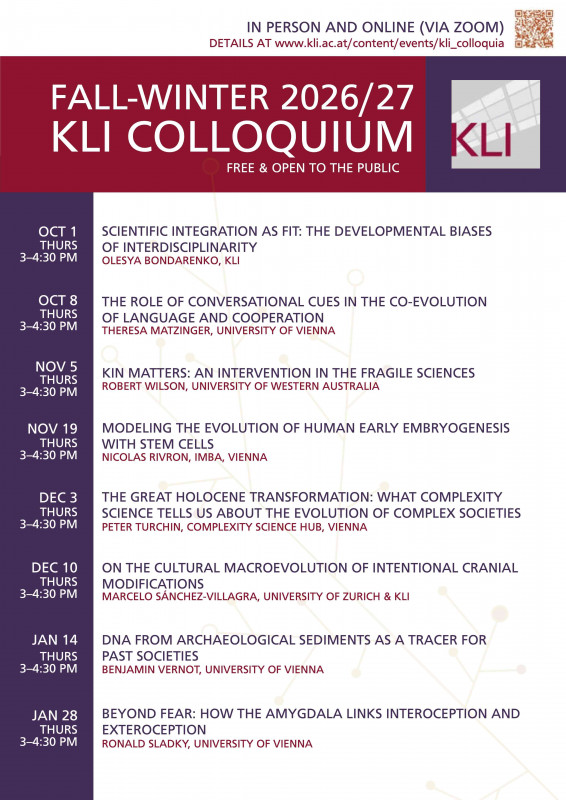
Scientific Integration as Fit: The Developmental Biases of Interdisciplinarity
Olesya BONDARENKO (KLI)
8 October 2026 (Thurs) 3-4:30 PM CET
The Role of Conversational Cues in the Co-Evolution of Language and Cooperation
Theresa MATZINGER (University of Vienna)
5 November 2026 (Thurs) 3-4:30 PM CET
Kin Matters: An Intervention in the Fragile Sciences
Robert A. WILSON (University of Western Australia)
19 November 2026 (Thurs) 3-4:30 PM CET
Modeling the Evolution of Human Early Embryogenesis with Stem Cells
Nicolas RIVRON (Institute of Molecular Biotechnology/IMBA, Vienna)
3 December 2026 (Thurs) 3-4:30 PM CET
Peter TURCHIN (Complexity Science Hub, Vienna)
10 December 2026 (Thurs) 3-4:30 PM CET
On the Cultural Macroevolution of Intentional Cranial Modifications
Marcelo SÁNCHEZ-VILLAGRA (University of Zurich)
14 January 2027 (Thurs) 3-4:30 PM CET
DNA from Archaeological Sediments as a Tracer for Past Societies
Benjamin VERNOT (University of Vienna)
28 January 2027 (Thurs) 3-4:30 PM CET
Beyond Fear: How the Amygdala Links Interoception and Exteroception
Ronald SLADKY (University of Vienna)
KLI Colloquia 2014 – 2026
Event Details
Join via Zoom:
https://us02web.zoom.us/j/5881861923?omn=85945744831
Meeting ID: 588 186 1923
Topic description / abstract
During the Holocene the scale and complexity of human societies increased dramatically. Generations of scholars have proposed different theories explaining this evolution, which range from functionalist explanations, focusing on the provision of public goods, to conflict theories, emphasizing the role of internal class struggle or external warfare. I use a general dynamical model, based on the theoretical framework of cultural macroevolution (CME), and data in Seshat: Global History Databank to quantitatively test these theories. The best-supported model indicates a strong causal role played by a combination of increasing agricultural productivity and intensity of interpolity warfare, proxied by invention/adoption of military technologies. Overall, these empirical results provide support for two major theoretical ideas in CME: cumulative cultural evolution and (still controversial) cultural multi-level selection. I will also discuss our new results on nonlinear feedbacks in the coevolution of social scale and institutional complexty using Seshat data.
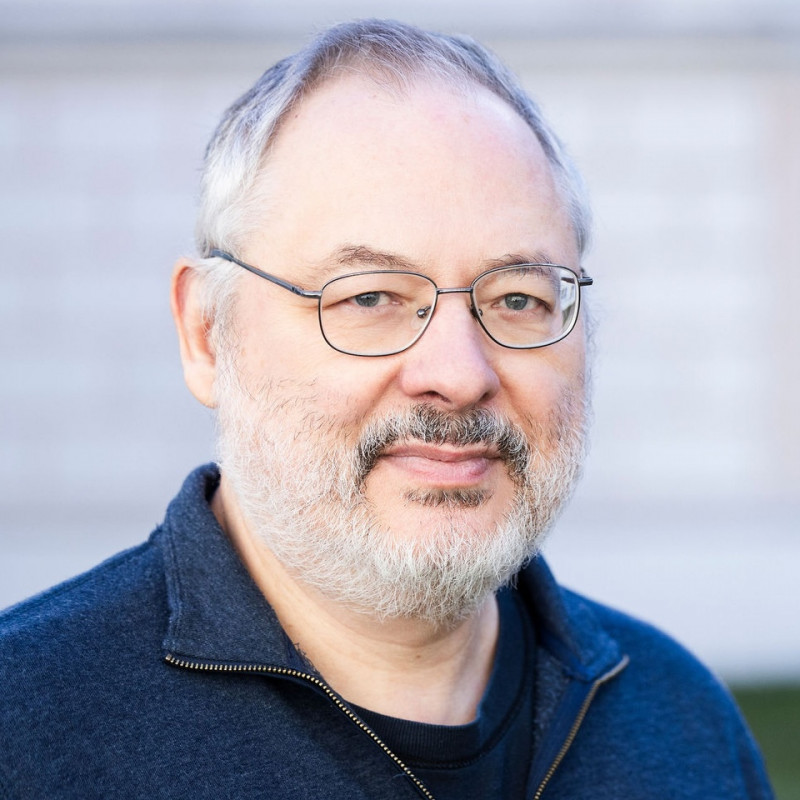
Biographical note
Peter Turchin is a complexity scientist who works in the field of historical social science that he and his colleagues call Cliodynamics. His research interests lie at the intersection of social and cultural evolution, historical macrosociology, economic history and cliometrics, mathematical modeling of long-term social processes, and the construction and analysis of historical databases. Currently he investigates a set of broad and interrelated questions: How do human societies evolve? In particular, what processes explain the evolution of ultrasociality—our capacity to cooperate in huge anonymous societies of millions? What processes are responsible for the resilience of complex societies to external and internal shocks? What causes political communities to cohere and what causes them to fall apart? Currently his main research effort is directing the Seshat Databank project (and its offshoot, CrisisDB) which builds and analyzes a massive historical database that enables us to empirically test predictions from theories attempting to explain why and how complex human societies evolved, and why they periodically experience political breakdown.
Turchin has published >200 articles in peer-reviewed journals that include Nature, Science, and PNAS. His publications are frequently cited and in 2004 he was designated as “Highly cited researcher” by ISIHighlyCited.com. In 2021 he was elected Fellow of the American Association for the Advancement of Science (AAAS). Turchin has authored ten books. His most recent books are End Times: Elites, Counter-Elites, and the Path of Political Disintegration (2023) and The Great Holocene Transformation (forthcoming).
