
KLI Colloquia are invited research talks of about an hour followed by 30 min discussion. The talks are held in English, open to the public, and offered in hybrid format.
Join via Zoom:
https://us02web.zoom.us/j/5881861923?omn=85945744831
Meeting ID: 588 186 1923
Fall-Winter 2026/27 KLI Colloquium Series
1 October 2026 (Thurs) 3-4:30 PM CET 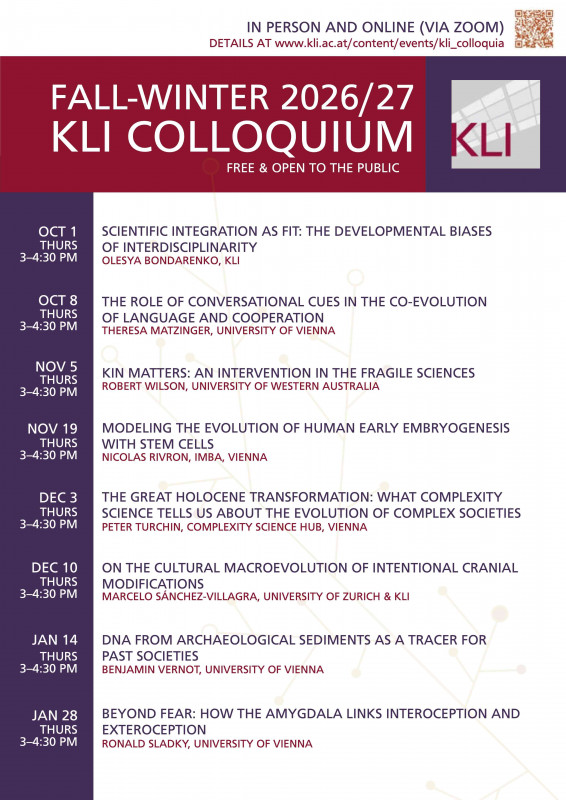
Scientific Integration as Fit: The Developmental Biases of Interdisciplinarity
Olesya BONDARENKO (KLI)
8 October 2026 (Thurs) 3-4:30 PM CET
The Role of Conversational Cues in the Co-Evolution of Language and Cooperation
Theresa MATZINGER (University of Vienna)
5 November 2026 (Thurs) 3-4:30 PM CET
Kin Matters: An Intervention in the Fragile Sciences
Robert A. WILSON (University of Western Australia)
19 November 2026 (Thurs) 3-4:30 PM CET
Modeling the Evolution of Human Early Embryogenesis with Stem Cells
Nicolas RIVRON (Institute of Molecular Biotechnology/IMBA, Vienna)
3 December 2026 (Thurs) 3-4:30 PM CET
Peter TURCHIN (Complexity Science Hub, Vienna)
10 December 2026 (Thurs) 3-4:30 PM CET
On the Cultural Macroevolution of Intentional Cranial Modifications
Marcelo SÁNCHEZ-VILLAGRA (University of Zurich)
14 January 2027 (Thurs) 3-4:30 PM CET
DNA from Archaeological Sediments as a Tracer for Past Societies
Benjamin VERNOT (University of Vienna)
28 January 2027 (Thurs) 3-4:30 PM CET
Beyond Fear: How the Amygdala Links Interoception and Exteroception
Ronald SLADKY (University of Vienna)
KLI Colloquia 2014 – 2026
Event Details
Topic description:
I shall address the connections between behavior and selection within the context of the present debate on the status of evolutionary theory both in biology and philosophy. I begin by describing Darwin´s initial formulation of his theory of evolution by natural selection and willl argue that such account of evolution was largely phenotypically construed in that organisms’ behaviors were given a relevant causal part to play in the evolutionary process. Second, the contention will be made that if the operations of organisms are deprived of this causal relevance, as the architects of neo-Darwinism have plainly done at times, the concept of selection would cease to make sense in explaining evolutionary processes. Much debate has recently arisen in the philosophy of biology over the status of selection as a natural force, with various philosophers and biologists alike arguing that natural selection is not to be interpreted as a real cause directing the evolutionary change of populations. I contend that in the absence of an account of selection that takes individuals seriously, it is very difficult to show why they are wrong. In this light, however, I defend that if there is a place for individuals in our understanding of evolution by means of considering the behavioral operations of animals in the wild as the real agents guiding the process of organic change, the concept of selection would be epistemologically safe. Finally, I will discuss specific cases of pair-wise coevolution in which different individuals actively select one another, thus guiding evolution by way of their behavior.
Biographical note:
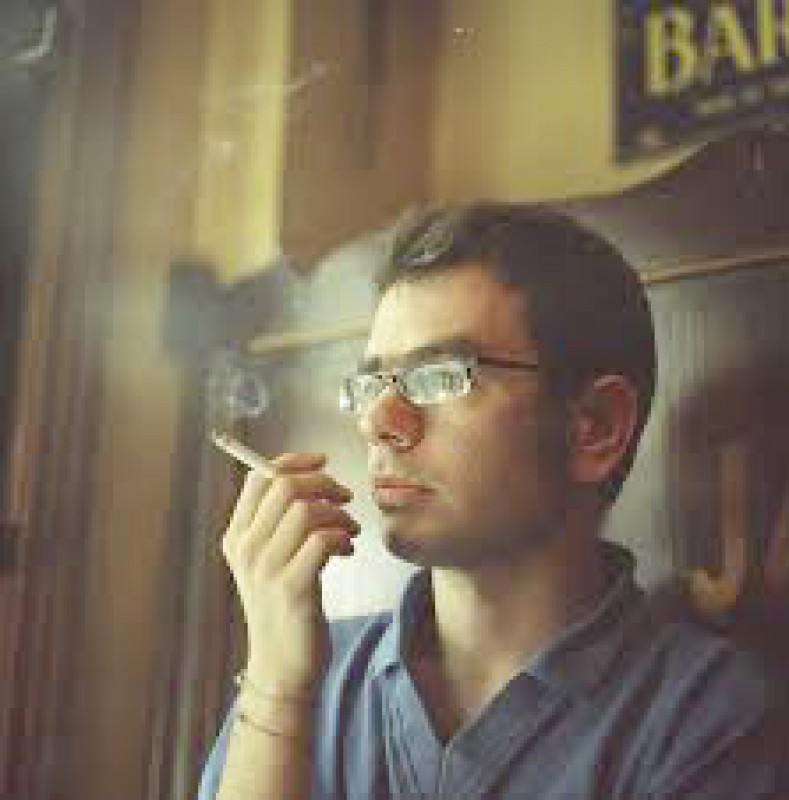
Dr Íñigo Ongay de Felipe (1979) lectures on Philosophy at the American School of Bilbao and at the Instituto de Estudios de Ocio of the Deusto University in Bilbao. He is also an affiliated researcher with the Fundación Gustavo Bueno in Oviedo.
