
KLI Colloquia are invited research talks of about an hour followed by 30 min discussion. The talks are held in English, open to the public, and offered in hybrid format.
Join via Zoom:
https://us02web.zoom.us/j/5881861923?omn=85945744831
Meeting ID: 588 186 1923
Fall-Winter 2026/27 KLI Colloquium Series
1 October 2026 (Thurs) 3-4:30 PM CET 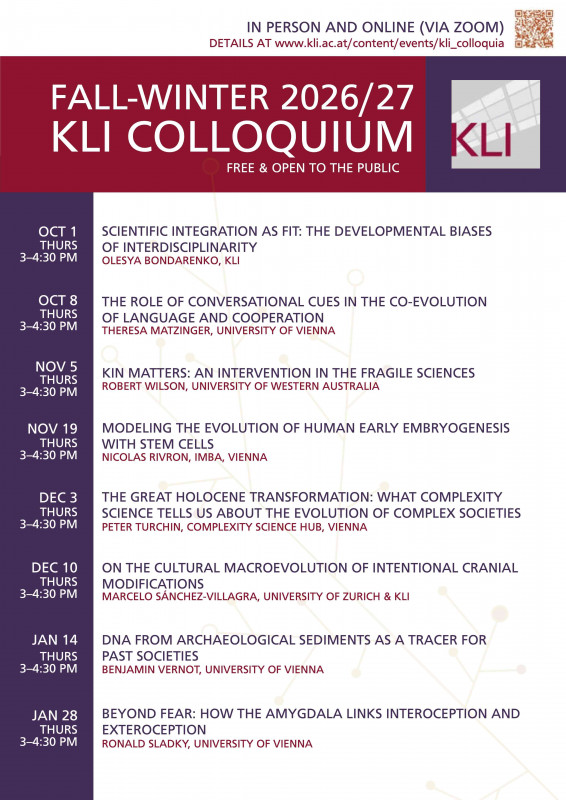
Scientific Integration as Fit: The Developmental Biases of Interdisciplinarity
Olesya BONDARENKO (KLI)
8 October 2026 (Thurs) 3-4:30 PM CET
The Role of Conversational Cues in the Co-Evolution of Language and Cooperation
Theresa MATZINGER (University of Vienna)
5 November 2026 (Thurs) 3-4:30 PM CET
Kin Matters: An Intervention in the Fragile Sciences
Robert A. WILSON (University of Western Australia)
19 November 2026 (Thurs) 3-4:30 PM CET
Modeling the Evolution of Human Early Embryogenesis with Stem Cells
Nicolas RIVRON (Institute of Molecular Biotechnology/IMBA, Vienna)
3 December 2026 (Thurs) 3-4:30 PM CET
Peter TURCHIN (Complexity Science Hub, Vienna)
10 December 2026 (Thurs) 3-4:30 PM CET
On the Cultural Macroevolution of Intentional Cranial Modifications
Marcelo SÁNCHEZ-VILLAGRA (University of Zurich)
14 January 2027 (Thurs) 3-4:30 PM CET
DNA from Archaeological Sediments as a Tracer for Past Societies
Benjamin VERNOT (University of Vienna)
28 January 2027 (Thurs) 3-4:30 PM CET
Beyond Fear: How the Amygdala Links Interoception and Exteroception
Ronald SLADKY (University of Vienna)
KLI Colloquia 2014 – 2026
Event Details

Topic description:
In this presentation, I will present some preliminary findings from my field research at the International Atomic Energy Agency (IAEA). The IAEA is a hybrid techno-legal organization charged with verifying the terms of the Non-Proliferation Treaty by evaluating the compliance of states with their safeguards agreements. Verification is achieved by sending Agency inspectors to nuclear facilities where they employ various techniques to ensure the facility’s nuclear material is not being diverted for military use. The IAEA derives its legitimacy from perceptions that it is technically competent, politically neutral, and objective in its judgments. This legitimacy is constantly threatened by the inevitably political stakes of global nuclear regulation which infuse the Agency’s functioning throughout its governance structure. Beyond formal assurances of “neutrality”, the IAEA must perform its apolitical technical competence through its practices and artifacts - from nuclear material verification to neutron counters, and from inspection reports to press releases. In other words, it must persuade with its technically objective and politically neutral practices and language in order to achieve a maximally political effect. Unlike a lot of scientific scholarship, the Agency’s “findings” cannot be independently verified or falsified since it is the only organization with the kind of access required to make assessments about nuclear activities (this, of course, doesn’t prevent many observers from having opinions about the findings). The relative success or failure of the IAEA’s work is based, in part, on its ability to provide persuasive documents, arrived at by “technically independent” means. I will explore the ways in which technical aspects of the IAEA’s work are seen to be and made to be apolitical. By putting a semiotic lens onto the artifacts and practices of the IAEA’s inspection work I will try to show the work of mediation that goes into producing “technical independence,” into making technical work legible as obviously technical.
Biographical note:
Anna Weichselbraun is a PhD candidate in linguistic and sociocultural anthropology at the University of Chicago. Her dissertation is entitled "Regulating the Nuclear: The Semiotic Production of Technical Independence at the International Atomic Energy Agency." During twenty months of fieldwork, which was supported by the National Science Foundation, the Wenner-Gren Foundation, and the Social Science Research Council, she learned how inspectors, bureaucrats, and diplomats at the IAEA negotiate the international and institutional boundaries of politics and technology in their working lives. She asks how organizational products such as technical inspection reports, policy papers, and official diplomatic statements contribute to the logical ordering of expertise within the IAEA. She is especially interested in how individuals communicate across different epistemic norms in the context of international organizations. Her research brings semiotic analysis to the study of science and technology in society.
