

KLI Colloquia are invited research talks of about an hour followed by 30 min discussion. The talks are held in English, open to the public, and offered in hybrid format.
Join via Zoom:
https://us02web.zoom.us/j/5881861923?omn=85945744831
Meeting ID: 588 186 1923
Fall-Winter 2026/27 KLI Colloquium Series
1 October 2026 (Thurs) 3-4:30 PM CET 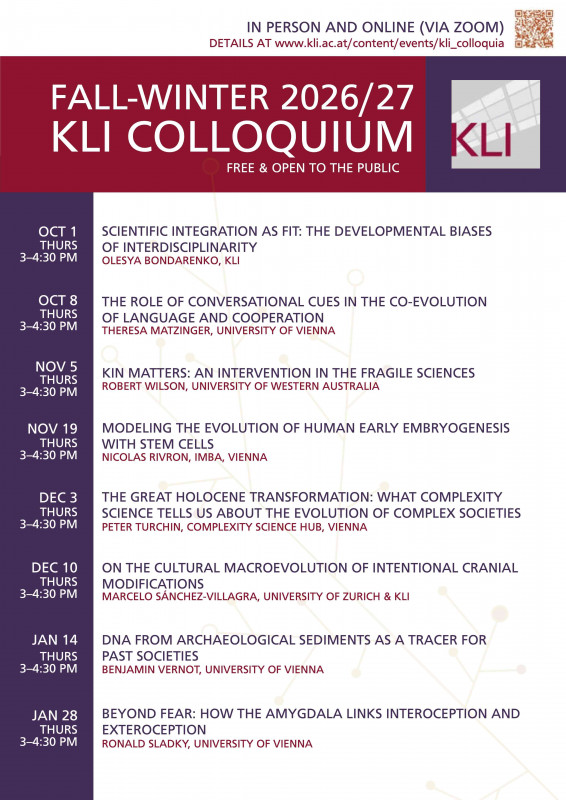
Scientific Integration as Fit: The Developmental Biases of Interdisciplinarity
Olesya BONDARENKO (KLI)
8 October 2026 (Thurs) 3-4:30 PM CET
The Role of Conversational Cues in the Co-Evolution of Language and Cooperation
Theresa MATZINGER (University of Vienna)
5 November 2026 (Thurs) 3-4:30 PM CET
Kin Matters: An Intervention in the Fragile Sciences
Robert A. WILSON (University of Western Australia)
19 November 2026 (Thurs) 3-4:30 PM CET
Modeling the Evolution of Human Early Embryogenesis with Stem Cells
Nicolas RIVRON (Institute of Molecular Biotechnology/IMBA, Vienna)
3 December 2026 (Thurs) 3-4:30 PM CET
Peter TURCHIN (Complexity Science Hub, Vienna)
10 December 2026 (Thurs) 3-4:30 PM CET
On the Cultural Macroevolution of Intentional Cranial Modifications
Marcelo SÁNCHEZ-VILLAGRA (University of Zurich)
14 January 2027 (Thurs) 3-4:30 PM CET
DNA from Archaeological Sediments as a Tracer for Past Societies
Benjamin VERNOT (University of Vienna)
28 January 2027 (Thurs) 3-4:30 PM CET
Beyond Fear: How the Amygdala Links Interoception and Exteroception
Ronald SLADKY (University of Vienna)
KLI Colloquia 2014 – 2026
Event Details

Topic description:
Assessing mental activity from the material residues of behavior is a crucial and thorny problem for both archeologists and animal cognition scholars. Assessing the behavioral performance that is supposedly guided by such mental activity, and produces the material residue more directly (at least in theory), is however an earlier step that is not easy either. This goes frequently overlooked, for we tend to focus on cognition and its species-typical requirements. In this talk, I offer an overview of the inferential processes that we use to deduce behavioral performance from artifacts. My interest lies specifically in accounting for behavioral performance that exceeds the innovation capacity of a single individual, which has recently been proposed as an evidential criterion for cumulative culture phenomena.
Biographical note:
Chiara holds a Master´s degree from the University of Milan and has been working on her PhD thesis "The Evolutionary Role of Imitation in the Hominid Lineage: Time for a Reappraisal" at the Victoria University of Wellington, New Zealand as well as at the Australian National University, Canberra. Having received a Writing-Up Fellowship from the KLI she is currently completing her PhD thesis.
