

KLI Colloquia are invited research talks of about an hour followed by 30 min discussion. The talks are held in English, open to the public, and offered in hybrid format.
Join via Zoom:
https://us02web.zoom.us/j/5881861923?omn=85945744831
Meeting ID: 588 186 1923
Fall-Winter 2026/27 KLI Colloquium Series
1 October 2026 (Thurs) 3-4:30 PM CET 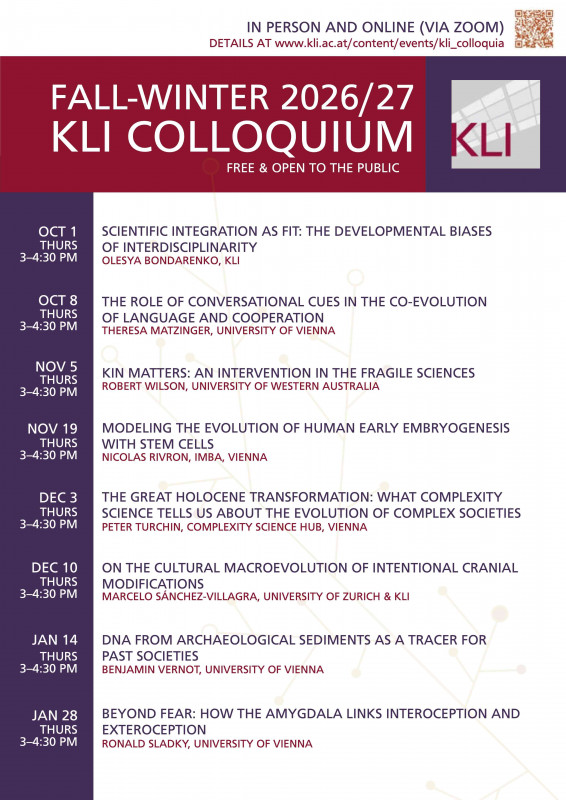
Scientific Integration as Fit: The Developmental Biases of Interdisciplinarity
Olesya BONDARENKO (KLI)
8 October 2026 (Thurs) 3-4:30 PM CET
The Role of Conversational Cues in the Co-Evolution of Language and Cooperation
Theresa MATZINGER (University of Vienna)
5 November 2026 (Thurs) 3-4:30 PM CET
Kin Matters: An Intervention in the Fragile Sciences
Robert A. WILSON (University of Western Australia)
19 November 2026 (Thurs) 3-4:30 PM CET
Modeling the Evolution of Human Early Embryogenesis with Stem Cells
Nicolas RIVRON (Institute of Molecular Biotechnology/IMBA, Vienna)
3 December 2026 (Thurs) 3-4:30 PM CET
Peter TURCHIN (Complexity Science Hub, Vienna)
10 December 2026 (Thurs) 3-4:30 PM CET
On the Cultural Macroevolution of Intentional Cranial Modifications
Marcelo SÁNCHEZ-VILLAGRA (University of Zurich)
14 January 2027 (Thurs) 3-4:30 PM CET
DNA from Archaeological Sediments as a Tracer for Past Societies
Benjamin VERNOT (University of Vienna)
28 January 2027 (Thurs) 3-4:30 PM CET
Beyond Fear: How the Amygdala Links Interoception and Exteroception
Ronald SLADKY (University of Vienna)
KLI Colloquia 2014 – 2026
Event Details
Topic description:
Biologists and medical researchers have well-developed physiological taxonomies for organisms that span quite broad swaths of multicellular life. Animals, for example, are generally thought to be built from four basic types of tissue: muscle, epithelial, connective, and nervous tissue; plants exhibit different but likewise highly-conserved tissue typology. These taxonomies are hierarchical; within these broad classes, many more varieties can be identified. Organs, in turn, are functional assemblages of these tissues and other structures. Tissues and organ systems are in many ways ideal test cases for philosophical theories of biological classification and natural kinds; for their physiological typographies are well-developed pieces of consensus science that play important inferential and explanatory roles in our understanding and control of the biological world. I will focus on their role in cross-species inference in medical research and make some suggestions concerning our general approach to biological kinds that such practice encourages.
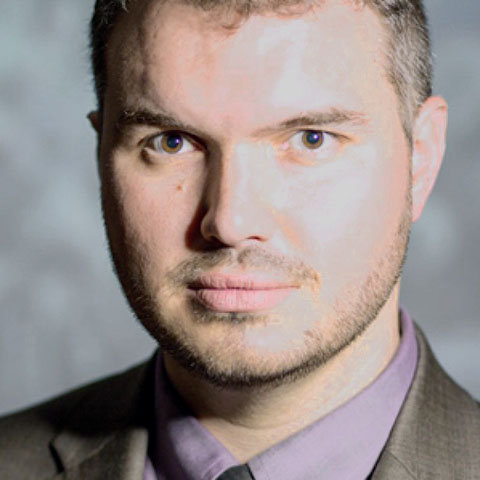
Biographical note:
Matthew H. Slater is an Associate Professor of Philosophy at Bucknell University in the USA. He is the author of *Are Species Real?* (Palgrave, 2013), has co-edited a number of volumes on metaphysics and the philosophy of science (including, from MIT Press, *Carving Nature at its Joints* (2011), *The Environment: Science and Ethics* (2012), and from Oxford University Press *Metaphysics and the Philosophy of Science*). He has written widely on metaphysics, philosophy of biology, and social epistemology. His recent essay, “Natural Kindness” won the 2015 Karl Popper Prize from the British Society for the Philosophy of Science. He is currently working on two book projects: one focusing on biological classification at various levels of generality and another, co-authored with Matthew Barker, on the role that norms play in scientific classification in general.
