

KLI Colloquia are invited research talks of about an hour followed by 30 min discussion. The talks are held in English, open to the public, and offered in hybrid format.
Join via Zoom:
https://us02web.zoom.us/j/5881861923?omn=85945744831
Meeting ID: 588 186 1923
Fall-Winter 2026/27 KLI Colloquium Series
1 October 2026 (Thurs) 3-4:30 PM CET 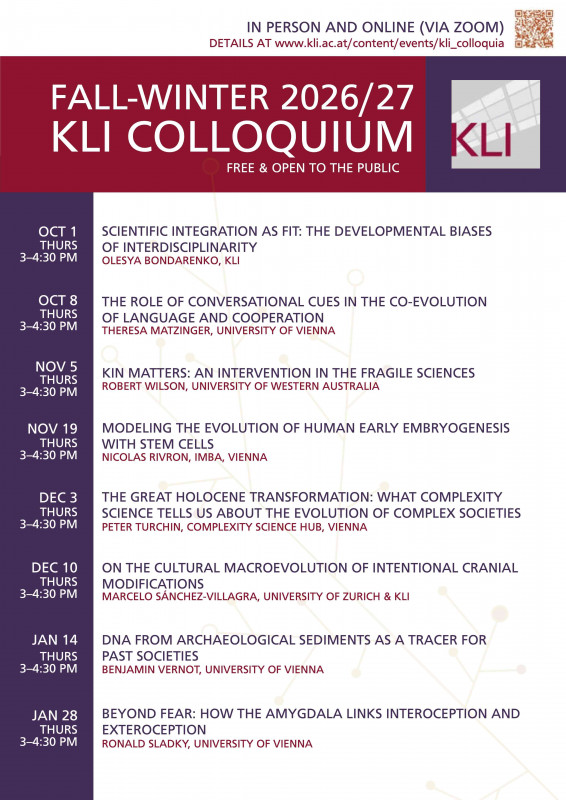
Scientific Integration as Fit: The Developmental Biases of Interdisciplinarity
Olesya BONDARENKO (KLI)
8 October 2026 (Thurs) 3-4:30 PM CET
The Role of Conversational Cues in the Co-Evolution of Language and Cooperation
Theresa MATZINGER (University of Vienna)
5 November 2026 (Thurs) 3-4:30 PM CET
Kin Matters: An Intervention in the Fragile Sciences
Robert A. WILSON (University of Western Australia)
19 November 2026 (Thurs) 3-4:30 PM CET
Modeling the Evolution of Human Early Embryogenesis with Stem Cells
Nicolas RIVRON (Institute of Molecular Biotechnology/IMBA, Vienna)
3 December 2026 (Thurs) 3-4:30 PM CET
Peter TURCHIN (Complexity Science Hub, Vienna)
10 December 2026 (Thurs) 3-4:30 PM CET
On the Cultural Macroevolution of Intentional Cranial Modifications
Marcelo SÁNCHEZ-VILLAGRA (University of Zurich)
14 January 2027 (Thurs) 3-4:30 PM CET
DNA from Archaeological Sediments as a Tracer for Past Societies
Benjamin VERNOT (University of Vienna)
28 January 2027 (Thurs) 3-4:30 PM CET
Beyond Fear: How the Amygdala Links Interoception and Exteroception
Ronald SLADKY (University of Vienna)
KLI Colloquia 2014 – 2026
Event Details

Topic description:
I will begin my talk with a quick introduction to causal modeling, which frames how I think about problems and their solutions in evolutionary biology. Then I will move to thinking about causal structures in group selection, and how these are typically represented. What is nearly universally held by group selection researchers is that group selection requires fitness affecting interactions between individuals. However, typically we choose to model these interactions with aggregative, group-level variables. So, aggregate fitness is modeled as a function of an aggregate trait variable. The primary aim of my talk is to assess how such a modeling strategy fares given certain predictive aims and given that the world really is governed by fitness affecting interactions rather than aggregative variables. To do so I create a simulation involving fitness affecting interactions among healthy and cancer cells. Cancer research is increasingly filled with theoretical models of a Darwinian and multi-level selectionist stripe. The bulk of my talk will be dedicated to describing the simulation and its behavior as we change the range of fitness affecting interactions. Finally, I will reveal some preliminary results of testing the common aggregative representational strategy against this simulated ``truth.” For certain predictive aims, the strategy does pretty well. For others, it is not only inaccurate, on average, but woefully imprecise. Specifically, if we care about ``regime shift” predictions or predictions that are the result of interventions (as is the case in cancer research), I think these preliminary results provide some reason to rethink how we model fitness affecting interactions.
Biographical note:
Wes Anderson did his undergraduate and masters studies in philosophy at Portland State University and the University of Wisconsin, Milwaukee, respectively. He has always been interested in causation, specifically causal inference and representation, in the biological sciences, and he recently defended his dissertation on the causal theory of natural selection within Arizona State University’s history and philosophy of science program. He is now a postdoctoral researcher at the KLI, where he is extending this research. In particular, he has been thinking about certain causal structures like niche construction in a demographic setting and how to make inferences from observational data to inter-individual causation.
