

KLI Colloquia are invited research talks of about an hour followed by 30 min discussion. The talks are held in English, open to the public, and offered in hybrid format.
Join via Zoom:
https://us02web.zoom.us/j/5881861923?omn=85945744831
Meeting ID: 588 186 1923
Fall-Winter 2026/27 KLI Colloquium Series
1 October 2026 (Thurs) 3-4:30 PM CET 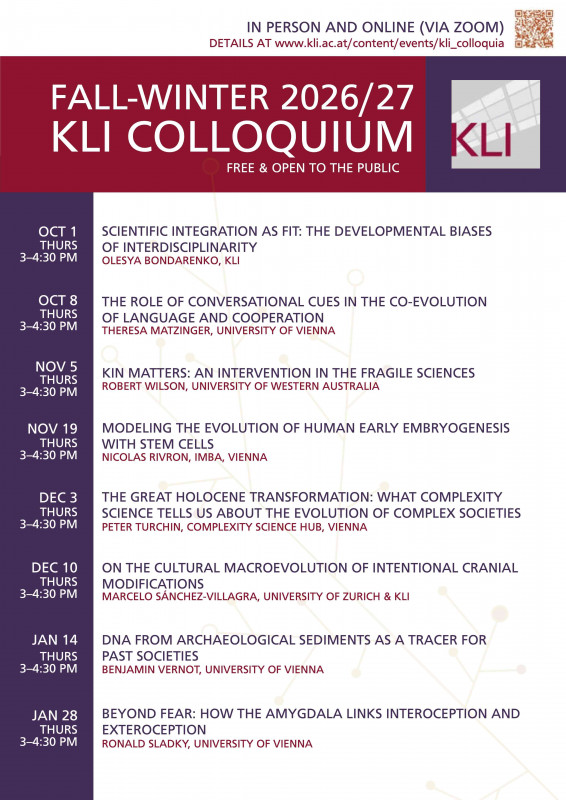
Scientific Integration as Fit: The Developmental Biases of Interdisciplinarity
Olesya BONDARENKO (KLI)
8 October 2026 (Thurs) 3-4:30 PM CET
The Role of Conversational Cues in the Co-Evolution of Language and Cooperation
Theresa MATZINGER (University of Vienna)
5 November 2026 (Thurs) 3-4:30 PM CET
Kin Matters: An Intervention in the Fragile Sciences
Robert A. WILSON (University of Western Australia)
19 November 2026 (Thurs) 3-4:30 PM CET
Modeling the Evolution of Human Early Embryogenesis with Stem Cells
Nicolas RIVRON (Institute of Molecular Biotechnology/IMBA, Vienna)
3 December 2026 (Thurs) 3-4:30 PM CET
Peter TURCHIN (Complexity Science Hub, Vienna)
10 December 2026 (Thurs) 3-4:30 PM CET
On the Cultural Macroevolution of Intentional Cranial Modifications
Marcelo SÁNCHEZ-VILLAGRA (University of Zurich)
14 January 2027 (Thurs) 3-4:30 PM CET
DNA from Archaeological Sediments as a Tracer for Past Societies
Benjamin VERNOT (University of Vienna)
28 January 2027 (Thurs) 3-4:30 PM CET
Beyond Fear: How the Amygdala Links Interoception and Exteroception
Ronald SLADKY (University of Vienna)
KLI Colloquia 2014 – 2026
Event Details
Topic description:
In this talk I shall argue that the number of potential evolutionary pathways available to life are not endless, but in fact are quite limited. Limits in evolution are determined by functional and developmental constraints, or by both working in concert, and these limits produce a directionality component to biological evolution. I shall further argue that evolution is neither directionless and unpredictable nor directed and predetermined, but rather directional in a probabilistic fashion.
Biographical note:
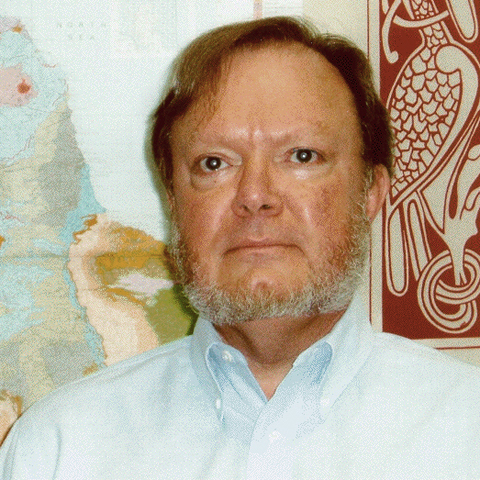
George McGhee is Distinguished Professor of Paleobiology at Rutgers University (New Brunswick, New Jersey, USA), where he is a member of the Geological Sciences, Ecology & Evolution, and Oceanography graduate faculties. He completed the Master’s degree in paleontology at the University of North Carolina at Chapel Hill, and the PhD at the University of Rochester, working under the direction of Professor David M. Raup. He conducted pre-doctoral research with Professor Adolf Seilacher’s Konstruktionsmorphologie research group at the University of Tübingen, and following his doctoral work he has held the positions of Visiting Scientist at the Field Museum of Natural History (Chicago), Research Associate at the American Museum of Natural History (New York), and Visiting Professor at the University of Tübingen.
Dr. McGhee is the author of over 150 research publications, and 5 research books: The Late Devonian Mass Extinction, When the Invasion of Land Failed: The Legacy of the Devonian Extinction, and Theoretical Morphology: The Concept and Its Applications, all published by Columbia University Press (New York); The Geometry of Evolution: Adaptive Landscapes and Theoretical Morphospaces, published by Cambridge University Press (England); and Convergent Evolution: Limited Forms Most Beautiful, published by MIT in the Vienna Series in Theoretical Biology.
