KLI Colloquia are invited research talks of about an hour followed by 30 min discussion. The talks are held in English, open to the public, and offered in hybrid format.
Join via Zoom:
https://us02web.zoom.us/j/5881861923?omn=85945744831
Meeting ID: 588 186 1923
Fall-Winter 2026/27 KLI Colloquium Series
1 October 2026 (Thurs) 3-4:30 PM CET 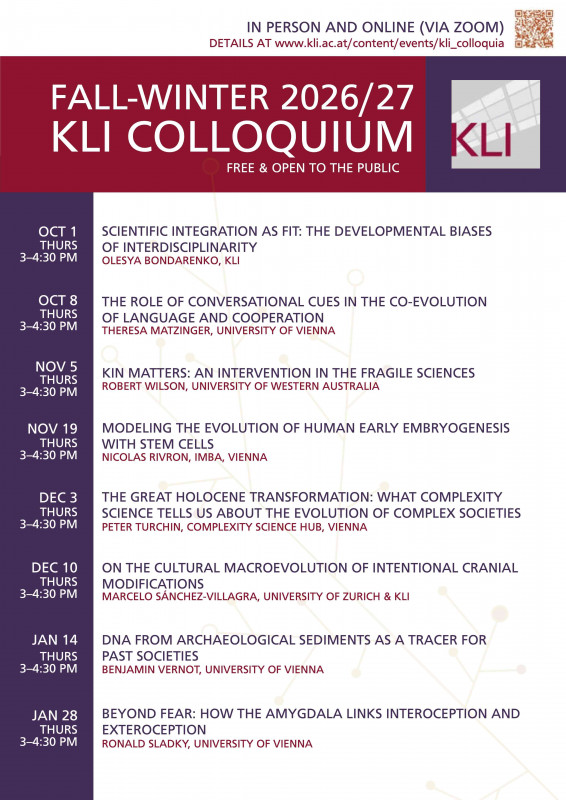
Scientific Integration as Fit: The Developmental Biases of Interdisciplinarity
Olesya BONDARENKO (KLI)
8 October 2026 (Thurs) 3-4:30 PM CET
The Role of Conversational Cues in the Co-Evolution of Language and Cooperation
Theresa MATZINGER (University of Vienna)
5 November 2026 (Thurs) 3-4:30 PM CET
Kin Matters: An Intervention in the Fragile Sciences
Robert A. WILSON (University of Western Australia)
19 November 2026 (Thurs) 3-4:30 PM CET
Modeling the Evolution of Human Early Embryogenesis with Stem Cells
Nicolas RIVRON (Institute of Molecular Biotechnology/IMBA, Vienna)
3 December 2026 (Thurs) 3-4:30 PM CET
Peter TURCHIN (Complexity Science Hub, Vienna)
10 December 2026 (Thurs) 3-4:30 PM CET
On the Cultural Macroevolution of Intentional Cranial Modifications
Marcelo SÁNCHEZ-VILLAGRA (University of Zurich)
14 January 2027 (Thurs) 3-4:30 PM CET
DNA from Archaeological Sediments as a Tracer for Past Societies
Benjamin VERNOT (University of Vienna)
28 January 2027 (Thurs) 3-4:30 PM CET
Beyond Fear: How the Amygdala Links Interoception and Exteroception
Ronald SLADKY (University of Vienna)
KLI Colloquia 2014 – 2026
Event Details

Topic description:
Pythagoras' dream was that all is number, hence entailing law. Newton formulated this in classical physics, whose laws entail the becoming of the universe from given initial (and boundary) conditions. Do similar mathematizable laws entail the becoming of the biosphere? I am convinced the answer is “No”. Physics requires the prestatement of the very phase space of the system. In terms of that phase space, the relevant variables are known and dynamical laws can be written and then integrated, much as Newton taught us, to entail the temporal evolution of the system.
But we cannot prestate the phase space of biological evolution. Unprestatable new functionalities arise all the time due to Darwinian “preadaptations”, or “exaptation”. No one could have known 3 billion years ago that feathers would evolve for thermoregulation then be co-opted for flight. No one could have known that legs would evolve from the fins of fish, or that fins would arise. Not only do we not know what will happen, we do not even know what can happen. Hence we can write no laws of motion for the evolution of the biosphere, we have no idea what the relavant variables will be. Lacking laws of motion, we cannot integrate the missing laws, so no laws entail the radical emergence of the most complex system in the universe that we know, the biosphere. This evolution is not even mathematizable and the Pythagoran dream here fails.
Biographical note:
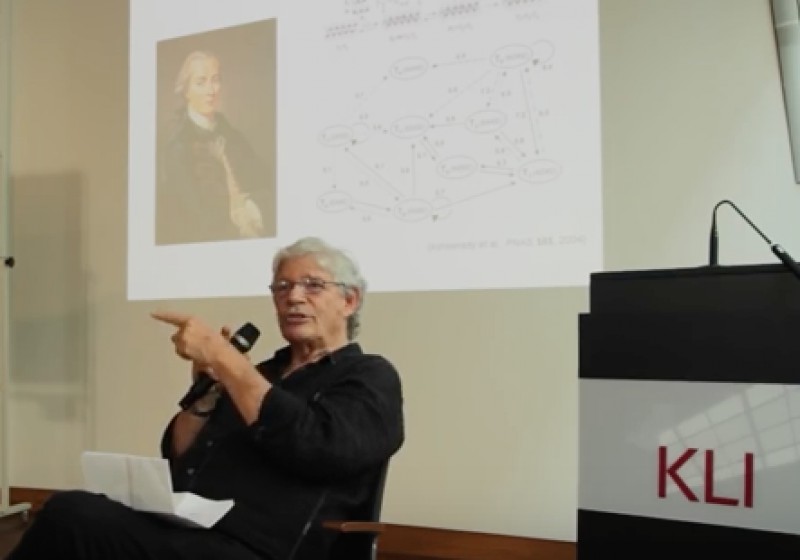
Stuart Kauffman is a theoretical biologist and a pioneer of complex systems research. Kauffman introduced many now-familiar models of complex systems, such as boolean networks to study gene regulatory networks, the NK model to study fitness landscapes, and collectively autocatalytic sets to study the origin of life. He is probably best known for arguing that the complexity of biological systems and organisms might result as much from self-organization and far-from-equilibrium dynamics as from Darwinian adaptation. Kauffman is the author of several books, including his latest, "Humanity in a creative universe", in which he argues that biological evolution is not entailed by any laws.

Watch the full KLI lecture by Stuart Kauffman on the KLI YouTube channel: