

KLI Colloquia are invited research talks of about an hour followed by 30 min discussion. The talks are held in English, open to the public, and offered in hybrid format.
Join via Zoom:
https://us02web.zoom.us/j/5881861923?omn=85945744831
Meeting ID: 588 186 1923
Fall-Winter 2026/27 KLI Colloquium Series
1 October 2026 (Thurs) 3-4:30 PM CET 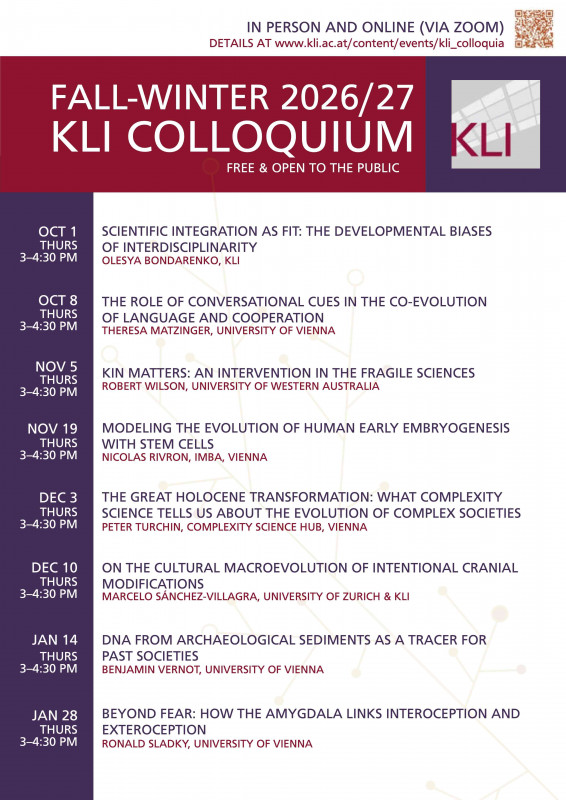
Scientific Integration as Fit: The Developmental Biases of Interdisciplinarity
Olesya BONDARENKO (KLI)
8 October 2026 (Thurs) 3-4:30 PM CET
The Role of Conversational Cues in the Co-Evolution of Language and Cooperation
Theresa MATZINGER (University of Vienna)
5 November 2026 (Thurs) 3-4:30 PM CET
Kin Matters: An Intervention in the Fragile Sciences
Robert A. WILSON (University of Western Australia)
19 November 2026 (Thurs) 3-4:30 PM CET
Modeling the Evolution of Human Early Embryogenesis with Stem Cells
Nicolas RIVRON (Institute of Molecular Biotechnology/IMBA, Vienna)
3 December 2026 (Thurs) 3-4:30 PM CET
Peter TURCHIN (Complexity Science Hub, Vienna)
10 December 2026 (Thurs) 3-4:30 PM CET
On the Cultural Macroevolution of Intentional Cranial Modifications
Marcelo SÁNCHEZ-VILLAGRA (University of Zurich)
14 January 2027 (Thurs) 3-4:30 PM CET
DNA from Archaeological Sediments as a Tracer for Past Societies
Benjamin VERNOT (University of Vienna)
28 January 2027 (Thurs) 3-4:30 PM CET
Beyond Fear: How the Amygdala Links Interoception and Exteroception
Ronald SLADKY (University of Vienna)
KLI Colloquia 2014 – 2026
Event Details

Topic description:
How can cognition be interpreted in such a way that it takes in intelligent phenomena in a wide diversity of organisms, ranging from bacteria, protists, plants and fungi to animals? After its rise to prominence in cognitive science, the word cognition can now be seen as a general term to refer to the various mental processes that make us – humans – intelligent. However, the word cognition is less easily applied to intelligent phenomena in other organisms despite an increasing amount of research that would warrant such a description. One issue here is that the application of the word cognition remains elusive. Several closely related commitments are important: (a) cognition is closely linked to mind, a notion that is not self-evidently naturalistic; (b) like mind, cognition is by default tied to the human condition; and (c) the lack of empirical specificity is not considered highly relevant as cognitive phenomena can be recognized ‘on sight’. In this talk, these three commitments will be set aside and an alternative interpretation of cognition will be proposed. This proposal construes cognition explicitly as a technical cognitive science concept that can be dissociated from (a) the notion of mind; (b) from taking humans as its default target; and (c) from an intuitive demarcation. While mind and its characteristics remain in place, cognition comes to articulate a newly demarcated domain that consists of the many different ways by means of which all organisms interact with their environments to maintain and reproduce themselves; humans included. Cognition thus acquires a new and fundamentally different empirical meaning independent from mental concepts. The word cognition can be maintained nevertheless as it still refers to the processes that make humans intelligent. When this proposal is followed, cognition can become a more definite empirical domain that is both conceptually and empirically integrated with the other natural sciences, which does justice to the wide variety of intelligent phenomena that is now being uncovered among nonhumans, and which opens up a broad variety of new conceptual and empirical options in studying this diversity.
Biographical note:
Fred Keijzer is Associate Professor at the Department of Theoretical Philosophy, University of Groningen. His research focuses on issues within the philosophy of cognition and biology. Initially starting out from work on neural networks and embodied cognition he developed a critique of the use of representations within the cognitive sciences (Representation and Behavior, 2001, MIT Press). Subsequently he turned to the prior biological background of (minimal forms of) cognition and its various implications for cognition. Recently, he worked on conceptual issues in relation to the evolution of early nervous systems and the animal sensorimotor organization.
