

KLI Colloquia are invited research talks of about an hour followed by 30 min discussion. The talks are held in English, open to the public, and offered in hybrid format.
Join via Zoom:
https://us02web.zoom.us/j/5881861923?omn=85945744831
Meeting ID: 588 186 1923
Fall-Winter 2026/27 KLI Colloquium Series
1 October 2026 (Thurs) 3-4:30 PM CET 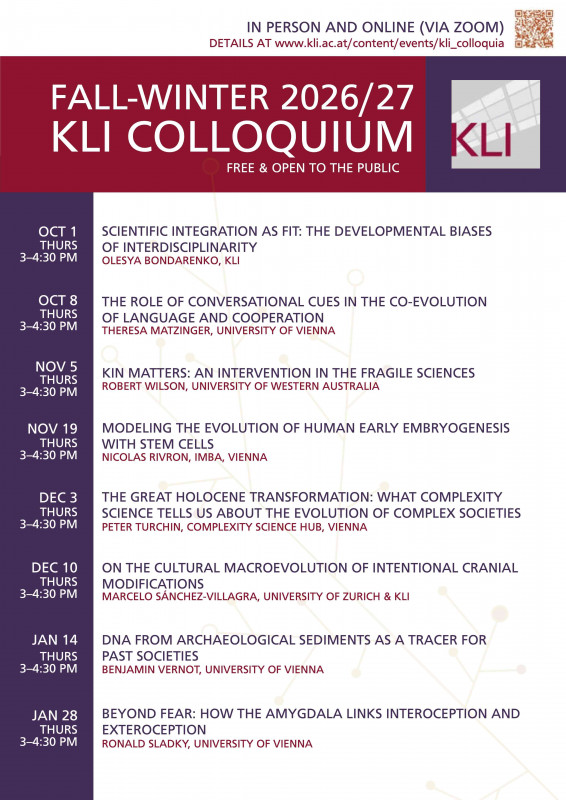
Scientific Integration as Fit: The Developmental Biases of Interdisciplinarity
Olesya BONDARENKO (KLI)
8 October 2026 (Thurs) 3-4:30 PM CET
The Role of Conversational Cues in the Co-Evolution of Language and Cooperation
Theresa MATZINGER (University of Vienna)
5 November 2026 (Thurs) 3-4:30 PM CET
Kin Matters: An Intervention in the Fragile Sciences
Robert A. WILSON (University of Western Australia)
19 November 2026 (Thurs) 3-4:30 PM CET
Modeling the Evolution of Human Early Embryogenesis with Stem Cells
Nicolas RIVRON (Institute of Molecular Biotechnology/IMBA, Vienna)
3 December 2026 (Thurs) 3-4:30 PM CET
Peter TURCHIN (Complexity Science Hub, Vienna)
10 December 2026 (Thurs) 3-4:30 PM CET
On the Cultural Macroevolution of Intentional Cranial Modifications
Marcelo SÁNCHEZ-VILLAGRA (University of Zurich)
14 January 2027 (Thurs) 3-4:30 PM CET
DNA from Archaeological Sediments as a Tracer for Past Societies
Benjamin VERNOT (University of Vienna)
28 January 2027 (Thurs) 3-4:30 PM CET
Beyond Fear: How the Amygdala Links Interoception and Exteroception
Ronald SLADKY (University of Vienna)
KLI Colloquia 2014 – 2026
Event Details
Abstract / description:
Major transitions in evolution, including the transition to obligate endosymbiosis, represent an increase in biological complexity through the integration of independently replicating units into a single, higher-level, replicating unit. Yet, the evolutionary developmental steps underlying this integration remain unknown. The major transition to obligate symbiosis between the hyperdiverse genus Camponotus (carpenter ants) and the bacteria Blochmannia evolved ~40 MYA, where Blochmannia now provides nutrition and immunity and Camponotus ensures vertical transmission through its germplasm. In all ants, a single germplasm at the posterior pole of the embryo simultaneously specifies both the germline and posterior axis. Here we show that this transition to obligate symbiosis evolved in two steps, both of which occurred through the duplication of germplasm followed by its functional divergence. Blochmannia induced the first duplication event by inducing maternal expression of Hox genes ultrabithorax and abdominal-A within the ancestral germplasm. This led to a division of labour between each duplicate, where the ancestral germplasm now functions only as the germline, while in the first duplicate these Hox genes were re-wired allowing it to function only in specifying the embryonic posterior in a novel location. Blochmannia also induced the second duplication event resulting in the co-option of the ancestral germplasm to localize Blochmannia into bacteriocytes, while the second duplicate diverged to function as a novel germline. We propose that environmentally-induced duplication of pre-existing cells, organs, or individuals followed by divergence of ancient genes allowing each duplicate to take on novel functions may be a general pathway to major evolutionary transitions.
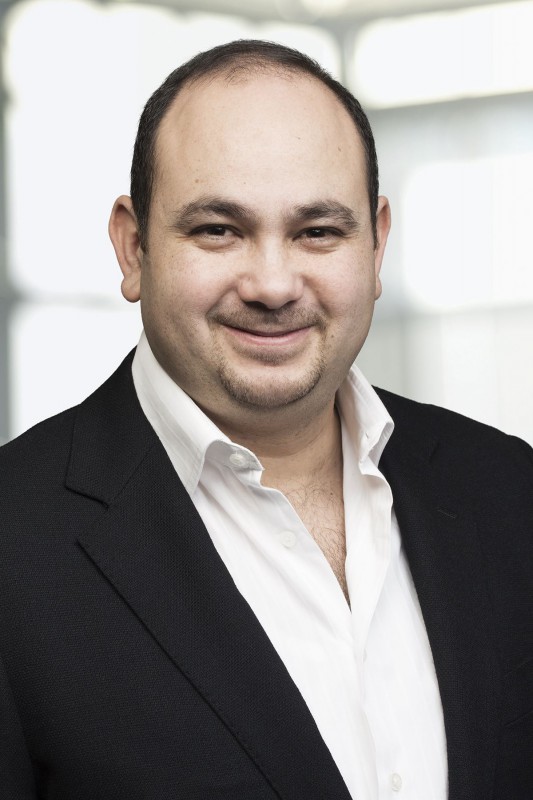
Biographical note:
Ehab Abouheif is James McGill Professor and John Simon Guggenheim Fellow at McGill University in Montreal, Canada. He served as President of the Pan-American Society for Evolutionary Developmental Biology from 2013-2015, and is currently Past-President until 2017. He obtained his PhD from Duke University in 2002 under the direction of Gregory A. Wray, and from 2002-2004, was HHMI Postdoctoral Fellow at the University of Chicago and the University of California, Berkeley with Nipam H. Patel. In 2004, he returned home to join the Department of Biology at McGill University as Canada Research Chair in Evolutionary Developmental Biology. Professor Abouheif works at the intersection of ecology, evolutionary and developmental biology (also known as eco-evo-devo). Using the complex societies of ants as a model his lab works to uncover the rules by which genes and environment interact during development and evolution.
