
KLI Colloquia are invited research talks of about an hour followed by 30 min discussion. The talks are held in English, open to the public, and offered in hybrid format.
Join via Zoom:
https://us02web.zoom.us/j/5881861923?omn=85945744831
Meeting ID: 588 186 1923
Fall-Winter 2026/27 KLI Colloquium Series
1 October 2026 (Thurs) 3-4:30 PM CET 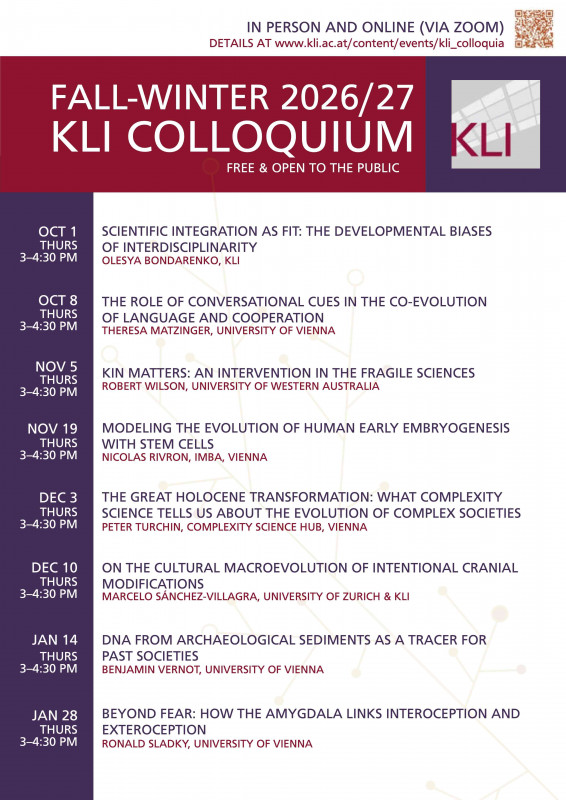
Scientific Integration as Fit: The Developmental Biases of Interdisciplinarity
Olesya BONDARENKO (KLI)
8 October 2026 (Thurs) 3-4:30 PM CET
The Role of Conversational Cues in the Co-Evolution of Language and Cooperation
Theresa MATZINGER (University of Vienna)
5 November 2026 (Thurs) 3-4:30 PM CET
Kin Matters: An Intervention in the Fragile Sciences
Robert A. WILSON (University of Western Australia)
19 November 2026 (Thurs) 3-4:30 PM CET
Modeling the Evolution of Human Early Embryogenesis with Stem Cells
Nicolas RIVRON (Institute of Molecular Biotechnology/IMBA, Vienna)
3 December 2026 (Thurs) 3-4:30 PM CET
Peter TURCHIN (Complexity Science Hub, Vienna)
10 December 2026 (Thurs) 3-4:30 PM CET
On the Cultural Macroevolution of Intentional Cranial Modifications
Marcelo SÁNCHEZ-VILLAGRA (University of Zurich)
14 January 2027 (Thurs) 3-4:30 PM CET
DNA from Archaeological Sediments as a Tracer for Past Societies
Benjamin VERNOT (University of Vienna)
28 January 2027 (Thurs) 3-4:30 PM CET
Beyond Fear: How the Amygdala Links Interoception and Exteroception
Ronald SLADKY (University of Vienna)
KLI Colloquia 2014 – 2026
Event Details
Topic description / abstract:
Organisms are characterized by the astonishing diversity and complexity of their forms. Yet, development has to ensure that these forms are robustly reproduced between generations, while allowing for some variation. In this talk, I will present how a computational model combining gene regulatory dynamics, cell-cell signalling, biomechanics and cell behaviours may help identify developmental and variational commonalities between complex and stable morphologies. We show that cell-cell signalling contributes to stabilizing morphologies rather than increasing their complexity, which has implications for the evolution of early multicellular life. We also show that increasing complexity has consequences for the genotype-phenotype map and, thus, for the appearance of novelties and further morphological evolution. Finally, I will present a specific model of turtle shell development which suggests that environmental, i.e. non-genetic, factors may play an underestimated role in generating morphological variation.
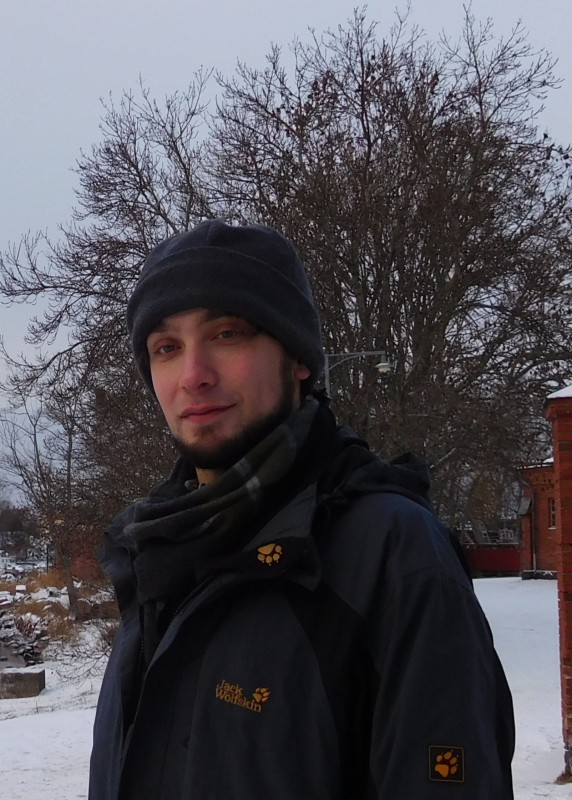
Biographical note:
Roland Zimm studies evo-devo questions using mathematical models. In particular, he is interested in relating development with patterns of phenotypic variation. He completed his Biology studies at the Technical University of Dresden with a theoretical model of cell type transdifferentiation to join Isaac Salazar-Ciudad’s group at Helsinki University. Currently, he is finishing his PhD at the KLI.
