

KLI Colloquia are invited research talks of about an hour followed by 30 min discussion. The talks are held in English, open to the public, and offered in hybrid format.
Join via Zoom:
https://us02web.zoom.us/j/5881861923?omn=85945744831
Meeting ID: 588 186 1923
Fall-Winter 2026/27 KLI Colloquium Series
1 October 2026 (Thurs) 3-4:30 PM CET 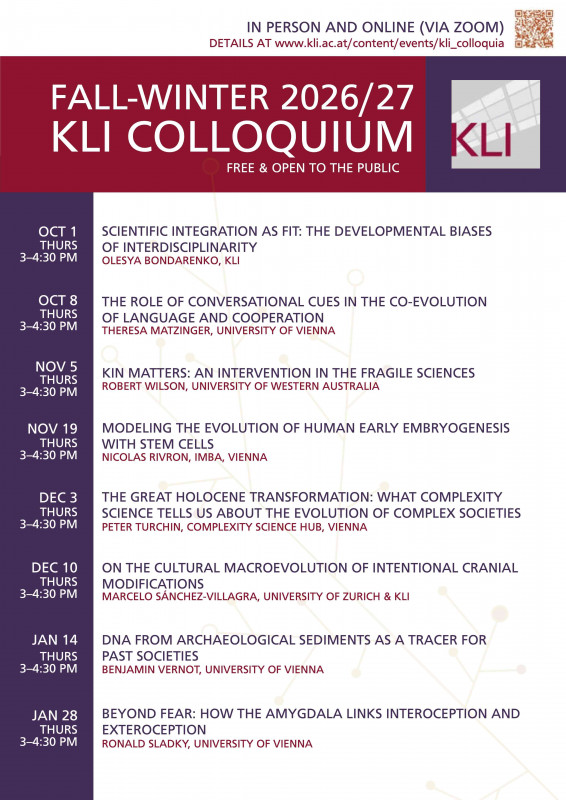
Scientific Integration as Fit: The Developmental Biases of Interdisciplinarity
Olesya BONDARENKO (KLI)
8 October 2026 (Thurs) 3-4:30 PM CET
The Role of Conversational Cues in the Co-Evolution of Language and Cooperation
Theresa MATZINGER (University of Vienna)
5 November 2026 (Thurs) 3-4:30 PM CET
Kin Matters: An Intervention in the Fragile Sciences
Robert A. WILSON (University of Western Australia)
19 November 2026 (Thurs) 3-4:30 PM CET
Modeling the Evolution of Human Early Embryogenesis with Stem Cells
Nicolas RIVRON (Institute of Molecular Biotechnology/IMBA, Vienna)
3 December 2026 (Thurs) 3-4:30 PM CET
Peter TURCHIN (Complexity Science Hub, Vienna)
10 December 2026 (Thurs) 3-4:30 PM CET
On the Cultural Macroevolution of Intentional Cranial Modifications
Marcelo SÁNCHEZ-VILLAGRA (University of Zurich)
14 January 2027 (Thurs) 3-4:30 PM CET
DNA from Archaeological Sediments as a Tracer for Past Societies
Benjamin VERNOT (University of Vienna)
28 January 2027 (Thurs) 3-4:30 PM CET
Beyond Fear: How the Amygdala Links Interoception and Exteroception
Ronald SLADKY (University of Vienna)
KLI Colloquia 2014 – 2026
Event Details
Topic description / abstract:
The global human skeletal variation has been explained both by random (e.g. genetic drift) and non-random (e.g. selection) factors. The differential influence of each factor varies according not only to the specificity of the populations of interest, but also the cranial modules being considered. Particularly, the face and mandible have been described as the two skull modules with the strongest environmental influence. Moreover, due to their prominent functional role associated to chewing, diet has been suggested to contributing most to shaping these modules. However, there is no study analysing both anatomical structures together in the same set of specimens; nor evaluating diet quantitatively. More critically, diet has been considered by its consistency (hard/soft) but not it´s nutritional components (carbohydrates/proteins). As a result, it remains unclear what differential role diet composition may have played in shaping human facial and mandibular variation. In fact, diet diversity is often reduced and simplified, thus underestimating its actual multifactorial complexity. South America constitutes an excellent case study for evaluating the impact of ecological factors on the skeleton. Despite being the last continent to be colonized by modern humans, populations here have been characterized as widely diverse, exhibiting higher variation than expected under a neutral evolutionary scenario. This could be either explained by the combination of microevolutionary processes and adaptation to a large diversity of environments. In this talk, I will discuss this issues by reviewing previous studies on the impact of diet on the skull, as well as presenting preliminary results of a multi-method approach. I argue for the importance of developing holistic studies.
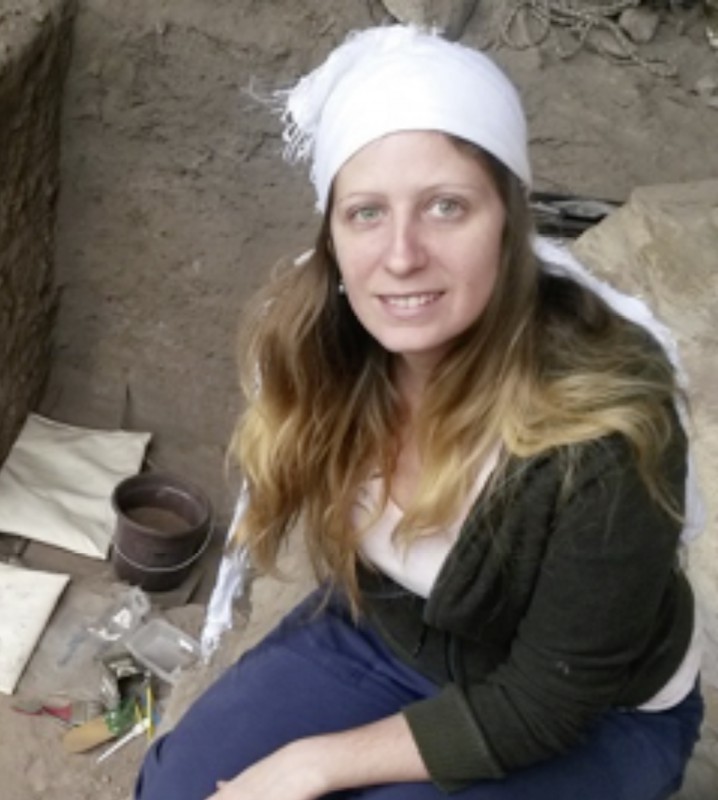
Biographical note:
Lumila Menéndez is a bioanthropologist, with a BA in Anthropology, and a Ph.D. in Natural science, both from the University of La Plata (Argentina). During her PhD she contributed to discuss the strong impact that nutritional components have on the cranial shape of South American populations. She currently is a post-doctoral fellow at University of Tübingen (Germany), where she is studying the skeletal pattern of the earliest Andean populations living at highlands. Her main research interest is human evolution, specifically the peopling and concomitant morphological diversification of South America. She investigates this with a particular focus on the impact of non-random factors on the skeleton.
