
KLI Colloquia are invited research talks of about an hour followed by 30 min discussion. The talks are held in English, open to the public, and offered in hybrid format.
Join via Zoom:
https://us02web.zoom.us/j/5881861923?omn=85945744831
Meeting ID: 588 186 1923
Fall-Winter 2026/27 KLI Colloquium Series
1 October 2026 (Thurs) 3-4:30 PM CET 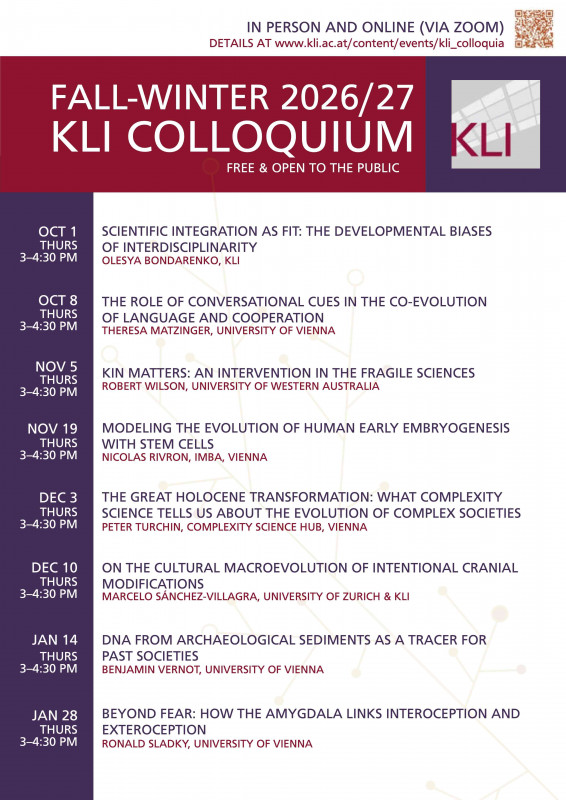
Scientific Integration as Fit: The Developmental Biases of Interdisciplinarity
Olesya BONDARENKO (KLI)
8 October 2026 (Thurs) 3-4:30 PM CET
The Role of Conversational Cues in the Co-Evolution of Language and Cooperation
Theresa MATZINGER (University of Vienna)
5 November 2026 (Thurs) 3-4:30 PM CET
Kin Matters: An Intervention in the Fragile Sciences
Robert A. WILSON (University of Western Australia)
19 November 2026 (Thurs) 3-4:30 PM CET
Modeling the Evolution of Human Early Embryogenesis with Stem Cells
Nicolas RIVRON (Institute of Molecular Biotechnology/IMBA, Vienna)
3 December 2026 (Thurs) 3-4:30 PM CET
Peter TURCHIN (Complexity Science Hub, Vienna)
10 December 2026 (Thurs) 3-4:30 PM CET
On the Cultural Macroevolution of Intentional Cranial Modifications
Marcelo SÁNCHEZ-VILLAGRA (University of Zurich)
14 January 2027 (Thurs) 3-4:30 PM CET
DNA from Archaeological Sediments as a Tracer for Past Societies
Benjamin VERNOT (University of Vienna)
28 January 2027 (Thurs) 3-4:30 PM CET
Beyond Fear: How the Amygdala Links Interoception and Exteroception
Ronald SLADKY (University of Vienna)
KLI Colloquia 2014 – 2026
Event Details
Topic description / abstract:
My research focuses on understanding ‘major evolutionary transitions’, events in the history of life that have resulted in large increases in biological complexity. Classic examples include the evolution of the eukaryotic cell, multicellular organisms and superorganismal societies. Despite seeming very different, all major evolutionary transitions are united by similar underlying evolutionary forces favouring high levels of cooperation between genes, cells or organisms leading to the evolution of new ‘higher level’ individuals. I use a combination of experimental and comparative techniques to ask questions about how and why major evolutionary transitions occur. In my current position, I am investigating the role of division of labour in the evolution of multicellular complexity using baker's yeast as a model system.
Biographical note:
I was awarded my BA in Biological Sciences from Oxford University in 2010, where I then continued onto my DPhil between 2012-2015 under the supervision of Prof. Stu West. My DPhil focused on understanding the factors favouring major evolutionary transitions, and particularly multicellularity, using a combination of experimental and comparative methods. After my DPhil, I moved to Amsterdam to work with Prof. Toby Kiers at Vrije Universiteit, where I worked on the evolution of symbiosis. In 2017, I was awarded a Distinguished Post-doctoral Fellowship from the Carlsberg Foundation, to work with Prof. Koos Boomsma at the University of Copenhagen. In my current position in Copenhagen, I am using baker's yeast as a model system to understand multicellular evolution and continuing using comparative methods to investigate major evolutionary transitions more broadly.
