

KLI Colloquia are invited research talks of about an hour followed by 30 min discussion. The talks are held in English, open to the public, and offered in hybrid format.
Join via Zoom:
https://us02web.zoom.us/j/5881861923?omn=85945744831
Meeting ID: 588 186 1923
Fall-Winter 2026/27 KLI Colloquium Series
1 October 2026 (Thurs) 3-4:30 PM CET 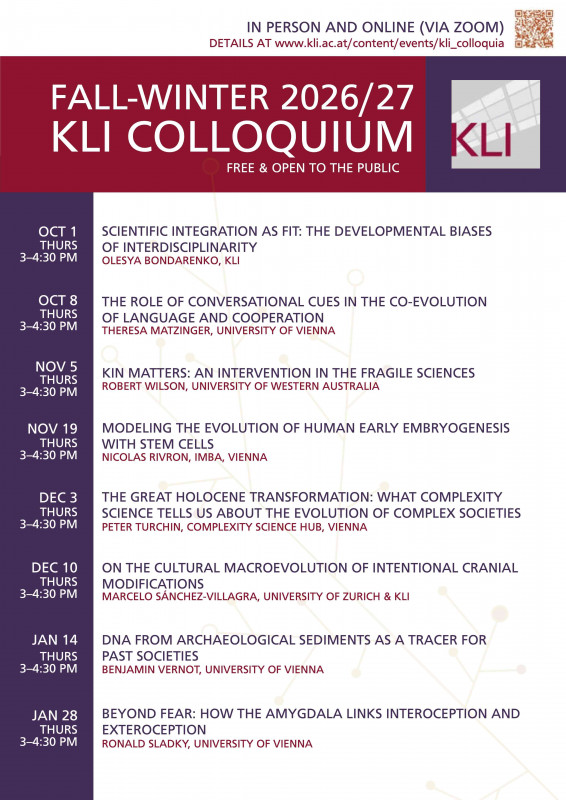
Scientific Integration as Fit: The Developmental Biases of Interdisciplinarity
Olesya BONDARENKO (KLI)
8 October 2026 (Thurs) 3-4:30 PM CET
The Role of Conversational Cues in the Co-Evolution of Language and Cooperation
Theresa MATZINGER (University of Vienna)
5 November 2026 (Thurs) 3-4:30 PM CET
Kin Matters: An Intervention in the Fragile Sciences
Robert A. WILSON (University of Western Australia)
19 November 2026 (Thurs) 3-4:30 PM CET
Modeling the Evolution of Human Early Embryogenesis with Stem Cells
Nicolas RIVRON (Institute of Molecular Biotechnology/IMBA, Vienna)
3 December 2026 (Thurs) 3-4:30 PM CET
Peter TURCHIN (Complexity Science Hub, Vienna)
10 December 2026 (Thurs) 3-4:30 PM CET
On the Cultural Macroevolution of Intentional Cranial Modifications
Marcelo SÁNCHEZ-VILLAGRA (University of Zurich)
14 January 2027 (Thurs) 3-4:30 PM CET
DNA from Archaeological Sediments as a Tracer for Past Societies
Benjamin VERNOT (University of Vienna)
28 January 2027 (Thurs) 3-4:30 PM CET
Beyond Fear: How the Amygdala Links Interoception and Exteroception
Ronald SLADKY (University of Vienna)
KLI Colloquia 2014 – 2026
Event Details

Topic description / abstract:
Evolvability is the ability of a system or population to respond to selection by producing heritable and selectable phenotypic variation. In contrast robustness is the ability of a phenotype to persist against perturbations. Hence, a system cannot be evolvable and robust at the same time. However, evolvability and robustness are both important properties to evolve complex traits. This creates a paradox for the evolution of complex phenotypes. It is assumed that properties of embryological development are playing an important role in determining how genetic variation translates into phenotypic variation and thus affecting the relationship between evolvability and robustness. By investigating the structure of the genotype-phenotype map, we can enhance our knowledge about evolvability and how it shapes evolutionary processes. I am using different types of mathematical models of the genotype-phenotype map to explore different aspects that affect the relationship between evolvability and robustness. I am demonstrating that the relationship between evolvability and robustness depends on the topology of the genotype-phenotype map using the concept of a Boolean genotype-phenotype map. I am challenging this argument using an evolutionary model of a genotype-phenotype map that is motivated by the development of butterfly eyespots. The underlying genetic architecture is a modified pattern-formation model that describes the formation of eyespots on the wings in B. anynana. We investigate the quantitative morphological change of the eyespot under selection to study the relationship between evolvability and robustness.
Biographical note:
Christine Syrowatka is a PhD fellow in Thomas Hansen’s lab at the University of Oslo. Her research addresses open questions in evolutionary developmental biology using mathematical and statistical methods and models. In particular, she is investigating the paradoxical relationship between evolvability and robustness by developing models of the genotype-phenotype map and studying it in different contexts. She is now finishing her PhD at the KLI.
