
KLI Colloquia are invited research talks of about an hour followed by 30 min discussion. The talks are held in English, open to the public, and offered in hybrid format.
Join via Zoom:
https://us02web.zoom.us/j/5881861923?omn=85945744831
Meeting ID: 588 186 1923
Fall-Winter 2026/27 KLI Colloquium Series
1 October 2026 (Thurs) 3-4:30 PM CET 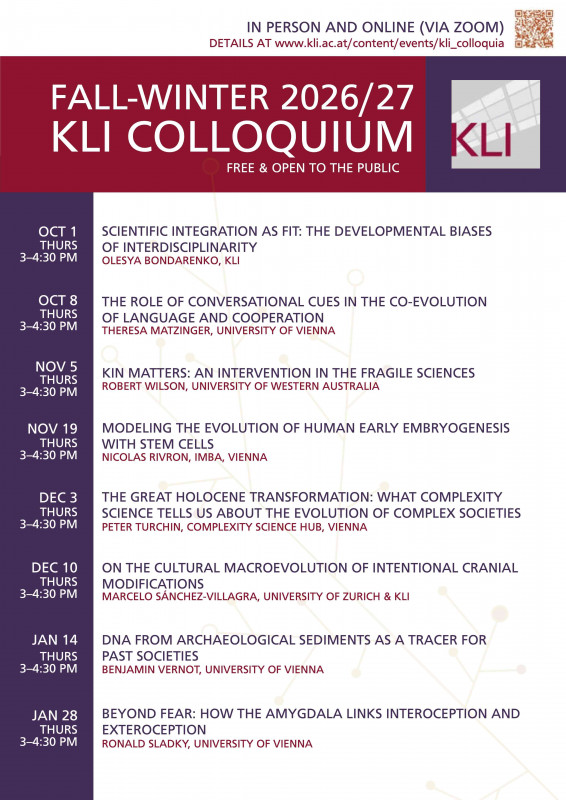
Scientific Integration as Fit: The Developmental Biases of Interdisciplinarity
Olesya BONDARENKO (KLI)
8 October 2026 (Thurs) 3-4:30 PM CET
The Role of Conversational Cues in the Co-Evolution of Language and Cooperation
Theresa MATZINGER (University of Vienna)
5 November 2026 (Thurs) 3-4:30 PM CET
Kin Matters: An Intervention in the Fragile Sciences
Robert A. WILSON (University of Western Australia)
19 November 2026 (Thurs) 3-4:30 PM CET
Modeling the Evolution of Human Early Embryogenesis with Stem Cells
Nicolas RIVRON (Institute of Molecular Biotechnology/IMBA, Vienna)
3 December 2026 (Thurs) 3-4:30 PM CET
Peter TURCHIN (Complexity Science Hub, Vienna)
10 December 2026 (Thurs) 3-4:30 PM CET
On the Cultural Macroevolution of Intentional Cranial Modifications
Marcelo SÁNCHEZ-VILLAGRA (University of Zurich)
14 January 2027 (Thurs) 3-4:30 PM CET
DNA from Archaeological Sediments as a Tracer for Past Societies
Benjamin VERNOT (University of Vienna)
28 January 2027 (Thurs) 3-4:30 PM CET
Beyond Fear: How the Amygdala Links Interoception and Exteroception
Ronald SLADKY (University of Vienna)
KLI Colloquia 2014 – 2026
Event Details
Topic description / abstract:
Multi-Cultural societies remain stable through time, even when there is conspicuous interaction amongst individuals of the different constituting cultures. The dynamics leading to this outcome necessarily involve individual choice to facilitate or prevent full cultural blend or to remain differentiated, in what we call a multi-culture. Although there are several theories of cultural evolution and change, these do not fully account for multi-cultural stability.
I present computational models based on Language Games (Wittgenstein) that describe the fate and stability of populations that remain segregated. In this model, a cultural trait is a feature that is horizontally transmitted by an agent, and which the other agent learns but idiosyncratically decides to further transmit or not.
In other words, there is individual choice amongst possible alternative cultural traits regarding what trait to spread in further interaction. Said choice is based on learning processes that are unique to the individuals and which assign preferential rewards to prior knowledge (e.g. cultural bias) agains to the new knowledge. (In classic naming games this reward is symmetric, i.e. the same rate of Hebbian reward applies to any choice. This asymmetric reward system is at the core of what allows two (or potentially more) cultures to blend or to remain separated.
A general result of this model is that cultures (or at least specific traits of these) either blend or remain separated. In other words, there is no continuous degree of mixability in a population, even if preferences are distributed heterogeneously.
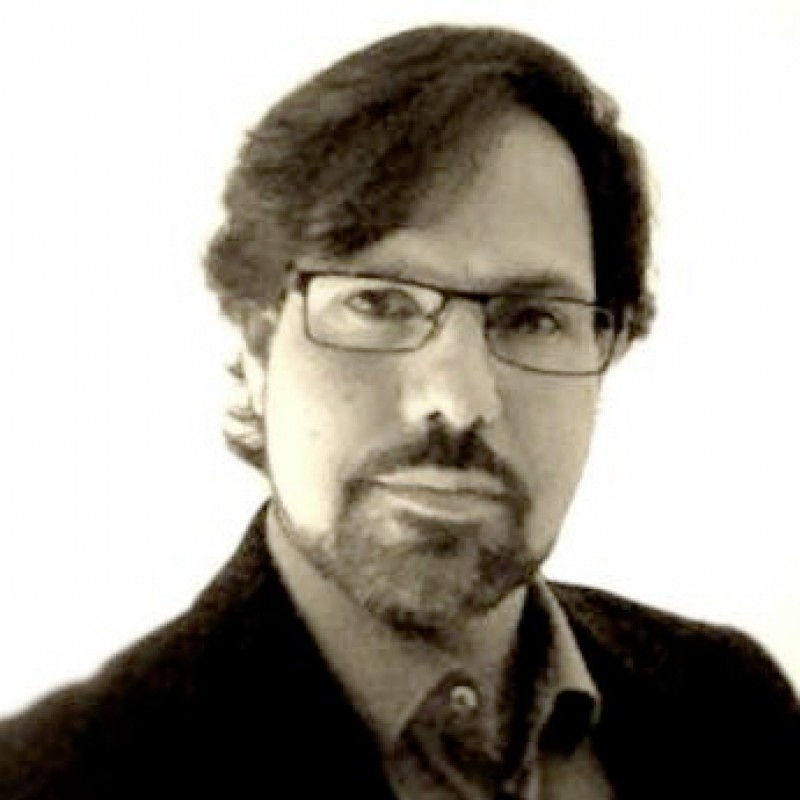
Biographical note:
Harold P. de Vladar is a theoretical evolutionary biologist with experience in different sub-fields that include population and quantitative genetics, evolution of complexity, origins of life and others. Lately he has been developing cognitive frameworks to understand aspects of cultural change and their relationship to evolution. He also applies the ideas to understand cognition in terms of evolutionary processes implemented in brains through synaptic plasticity, in what is known as Neuronal Replicators.
Harold obtained his PhD from Groningen University (2009) and has been postdoc and researcher in IST Austria, Parmenides Foundation, the Hungarian Academy of Sciences, and other European institutions. He is currently a Senior Fellow at the Konrad Lorenz Institute where he is developing his ideas of cultural dynamics and evolution.
