
KLI Colloquia are invited research talks of about an hour followed by 30 min discussion. The talks are held in English, open to the public, and offered in hybrid format.
Join via Zoom:
https://us02web.zoom.us/j/5881861923?omn=85945744831
Meeting ID: 588 186 1923
Fall-Winter 2026/27 KLI Colloquium Series
1 October 2026 (Thurs) 3-4:30 PM CET 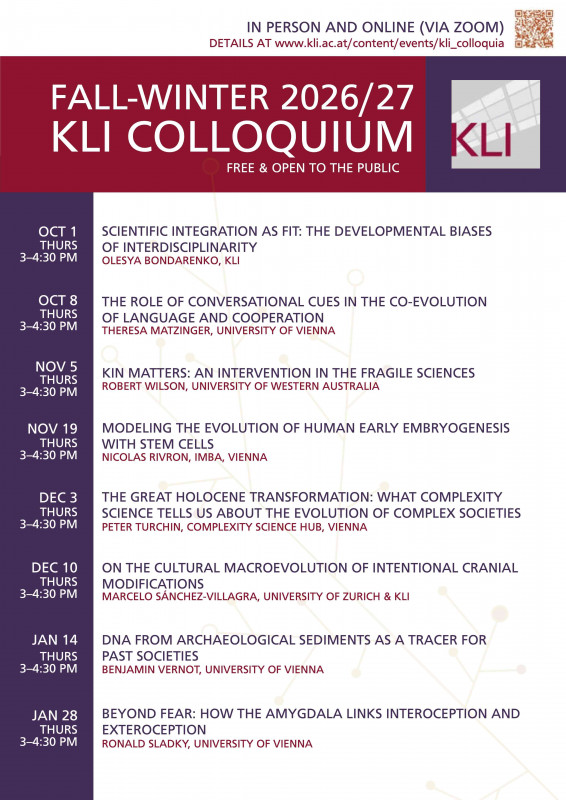
Scientific Integration as Fit: The Developmental Biases of Interdisciplinarity
Olesya BONDARENKO (KLI)
8 October 2026 (Thurs) 3-4:30 PM CET
The Role of Conversational Cues in the Co-Evolution of Language and Cooperation
Theresa MATZINGER (University of Vienna)
5 November 2026 (Thurs) 3-4:30 PM CET
Kin Matters: An Intervention in the Fragile Sciences
Robert A. WILSON (University of Western Australia)
19 November 2026 (Thurs) 3-4:30 PM CET
Modeling the Evolution of Human Early Embryogenesis with Stem Cells
Nicolas RIVRON (Institute of Molecular Biotechnology/IMBA, Vienna)
3 December 2026 (Thurs) 3-4:30 PM CET
Peter TURCHIN (Complexity Science Hub, Vienna)
10 December 2026 (Thurs) 3-4:30 PM CET
On the Cultural Macroevolution of Intentional Cranial Modifications
Marcelo SÁNCHEZ-VILLAGRA (University of Zurich)
14 January 2027 (Thurs) 3-4:30 PM CET
DNA from Archaeological Sediments as a Tracer for Past Societies
Benjamin VERNOT (University of Vienna)
28 January 2027 (Thurs) 3-4:30 PM CET
Beyond Fear: How the Amygdala Links Interoception and Exteroception
Ronald SLADKY (University of Vienna)
KLI Colloquia 2014 – 2026
Event Details
Topic description / abstract:
During my short stay at the KLI, I started a completely new historical project – on the experimental intersex studies on butterflies by Richard Goldschmidt in the 1910s and the 1920s. Unfortunately, I have not yet accumulated sufficient substance in order to be able to give a presentation on the matter. Instead, I would like to take the opportunity to introduce to you my forthcoming book on the French epistemologist Gaston Bachelard and his interaction with the copper engraver Albert Flocon. We could perhaps say that it is a case study of embodied knowledge, in which the hand of the engraver stands central. In order to get an impression of that work, we will have a look at a number of these engravings.
Biographical note:
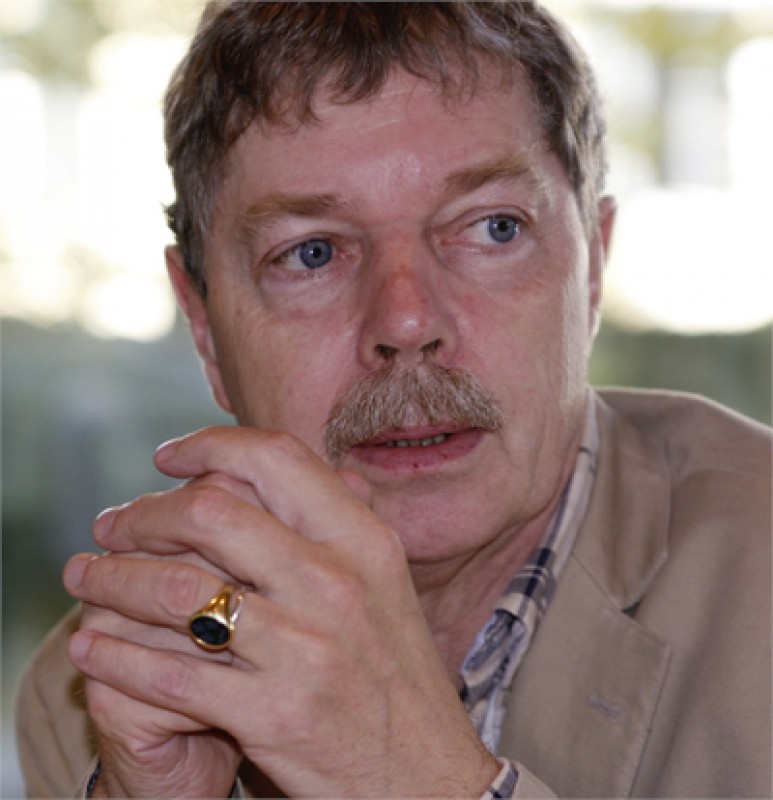
Hans-Jörg Rheinberger, *1946, studied philosophy, linguistics, and biology at the Erberhard Karls University of Tübingen and the Free as well as Technical University of Berlin. He earned a Masters degree in philosophy in 1973 and a Diploma degree in biology in 1979. A Ph.D. in biology and a Habilitation in molecular biology followed in 1982 and 1987, respectively. From 1978 to 1990, he worked at the Max Planck Institute for Molecular Genetics in Berlin. From 1990 to 1994, he was Assistant Professor at the University of Lübeck, and from 1994 to 1996, Associate Professor at the University of Salzburg. In 1997, he was appointed Director at the Max Planck Institute for the History of Science in Berlin. Since 2014, he is Director emeritus at the MPIWG. Rheinberger held may visiting fellowships and professorships around the world. He is a Member of the Berlin Brandenburg Academy of Sciences in Berlin, of the German National Academy of Sciences Leopoldina, and of the Académie Internationale de Philosophie des Sciences. He holds a Doctor honoris causa from the ETH Zurich. Among his publications are: Toward a History of Epistemic Things, Stanford 1997, An Epistemology of the Concrete, Durham and London 2010, On Historicizing Epistemology, Stanford 2010, Experimentalität. Hans-Jörg Rheinberger im Gespräch über Labor, Atelier und Archiv, Berlin 2018, and most recently: The Hand of the Engraver. Albert Flocon Meets Gaston Bachelard, Albany 2018.
