

KLI Colloquia are invited research talks of about an hour followed by 30 min discussion. The talks are held in English, open to the public, and offered in hybrid format.
Join via Zoom:
https://us02web.zoom.us/j/5881861923?omn=85945744831
Meeting ID: 588 186 1923
Fall-Winter 2026/27 KLI Colloquium Series
1 October 2026 (Thurs) 3-4:30 PM CET 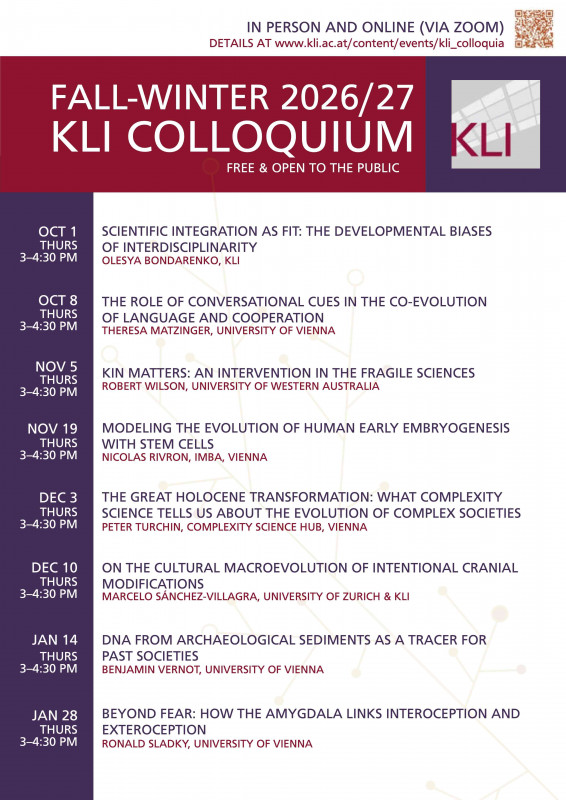
Scientific Integration as Fit: The Developmental Biases of Interdisciplinarity
Olesya BONDARENKO (KLI)
8 October 2026 (Thurs) 3-4:30 PM CET
The Role of Conversational Cues in the Co-Evolution of Language and Cooperation
Theresa MATZINGER (University of Vienna)
5 November 2026 (Thurs) 3-4:30 PM CET
Kin Matters: An Intervention in the Fragile Sciences
Robert A. WILSON (University of Western Australia)
19 November 2026 (Thurs) 3-4:30 PM CET
Modeling the Evolution of Human Early Embryogenesis with Stem Cells
Nicolas RIVRON (Institute of Molecular Biotechnology/IMBA, Vienna)
3 December 2026 (Thurs) 3-4:30 PM CET
Peter TURCHIN (Complexity Science Hub, Vienna)
10 December 2026 (Thurs) 3-4:30 PM CET
On the Cultural Macroevolution of Intentional Cranial Modifications
Marcelo SÁNCHEZ-VILLAGRA (University of Zurich)
14 January 2027 (Thurs) 3-4:30 PM CET
DNA from Archaeological Sediments as a Tracer for Past Societies
Benjamin VERNOT (University of Vienna)
28 January 2027 (Thurs) 3-4:30 PM CET
Beyond Fear: How the Amygdala Links Interoception and Exteroception
Ronald SLADKY (University of Vienna)
KLI Colloquia 2014 – 2026
Event Details
Topic description / abstract:
What can environmental history bring to debates about sustainability? The sustainability debate needs to acknowledge the mortgage we have already put on the future by eg. producing Plutonium, by the underground labyrinths of abandoned mines and soils drenched with POPs (including Dioxin in Vietnam). Risky and long-lived products are a defining feature of the Anthropocene, as are world-wide degradation of land and ocean ecosystems which will not easily heal anytime soon. Regulated rivers and hydropower plants cannot be left alone, constant investments into the upkeep of infrastructure are necessary. If the care of legacies is not included into plans for the future, these plans are likely to fail.
By looking into the past to identify and assess hazardous legacies, we can gain a better understanding of the challenges ahead. Examples range from mine-filling and some of the most pertinent nuclear facilities to soil degradation and river course changes. The environmental humanities look at society as a source of these legacies and ask how and why such legacies arose to offer reflection and potential alleviation of such legacies.
Biographical Note:
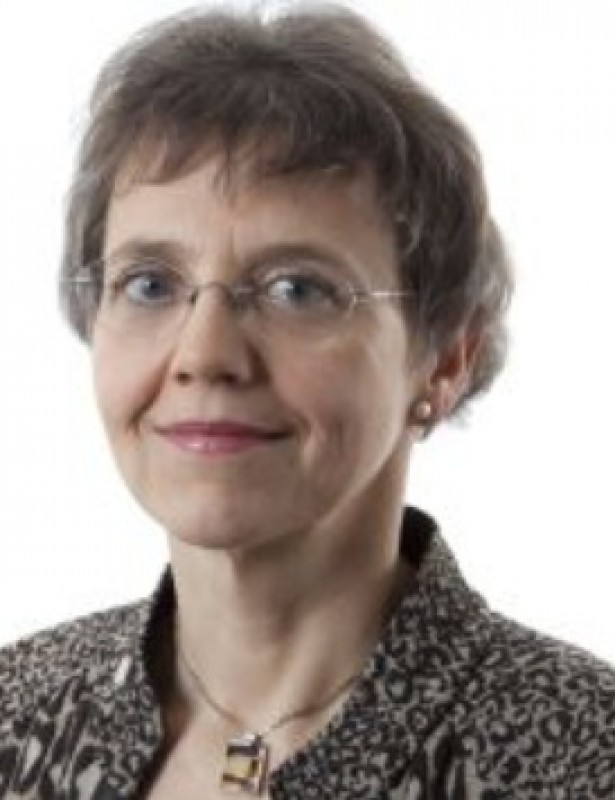
Verena Winiwarter was appointed Professor of Environmental History at Alpen-Adria-Universität Klagenfurt in 2007, and holds the same position at BOKU since 3/2018, when the Institute of Social Ecology was moved. First trained as a chemical engineer, she holds a PhD in Environmental History from Vienna University and was granted the venia legendi in Human Ecology in 2003 at Vienna University. Since 2016, she is a full member of the Austrian Academy of Sciences, Chairperson of the
Commission for Interdisciplinary Ecological Studies (OEAW), President of ICEHO, founding member of ESEH and member of the advisory boards of the Centre for Environmental History (University Tallinn), Deutsches Museum (München) and Technisches Museum Wien. Her main research interests comprise the history of landscapes, in particular rivers, images, and the environmental history of soils and legacies. Her 2014 co-authored book “Umwelt hat Geschichte. Sechzig Reisen durch die Zeit” was elected as Wissenschaftsbuch des Jahres in Austria and Umweltbuch des Jahres in Germany. In 2013, she was „WissenschaftlerIn des Jahres“ in Austria, elected by the council of science and education journalists.
